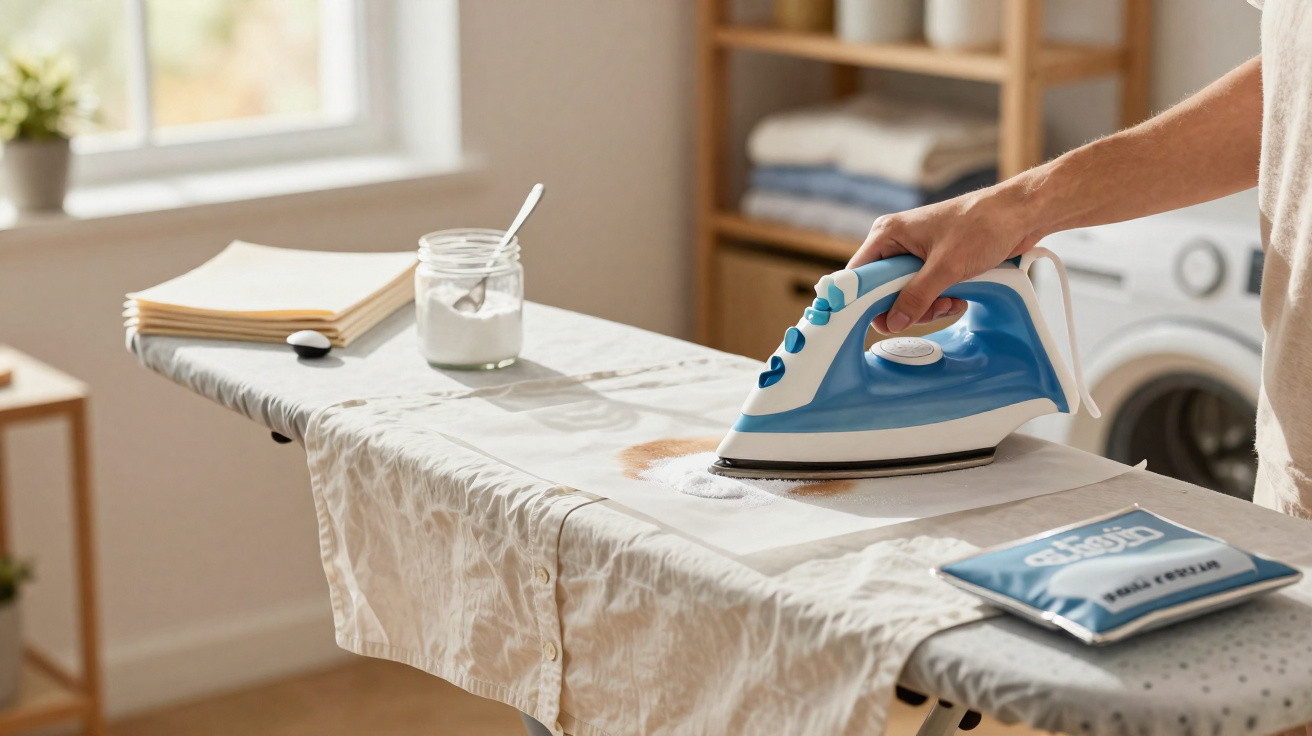
A simple trio of kitchen staples and an everyday appliance can often sort it out in just a few minutes.
Anyone who has splashed oil, butter or roasting gravy onto a T-shirt, tablecloth or tea towel will know the issue: even after several washes, a dark, slightly greasy-looking shadow remains. This is where a smart technique using three unassuming aids and gentle heat comes in – and it works surprisingly quickly.
Why old grease stains are so persistent
Fresh grease marks can often be removed with washing-up liquid and plenty of water. The difficulty starts when the grease has had time to soak into the fibres and dry completely.
This is what happens:
- The grease solidifies within the fibre.
- Water and detergent can reach only the surface.
- The visible discolouration may fade slightly, but it does not disappear.
The following are particularly susceptible:
- Cotton (T-shirts, tea towels and bed linen)
- Denim
- Hard-wearing blended fabrics and canvas
“The answer is not to scrub harder, but to get the grease moving again – then draw it out of the fibre in a targeted way.”
That is exactly where a combination of bicarbonate of soda (household baking soda, or sodium bicarbonate), baking paper and an ordinary iron becomes useful.
The unassuming trio for dried-in grease
Bicarbonate of soda as a grease magnet
Bicarbonate of soda from the kitchen or cleaning cupboard acts like an absorbent powder. It binds grease and helps lift it out of the fibres.
- Use only pure, dry bicarbonate of soda, with no fragrance or added ingredients.
- One to two teaspoons will usually be enough for an average-sized stain.
- The surface should have a light dusting rather than a thick pile of powder.
Damp or clumped powder absorbs far less effectively, so always seal the packet properly after use.
Baking paper as a clean protective layer
Baking paper acts as the grease absorber between the fabric and the iron:
- It does not shed fibres and is less likely to tear.
- It tolerates heat without sticking to the material or the iron.
- It absorbs the released layer of grease cleanly.
A folded rectangle is entirely sufficient, provided it generously covers the stained area. Kitchen roll may appear similar at first, but it can tear under heat and leave lint behind. Cling film is unsuitable: it melts and, in the worst case, damages both the fabric and the iron.
The iron as a gentle heat source
The iron is not there to smooth the fabric; instead, it provides controlled, mild heat:
- Temperature: choose a low to medium setting appropriate for the fabric.
- Always work without steam – moisture can enlarge stain edges.
- Use brief periods of pressure rather than long back-and-forth movements.
A clean, absorbent layer of terry towel works well underneath. It prevents loosened grease from passing through to the other side.
The two-minute method for grease stains, step by step
Preparing the affected area
Correct preparation comes first, so that the stain does not spread any further:
- Blot fresh marks carefully with kitchen roll; do not rub.
- For old, dry stains, gently brush the area with a soft brush to loosen any crusted residue.
- Place a thick towel or firm piece of card underneath the stain.
- With delicate or dark fabrics, carry out a quick heat test on a hidden area.
Only continue once you know the material can tolerate the mild heat.
Apply bicarbonate of soda and cover
Next comes the actual “magic trick”:
- Dust the stained area lightly and evenly with bicarbonate of soda.
- Do not rub it in vigorously; simply spread it gently with your fingers.
- Place a piece of baking paper over it and smooth it flat.
“The bicarbonate of soda sits in the fabric, the baking paper forms the link to the iron – and the stain is gradually ‘drawn outwards’.”
Work with gentle heat
Now it is time to use the iron:
- Set it to “medium” or “wool/low cotton”, with the steam function switched off.
- Press the iron firmly onto the baking paper for a few seconds, then lift it away.
- Work gradually across the whole stained section, without sliding it around as you would when ironing.
- Treat the area for around one to two minutes in total.
Then lift the baking paper carefully. If it becomes slightly translucent in places, grease has transferred into it – which is a good sign.
If the mark is still visible, a second round will often help:
- Gently shake or brush away the used bicarbonate of soda.
- Sprinkle on fresh powder and use a clean piece of baking paper.
- Repeat with brief, mild heat.
Finally, wash the textile in the washing machine as normal. Before drying, check that the stain has genuinely gone. If it has not, repeat the treatment before putting the item in a tumble dryer or allowing it to harden on a radiator.
Where the method works well – and where it is risky
Very good results have been reported with:
- Cotton T-shirts and sweatshirts
- Jeans and sturdy fabric trousers
- Tea towels, tablecloths and cloth napkins
- Towels and durable synthetic fabrics
You should be much more cautious with:
- Silk and satin
- Wool and cashmere
- Leather and suede
- Fine velvet and coated fabrics
Heat can quickly cause shiny patches, distortion or colour changes in these materials. In such cases, specialist cleaning products or professional dry cleaning are often the safer option.
Common mistakes that can make the stain worse
It is easy to do exactly the wrong thing when reacting in a panic. Typical pitfalls include:
- Temperature too high: the grease effectively burns into the fabric and the shadow becomes permanent.
- Steam instead of dry heat: moisture drives the grease deeper into the fibre and creates unsightly edges.
- Vigorous scrubbing: especially on denim or knitwear, this can cause shiny patches and spread the stain.
- No absorbent base layer: the grease simply travels into the reverse side of the material or the ironing board.
- Washing straight away and using the tumble dryer: dryer heat fixes anything that has not been properly loosened beforehand.
“The seemingly quickest option – ‘I’ll just throw it in the machine, it’ll be fine’ – is often precisely what makes the stain permanent.”
How different types of grease respond
Not every stain is the same. This brief overview can help you select the right combination:
| Type of stain | Recommended approach |
|---|---|
| Butter, cream sauce | Start with the bicarbonate of soda and baking paper method, then treat with solid soap if necessary. |
| Cooking oil, deep-frying fat | Two brief passes with the iron are often needed, then wash normally. |
| Make-up, lipstick | First treat with a little soap or mild washing-up liquid, then use bicarbonate of soda and baking paper. |
| Mixed stains (for example, tomato sauce) | First loosen the grease with heat and bicarbonate of soda, then tackle remaining colour with soap or stain remover. |
A practical household kit for grease stains
People who have successfully tried this technique often put together a small “stain drawer”. A typical basic kit includes:
- A jar containing around 200 grams of dry bicarbonate of soda
- A roll of baking paper used only for stains
- A bar of unscented solid soap for coloured edges
- Two clean cotton cloths and an old, thick towel to use as an underlayer
This small set can deal with many everyday mishaps – from an oil streak on favourite jeans to roasting splashes on a tablecloth.
What to consider with tricky fabrics
For very delicate textiles, it is worth checking the care label closely. Symbols such as “dry clean only” indicate that heat, water or friction can cause damage quickly. In these situations, it is better to blot only while dry and, if unsure, ask a specialist before a grease stain turns into permanently ruined fabric.
A test on an inconspicuous area is also advisable for dark or intensely dyed fabrics. If the fibre develops shine or changes colour in response to the heat, stop the attempt.
Why timing makes such a difference
The fresher the grease mark, the easier it is to control. Blotting immediately after the mishap already removes a large share of the grease. Once the stain has dried deep into the fibres, substantially more time and care are needed.
The basic principle always remains the same: first absorb as much as possible while dry, then use mild heat to liquefy the remaining grease and draw it into the bicarbonate of soda and baking paper, before finishing with a wash in the machine. After trying this consciously a few times, you will soon develop a reliable feel for it – and will need to discard favourite items far less often simply because something went wrong at mealtimes.





Comments
No comments yet. Be the first to comment!
Leave a Comment