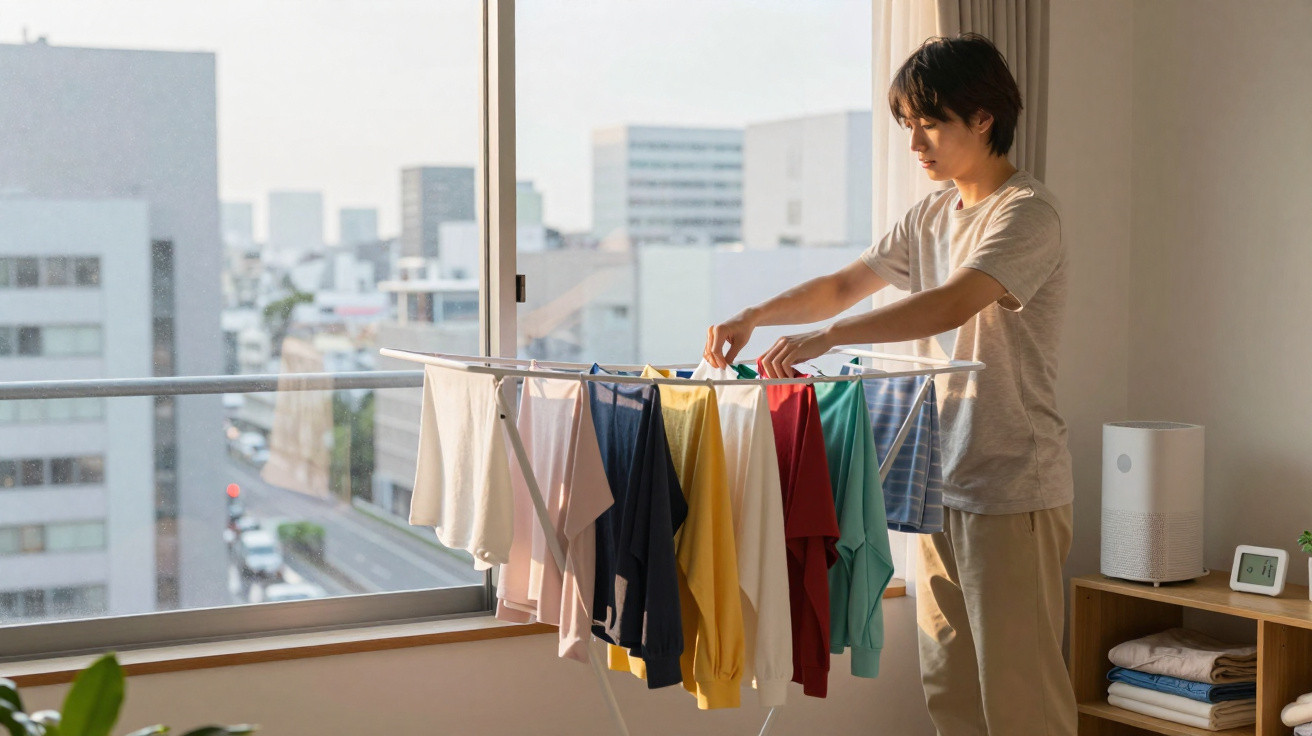
Living in a small flat means knowing the difficulty of drying laundry on rainy days or during colder months. In Tokyo, where rain is frequent and homes tend to be tiny, residents have developed a straightforward way to deal with the issue: the rainbow technique.
The method born from Tokyo's rain and tiny flats
Tokyo has a humid subtropical climate, with plentiful rainfall throughout the year. On top of that, much of the population lives in compact properties known as micro-flats, which do not always have a balcony or outdoor space for hanging washing.
In response, city residents began arranging laundry on the drying rack in a particular pattern resembling a rainbow. The longest items go at either end, with shorter garments placed progressively towards the middle.
- A well-ventilated room: Choose a room with good airflow, ideally one that receives some sunlight during the day.
- Rainbow shape: The garments should create a kind of upside-down U shape on the drying rack.
- Long garments at the ends: Trousers and dresses belong at the outer edges, while T-shirts and shorter items go in the centre.
- Space between items: Leaving a gap between garments allows air to circulate and speeds up drying.
- Towels hung diagonally: Suspending one side lower than the other improves airflow through the fabric.
How it can prevent that musty smell from appearing unexpectedly
Anyone who has taken an item from the drying rack and noticed that damp smell will know how unpleasant it is. It usually happens when a garment takes too long to dry, especially indoors where ventilation is poor.
The purpose of this Japanese technique is precisely to cut drying time. The sooner laundry loses its moisture, the less likely it is to develop the distinctive odour of fabric that has not dried properly.
The detail that can finish drying half an hour sooner
According to a property portal aimed at Tokyo residents, there is a genuine time difference between arranging laundry in a V shape and using the rainbow arrangement. It is not an insignificant difference.
Rainbow x V shape
The time saving that matters at the end of the day
With the traditional V-shaped layout, one load of washing can take around four and a half hours to dry.
With the rainbow arrangement instead, placing longer items at the ends reduces this to roughly four hours, because air can move between the garments with fewer obstructions.
Half an hour may not sound like much, but during winter or spells of continuous rain, that saved time can matter to anyone relying on an indoor drying rack.
Not every garment deserves the same place on the drying rack
Hangers help to keep larger items apart, preventing them from sitting against each other. For socks and underwear, meanwhile, a multi-hook hanger resembling an octopus makes organisation easier without taking up as much space.
Positioning the drying rack perpendicular to the room's airflow, with its back towards the entrance door, can also help considerably. These are simple adjustments, yet they allow laundry to dry more evenly.
A habit that starts before the washing is even hung up
Taking laundry out of the washing machine as soon as the cycle ends is also part of the Japanese drying routine. Leaving garments crumpled inside the machine for only ten minutes can already be enough for a musty smell to begin developing.
Ultimately, the rainbow technique shows that small changes to the way laundry is hung can make a difference, even without a tumble dryer and even in small homes. It is the sort of practical solution born from necessity that can work in any home, Japanese or Brazilian.
If you have also lost patience waiting for laundry to dry on a rainy day, share this tip with someone dealing with the same hassle at home.











Comments
No comments yet. Be the first to comment!
Leave a Comment