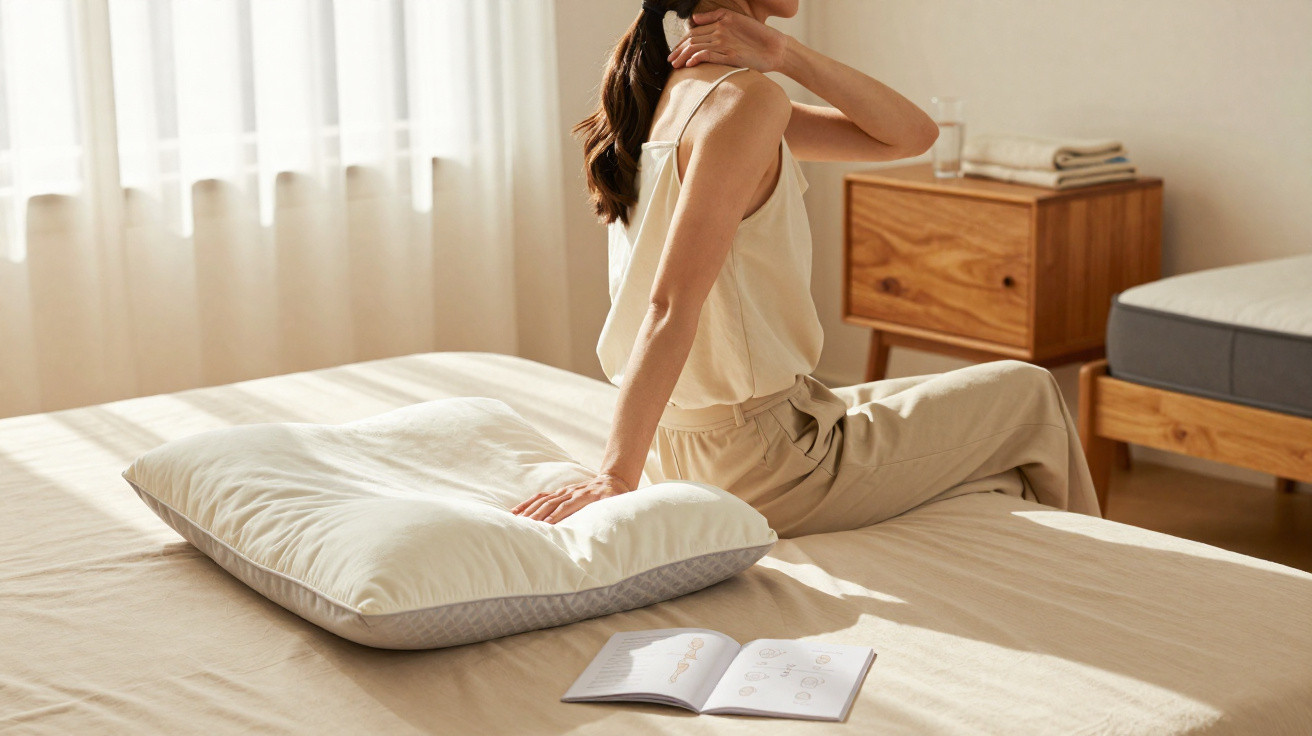
The woman sitting in the physiotherapist’s practice looked worn out.
She was neither ill nor injured - simply fed up with starting each day in pain. She slowly rotated her neck, checking the stiffness as though she were trying to start a car on a cold morning. “It’s weird,” she said. “I go to bed fine. I wake up and my neck is on fire. I’ve changed my pillow three times.”
The physiotherapist was unsurprised. He heard versions of this account every week: bargain hotel pillows, costly “orthopedic” pillows still in glossy boxes, and people who looked guilty because they assumed they must be sleeping incorrectly.
He gently guided her head and indicated the curve in her neck. “Your pillow is fighting against this,” he said. “Every night.”
The reality is both plain and harsh: certain pillows are gradually damaging your neck, often before you realise it.
Why some pillows quietly attack your neck
First, recognise that the neck has a natural curve, while plenty of pillows provide no support for it at all. A thin, worn-out pillow allows the head to sink so far that the neck curves like a bowstring. A deeply stuffed, lofty pillow creates the reverse problem, forcing the head forwards as though you were looking at a phone. Either shape can strain muscles and compress joints for hours at a time.
At night, your spine needs one thing: a relaxed, straight alignment running from the back of your head to your tailbone. An unsuitable pillow interrupts that alignment. You may feel comfortable while falling asleep, but your body keeps score by morning.
At times, a pillow is not universally bad - it is simply unsuitable for your body. The same pillow can produce entirely different outcomes for different people.
One Sunday morning at a packed IKEA, I saw couples squeezing pillows as if they were selecting boxing gloves. One man stretched out in the aisle to try an enormous high pillow. He appeared comfortable for ten seconds, and his girlfriend laughed. They bought two.
Three weeks afterwards, he was at a GP’s surgery with “mysterious” neck pain. It had begun as a dull ache before developing into headaches at his temples. The timing lined up exactly with the new pillows. When the GP asked how he slept, the explanation became clear: he was a side sleeper with relatively narrow shoulders, and the oversized pillows had held his head at a steep angle all night.
Statistics support these everyday accounts. Surveys indicate that up to a third of adults report regular morning neck pain, while sleep-ergonomics specialists frequently identify a direct relationship with pillow height and firmness. Most people fail to make the connection because the impact develops gradually, almost unnoticed. Your body adjusts - until it no longer can.
There is straightforward reasoning behind the pain caused by certain pillows. Your neck comprises a series of small joints, nerves and discs that function best in neutral, mid-range positions. An excessively high pillow bends the neck sideways or forwards. One that is too low lets it fall backwards or downwards. In either case, the muscles must keep working throughout the night merely to prevent the head from dropping further.
Memory foam that is not suited to your weight can hold you in a single position and subtly twist the upper spine. Soft, compressible feather pillows can initially feel luxurious, but may flatten under your head and leave it unsupported. Pain begins when your body shape and sleeping position do not match the pillow’s construction.
A pillow that seems soft and appealing in a shop can turn into eight hours of slow, repeated strain after dark. That is why people wake up asking, “What did I do yesterday?” when the true answer is, “You slept on the wrong hill every night this week.”
How to choose a pillow your neck will actually like
Begin with one simple principle: a pillow should fill the space between your head and mattress, preventing your neck from tipping. Lie on your normal mattress in your usual sleeping position, then slide a hand beneath your neck. The gap you feel is what the pillow should support gently - not squash or leave unsupported.
Side sleepers generally require a deeper pillow to span the gap between the shoulder and ear. Back sleepers need a slimmer option that supports the neck’s natural curve without forcing the chin towards the chest. Stomach sleepers are in the risk zone: choose the flattest pillow available, or begin practising rolling onto your side.
The key check is simple. Once you are lying down, picture a straight line travelling from the back of your head through the centre of your spine. It should appear relaxed and level, rather than bent.
There is also an easy technique physiotherapists use that works remarkably well at home. Take a photograph or short video from the side while you are in bed, at the height of the pillow. Do not arrange yourself for the camera; just settle naturally for a minute or two. Then assess your neck. Is your head noticeably lifted or drooping? If it is, the pillow height is wrong.
Firmness matters too. An extremely soft pillow can feel reassuring at first, yet half an hour later your head may have sunk far enough for the neck to hang. With a pillow that is too firm, the muscles cannot fully release because they are constantly resisting an unyielding surface. Most neck-supportive pillows fall into a middle range: your head settles slightly, then is held in place, as if supported by a gentle hand.
Let’s be honest: nobody measures their head with a tape measure every day in search of the ideal pillow. You test options, make adjustments and learn what works. The aim is not perfection, only reduced strain.
A particularly common mistake is assuming that price guarantees comfort. A generation of shoppers bought costly “miracle” pillows said to resolve everything from snoring to stress. Many now wake with the same neck pain, only on a more fashionable surface. The marketing may be persuasive, but your vertebrae are indifferent.
Another problem is keeping a pillow that stopped working years ago. If you fold it in half and it makes no effort to regain its shape, it is no longer really a pillow - it is an exhausted pancake of fabric. Yet thousands of people still rest their heads on one every night. On a more personal level, people often hold on to old pillows because they believe they “sleep better” with them, without recognising that they have merely adapted to a poor position.
We have all experienced that hotel-room moment: trying to punch an unfamiliar pillow into shape at 1 a.m., feeling equally irritated and desperate. Your neck retains those nights more clearly than you do.
“The best pillow is the one that respects your anatomy,” says a London-based osteopath. “Not the one that looks good on Instagram, not the one everyone swears by in the office. Your spine doesn’t follow trends.”
For a practical approach, run through this brief checklist as you settle down each night:
- Is my head aligned with my spine, or is it tilted upwards or downwards?
- Can I slide a hand beneath my neck without finding a large gap?
- Do I wake up with a headache, tight shoulders or pins and needles?
- Has my pillow become misshapen or lumpy?
- Did the pain begin around the time I changed my pillow or mattress?
No single answer offers the whole explanation, but together they create a useful picture. Often, that picture points back to a simple rectangle of fabric and filling that quietly governs a third of your life.
Living with your pillow, not against it
What makes the subject unusual is its intimacy. You spend more time with your pillow than with most people. It takes in your breath, skin and late-night worries. When your neck begins to hurt, the issue is not merely practical - it can affect your mood, patience and even how kindly you feel towards others in the morning.
For many people, pain from the night follows them into the day: less patience at breakfast, another coffee, and less desire to exercise because the neck is already sore. Neck pain caused by an unsuitable pillow does not remain in bed. It follows you to your desk, on your commute, and into the moment you turn to reverse the car and feel a sudden jolt of tightness.
The understated solution is not an act of heroism. It is simply choosing to give your neck a proper place to rest, much as you would make sure your phone has a charger that works.
There is a social element as well. People recommend pillows with the enthusiasm normally reserved for miracle skincare. One friend insists on a rock-hard latex block, another prefers a soft down cloud, and a third relies on an odd contoured wave that resembles equipment from a science-fiction laboratory. Each of them is right - for themselves.
What spreads most, however, is the conversation. When someone eventually links their “mysterious” migraines or shoulder knots to the cheap, flattened pillow they have owned since university, they talk about it. They mention it to their partner and their mum. Their neck pain gains a story instead of remaining just another complaint.
That is how habits change: not through flawless sleep-hygiene routines repeated from an article, but through untidy real-life trials and late-night conversations ending with, “Maybe it’s the pillow.”
A pillow cannot fix every difficulty in your life, but it can take less away from you: less energy lost to stiffness on waking, less low-level frustration and less silent resentment towards your own body.
There is something quietly radical about waking without thinking about your neck at all. No tightness as you turn to check the time. No need to stretch before you have even left the bed. Just an ordinary, neutral morning in which your body feels like your own again.
After experiencing that, it becomes difficult to keep dismissing the pain with “It’s just age” or “I slept funny.” Sometimes you did not sleep awkwardly at all. You simply slept on a pillow that never properly suited you.
| Key point | Detail | Benefit for the reader |
|---|---|---|
| Spinal alignment | A good pillow keeps the head aligned with the spine | Reduces muscle tension and painful waking |
| Suitable height | The required thickness differs for side, back and stomach sleepers | Helps you select a model that genuinely suits your body |
| Quality and lifespan | A pillow that flattens or becomes lumpy loses its support | Encourages replacement before pain becomes established |

















Comments
No comments yet. Be the first to comment!
Leave a Comment