
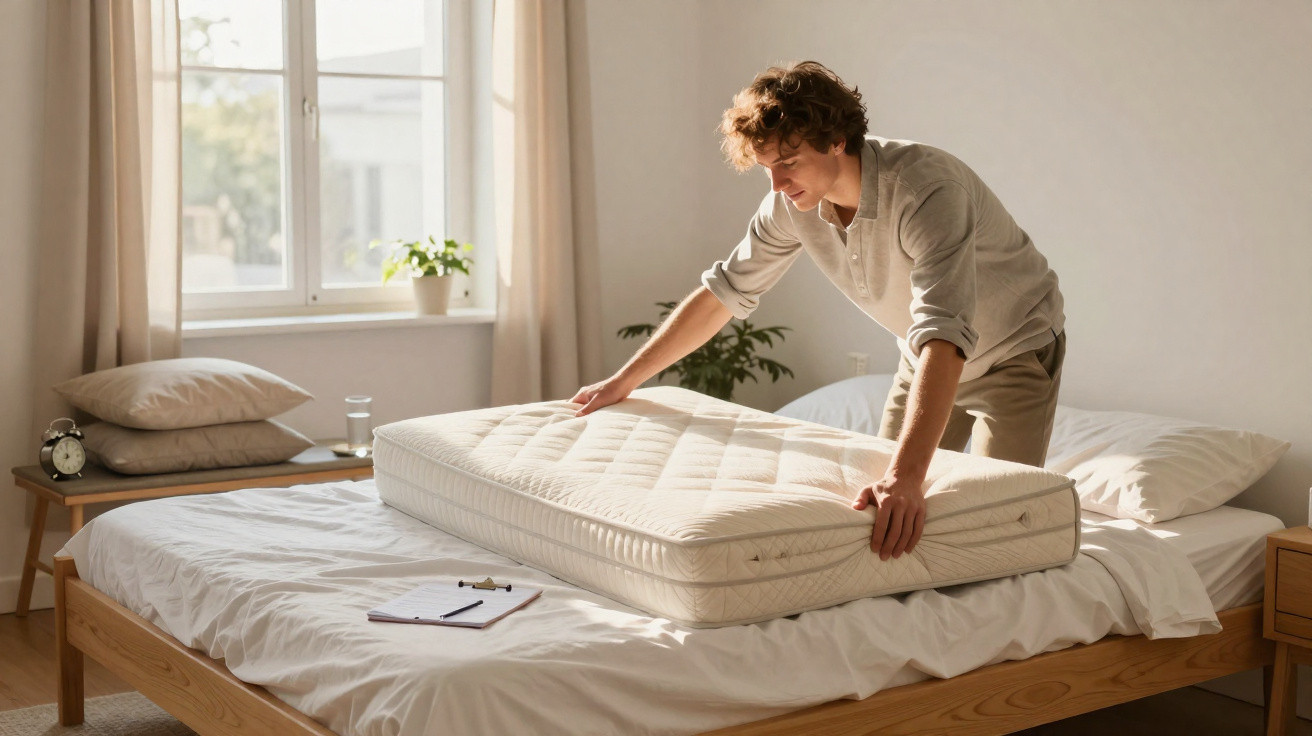
The discomfort often creeps in quietly in the morning.
You turn on to your side to pick up your phone, and suddenly feel that sharp tug in your lower back, as though someone had spent the night pressing on your spine.
You put it down to the mattress, getting older or long days at a desk. After a small stretch and a coffee, you assume it will ease.
Then, one evening at a friend’s house, you notice something odd: sitting on the sofa, she explains with a laugh that she cannot sleep unless a pillow is wedged between her knees. “Otherwise my back kills me,” she says, as if everyone should know this already.
You give it a go one night, almost for a laugh.
The following morning, things feel different.
Why this “weird” pillow habit protects your back
Your body does not simply stop functioning once the lights are out.
Throughout the night, your spine contends with gravity, your muscles continue supporting you, and your hips can turn slightly - particularly when you sleep on your side.
When your knees rest directly against one another, the upper leg is likely to roll forwards.
That slight shift turns the pelvis and takes the lower back with it.
Your body can compensate for a night or two.
After years spent in this twisted posture, though, the lower back can begin to protest.
Putting a simple pillow between your knees helps keep your legs parallel.
Your pelvis remains level, your spine is subject to less twisting and your muscles finally have an opportunity to relax.
Consider Léa, a 36-year-old graphic designer and habitual side sleeper.
For months, she had woken with a burning band of pain across her lower back, particularly following long weeks bent over her laptop.
She had tried all sorts of solutions: YouTube stretching videos, a firmer mattress and even a lumbar support cushion for her office chair.
None of them made a meaningful difference to her mornings.
One day, her physiotherapist saw how she lay on the examination couch and started laughing.
“You always sleep like that, with one leg twisted forward? Put something between your knees.”
Léa returned home, took the closest cushion and placed it between her thighs.
Within two weeks, her pain had fallen from a daily 7/10 to an occasional 2/10.
The explanation is remarkably straightforward.
Above all else, the spine prefers alignment.
When you lie on your side without support, the weight of your upper leg pulls on the hip and sacroiliac joints.
That strain is then passed on to the lumbar vertebrae, leaving them mildly rotated all night.
A pillow between the knees brings the knees and hips into better alignment.
The lower-back muscles no longer need to resist that rotation for hours.
They are able to release, repair and recover.
Night after night, those few centimeters of foam quietly rewrite the story your back tells you every morning.
How to position the pillow so it genuinely helps
The pillow-between-the-knees approach is only effective when it is positioned properly.
If it sits too low, is too thin or slips away after ten minutes, you are back where you started.
Lie on your side with your legs gently bent, creating a loose foetal position.
Place the pillow between your knees so it contacts both knees and part of your thighs.
The aim is straightforward: your legs should feel parallel rather than crossed or rotated.
Next, pay attention to your hips.
If they feel level instead of being drawn forwards or backwards, you are near the ideal position.
Your back ought to feel calmer.
Not flawless, but less strained.
Lots of people attempt this once using an ordinary cushion that goes flat within twenty minutes, then conclude that it “doesn’t work”.
We have all had that moment of expecting a miracle from something tried for only half a night.
The pillow must be thick enough to maintain a gap between the knees without pushing them unnaturally far apart.
For most adults, around 10–15 cm is often sufficient.
Steer clear of very soft pillows that collapse beneath the weight of your legs.
Also avoid cushions that are so firm that they force your hips into an uncomfortable position.
And yes, your body may need a few nights to adjust to this new routine rather than resist it.
“People think they have a ‘bad back’,” says Martin, a manual therapist who sees dozens of desk workers every week. “Very often, they just have a back that’s been sleeping twisted for ten years. A simple pillow between the knees is not magic, but it changes the forces on the spine all night. That’s several hours of relief, every single day.”
- Side sleeper: opt for a long, medium-firm cushion that reaches across the knees and part of the thighs.
- Pain in one hip: set the pillow slightly higher so that it also supports the upper thigh.
- Pregnant: choose a maternity or body pillow that supports both knees and the rotation of the belly.
- Restless sleeper: consider a knee pillow with a strap, so it remains in position overnight.
- Low budget: roll up a bath towel into a thick bundle and try it before purchasing anything.
When a small night-time change transforms your whole day
There is something almost unfair about back pain.
It affects every movement, from tying your shoelaces to lifting your child, yet many people still downplay it.
Sleeping with a pillow between your knees will not fix every spinal problem.
It is not a substitute for a medical assessment when pain is severe, travels down the leg or jolts you awake during the night.
Let’s be honest: no one manages this flawlessly every day with the finest ergonomic pillow in the world.
Yet for thousands of side sleepers, this modest, almost silly-looking routine can mean fewer anti-inflammatories, fewer mornings that begin with a groan and more energy for what genuinely matters.
Some describe a “before” and “after” once they make it a regular habit.
If those stiff, cautious mornings sound familiar, you could discreetly try this tonight.
Perhaps, within a few weeks, you will be the person who casually says, “Oh, I can’t sleep without my knee pillow anymore,” as somebody else listens sceptically while rubbing their lower back.
| Key point | Detail | Value for the reader |
|---|---|---|
| Spinal alignment during side sleep | A pillow keeps the knees and hips parallel, limiting lower-back rotation | Less stiffness in the morning and fewer recurring lumbar flare-ups |
| Simple setup at home | Try any medium-firm cushion or folded towel before spending money on specialist equipment | A quick, affordable way to find out whether the method relieves pain |
| Personalised adjustments | Altering the pillow’s height, firmness and placement for hip pain, pregnancy or desk-job issues | Improved long-term comfort and a routine suited to real-life habits |
FAQ:
- Question 1 Does sleeping with a pillow between the knees really help with sciatica?
- Answer 1 For many people with mild or moderate sciatic pain, it can, as it reduces twisting in the lower back and pelvis. This may ease pressure on the sciatic nerve overnight. If pain shoots down your leg, or you experience numbness or weakness, speak to a doctor or physiotherapist promptly.
- Question 2 What kind of pillow works best between the knees?
- Answer 2 A medium-firm pillow that retains its shape overnight is generally the best choice. Knee pillows and small memory-foam cushions can work well, although a folded bath towel or standard cushion may be enough initially. What matters is filling the gap between the knees without forcing the legs too far apart.
- Question 3 Is this useful if I sleep on my back, not on my side?
- Answer 3 If you mainly sleep on your back, it is usually more helpful to put a pillow beneath your knees rather than between them. This slight lift flattens the lumbar curve a little and can often reduce lower-back tension in back sleepers.
- Question 4 Can I use this trick during pregnancy?
- Answer 4 Yes, and many midwives recommend it. A long body pillow or maternity pillow that supports the knees and belly can reduce pressure on the lower back and pelvis. Sleeping on your side, particularly the left side, is generally encouraged during pregnancy.
- Question 5 How long before I feel a difference in my back?
- Answer 5 Some people find mornings easier after only a few nights, while others require two or three weeks for their muscles and joints to adapt. If nothing changes after a month, or if the pain gets worse, it is worth consulting a professional to investigate other possible causes.











Comments
No comments yet. Be the first to comment!
Leave a Comment