
The disagreement began with toast crumbs.
At least, that was Emma’s version as she removed the bedding at 11pm, flinging pillowcases into the laundry basket with exaggerated sighs. Her partner, sleepy and utterly bewildered, mumbled that “we just changed them.” She paused and stared at him. “Two weeks ago,” she replied. “That’s basically medieval.”
He reached for his phone, searched Google for “how often should you change bed sheets”, and scowled. The answers were all over the place: weekly, fortnightly, and some descriptions of dust mites so unsettling they could spoil sleep for good.
Still, everybody appears certain that their own approach is correct. There is the “I-change-them-every-three-days” group, and the “what-do-you-mean-Christmas-wasn’t-that-long-ago” group. Between these two poles, sleep specialists are discreetly settling on a remarkably specific routine.
One that could, at last, put an end to the bedding battles.
The surprisingly exact sweet spot for clean sheets
Most of us imagine we are cleaner in bed than we truly are. It may sound blunt, but over a single night you shed millions of skin cells, perspire into the material, and bring in urban dust, pet fur, make-up and anything on your feet when you “just quickly lie down”. None of it simply vanishes; it accumulates, night after night, in successive layers.
Microbiologists who grow cultures from used bedding describe it almost as an ecosystem. There are bacteria from your skin and mouth, fungi drawn to warm and slightly moist fabric, and dust mites feeding on shed skin. None of that is especially alarming after one night. Leave it undisturbed for weeks, however, and your comfortable bed becomes a low-key Petri dish.
For that reason, a growing number of hygiene and sleep experts agree on a straightforward recommendation: wash your bed sheets every seven days. This does not mean “roughly weekly if you happen to remember”; it means a genuine seven-day cycle. For most healthy adults, this is the point at which hygiene, comfort and everyday life genuinely align.
The figures support this. Polls in the UK and US suggest that people believe they are keeping up with their bedding, while many leave it far longer. In one British YouGov survey, some single men acknowledged keeping the same sheets on for a month or more, with a few even admitting to… three months. At the other extreme, social media is packed with people who say they replace their sheets “every two days”, carrying a quiet moral superiority that makes everyone else feel judged.
The laboratory evidence is rather less emotional. Researchers tracking pillowcases and sheets found that bacterial and fungal levels increase markedly after roughly a week. By days 7–10, you are no longer sleeping only in “you”; you are lying among particles from outdoors, traces of your own body and a flourishing population of microscopic visitors. It is not catastrophic, but it is certainly no longer fresh.
A weekly wash will not make a bed sterile, nor is that the aim. Instead, it prevents biological build-up from getting out of hand. It interrupts exponential growth at a useful point: sufficiently late to remain manageable, yet early enough to stop your bed becoming a permanent home for bacteria and dust mites. For anyone with allergies, eczema or asthma, this schedule can make a noticeable difference to how mornings feel.
How to make the “weekly wash” actually doable
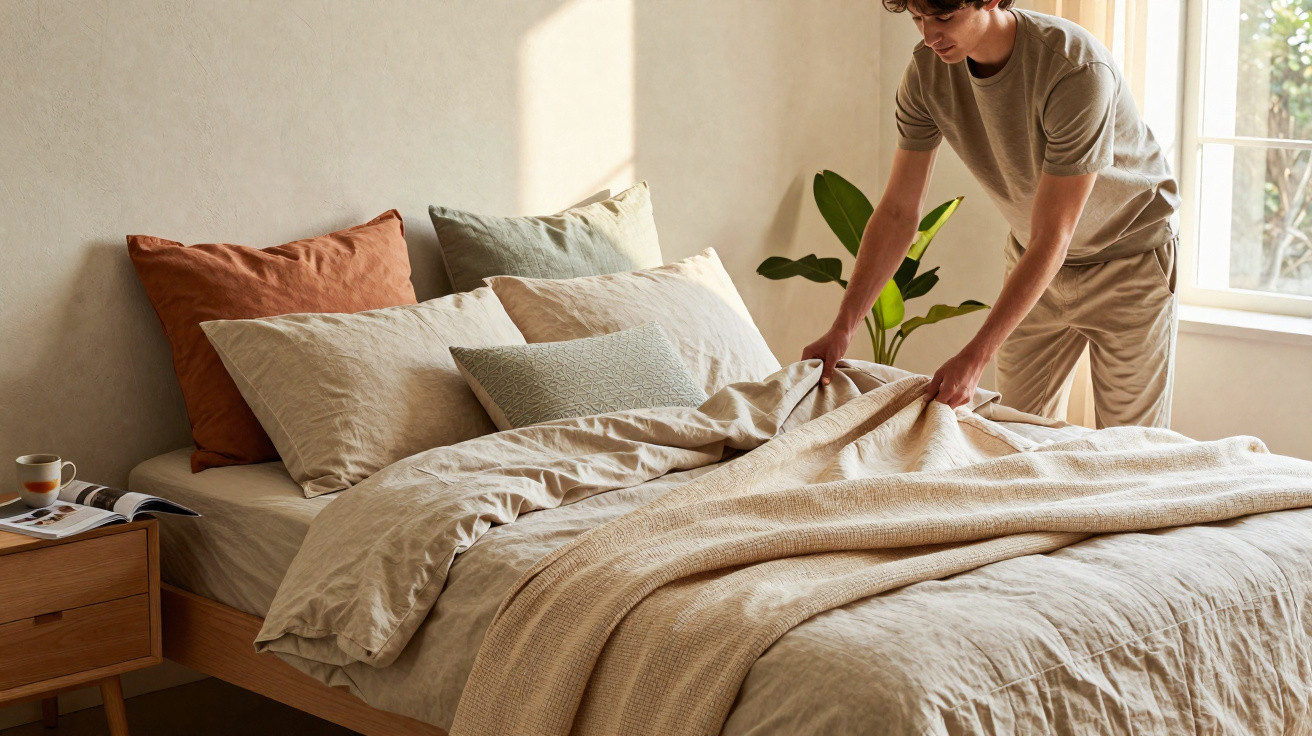
The answer is not merely knowing the seven-day guideline. You need to build it into your week, so you are not laundering sheets at midnight while a damp duvet cover hangs over the sofa. Begin by selecting one regular “bed day”: Sunday afternoon, Tuesday evening, or whenever your schedule naturally offers some breathing room. That small ritual can turn a chore into a weekly reset.
Then make the system as simple as possible. Having two complete sheet sets for every bed is the minimum for an easy routine; three is a luxury. Remove the used bedding, put the clean set straight on, and only afterwards think about loading the washing machine. This alone halves the “ugh, no clean sheets” problem. Lightweight, breathable cotton or linen also dries more quickly and copes better with regular washing without becoming worn-out.
Let’s be honest: nobody truly does that every day.
The main error is not laziness but guilt. Some people wash compulsively, almost treating any sign of “dirt” as something to punish themselves for. Others avoid considering it until an odour or visibly yellowing pillowcases trigger a complete cleaning crisis. Both ends of the spectrum create an oddly emotional connection to something as ordinary as fabric covering a mattress.
Experts advise a gentler approach. If you are ill, sweat overnight, share the bed with a partner or pet, or sleep naked, washing every 5–7 days is sensible. If you shower immediately before bed, wear pyjamas and avoid eating in bed, extending the interval to 10 days is unlikely to cause a disaster. The important thing is to keep a weekly schedule as your default, then adjust it calmly to suit your life rather than reacting in panic.
Clean bedding also changes the sensory experience of an evening. Many people say they drift off a little sooner on “fresh bed night”, even if they cannot quite explain why. Hygiene is part of it, and psychology is another. You are literally lying down in a signal that says, “today is reset”. That can affect you deeply, even if you never articulate it.
“We found that setting a weekly ‘sheet day’ does more for real-life bedroom hygiene than any number of scary dust mite statistics,” explains Dr. Hannah Cross, a sleep researcher. “Regular, predictable care lowers anxiety and keeps habits going. Fear-based advice wears off. Routines don’t.”
- Standard rule for most adults: Change and wash bed sheets every 7 days.
- High-sweat / pets / allergies: Aim for every 4–5 days if you can.
- Low-use or guest bed: Every 2–3 weeks, plus a wash after each guest.
- Pillowcases: Ideally twice a week, especially if you have acne or skin issues.
- Mattress protector: Every 1–2 months, more often in heatwaves.
The quiet meaning of clean sheets
We usually frame changing sheets as a household task, one item on the long, invisible list that keeps a home functioning. Yet beneath that, it is something more intimate. Who changes them, who notices, who grumbles, and who quietly does it for everyone else all reveal something about care and attentiveness within a home. Sometimes a dispute about bed linen is really about feeling unsupported with the mental load.
Weekly bedding can become a shared commitment. It need not be a strict rule, but rather a rhythm that everyone moves towards. On the chosen day, one person strips the bed, another folds the dry sheets, and a child “helps” by tossing pillowcases into a laundry basket twice their size. These tiny, unremarkable actions tell your body: this place is cared for. I am cared for.
There is another, more personal dimension too. Fresh sheets quietly measure time. They divide life into weeks: “since last Sunday”, or “that conversation we had on fresh sheet night”. You may not recall dates from a diary, yet you remember cool cotton after a difficult day, the distinctive sleep you had on the night you finally made a hard decision, or the morning light falling across the bed when you changed the sheets for the first time after a break-up.
Plenty of people change their bed sheets either excessively or too rarely. Both habits may come from the same impulse: wanting to feel safe, clean or in control in a body and world that seldom behave precisely as we would like. The understated middle ground now proposed by experts - that humane weekly interval - is not dramatic enough for social media. It is neither a life hack nor a confession, simply a gentle and sustainable way to live with your own physical reality.
Perhaps that is precisely why it matters. A bed is where you disappear each night and return each morning. It contains your finest ideas and your deepest fears. Treating that rectangle of fabric as an active part of your routine, rather than background furniture you only notice at the extremes, alters more than your washing timetable. It may change how you settle into your own life, week after week.
| Key point | Detail | Benefit for the reader |
|---|---|---|
| Ideal frequency | Change and wash sheets every 1 week for a healthy adult. | Provides a clear, realistic guide that avoids both excess and neglect. |
| Lifestyle adjustments | Reduce the interval to 4–5 days in cases of sweating, allergies, pets or illness. | Makes it possible to adapt habits to your actual situation without guilt. |
| Practical routine | Choose a fixed “sheet day” and keep at least two complete bedding sets. | Turns a chore into a straightforward ritual that is easy to maintain week after week. |














Comments
No comments yet. Be the first to comment!
Leave a Comment