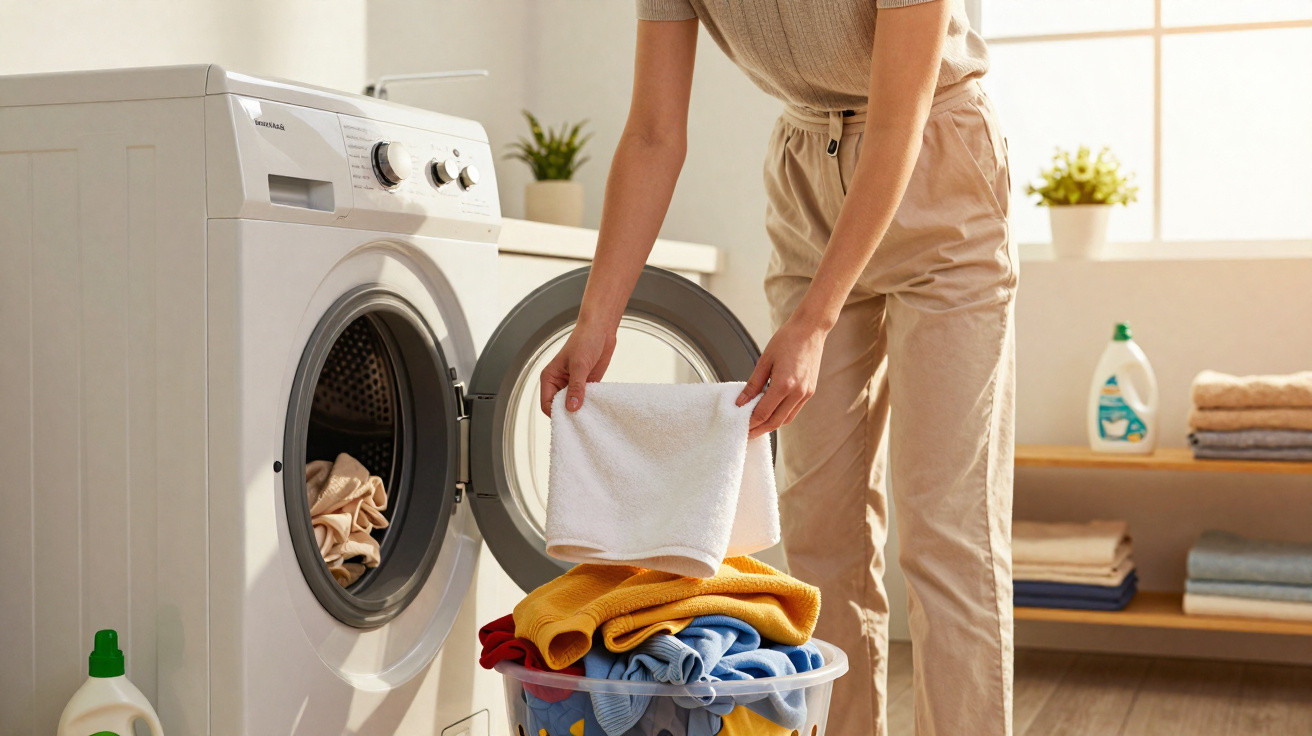
Jeans are still damp around the waistband. Towels feel weighty and cling to your hands. The display says the cycle is “complete”, yet your fingertips tell a different story. You put the washing back in, select another 20 minutes, and feel that familiar flicker of annoyance: more electricity, more time, more waiting.
It is a small household frustration, easily lost in the rush of a packed week, but it plays out in thousands of homes each evening. There is a quiet mismatch between the pace of life and the time laundry takes to dry. Perhaps someone has mentioned a “trick” involving a dry towel, and you have half-dismissed it while mentally filing it alongside strange internet hacks.
What if that slightly odd suggestion is as close as your tumble dryer gets to a cheat code?
Why one dry towel can make such a difference
The first time you add a large, fluffy dry towel to a wet load, it seems almost too straightforward to be effective. You shut the dryer door, press start, and pause for a moment, wondering whether you have been taken in by a TikTok myth. Five minutes later, though, something sounds different: the usual heavy thumping from the drum is lighter and more regular. Instead of tangling together, the clothes appear to be separating.
When the buzzer finally goes off, the change is subtle but noticeable. Jeans that would normally stick to your legs are ready to wear. Towels no longer resemble damp sandbags. You lift out a hoodie and find yourself thinking, wait, that’s actually dry. A single ordinary towel has altered the pace of the entire load.
On a grey Tuesday, a Leeds mother of two tried this with a huge pile of school uniforms. The load size, programme and machine stayed exactly the same. The sole difference was one large, dry cotton bath towel in the drum. Without it, the shirts needed 72 minutes to become properly dry. With the towel, they were ready to fold after 49 minutes. That is roughly thirty percent less time, achieved by adding only one item.
Researchers studying household appliance use have observed comparable results. A dryer has its toughest job at the start, when it must deal with surface moisture and clothing’s tendency to form one dense, heavy bundle. A dry towel effectively gives the appliance an assistant in the drum. It quickly absorbs some of the water, distributes heat and physically helps keep the other fabrics apart as everything tumbles.
There is a simple piece of physics behind it. Wet textiles retain water on their surfaces and deep within their fibres. A thick, dry cotton towel is extremely absorbent: during the first few minutes, it takes in moisture that would otherwise remain on lighter garments such as shirts and underwear. Once it becomes damp, it reduces humidity inside the drum, allowing the hot air to work properly rather than circulate like a tropical storm. The towel also acts as a soft battering ram, breaking apart clumps of jeans and bedding so warm air can reach a larger surface area.
That is why a broad claim such as “thirty percent faster” can be plausible. It is not magic, but a modest rebalancing of heat, humidity, movement and time.
How to use the dry-towel trick without damaging clothes
The method itself is almost suspiciously simple. Put your wet washing in the dryer as normal, then place one large, clean and completely dry bath towel on top. Choose a thick cotton towel, preferably a light-coloured one to avoid any risk of dye transfer. Shut the door, select your usual setting and start the cycle.
For a medium-sized load, it often works best to leave the towel in for the first 15–20 minutes. This is when it delivers most of the benefit, eagerly absorbing excess moisture and helping to loosen clumps. Once that first stage is over, pause the dryer, remove the now-damp towel and hang it up to air dry. Allow the rest of the load to finish without it. You have tackled the most demanding part of the cycle, when the dryer typically uses the most energy.
Very heavy or bulky loads need a slightly different approach. When the drum is full of towels, jeans or bedding, the dryer can become a slow cooker. For these loads, two dry towels can be used during the opening stage, creating more surface contact and absorbing more moisture. Remove both towels once they are damp, then let the remaining laundry finish. The aim is not to keep putting dry items in throughout the cycle; they are there as a starter motor to get the process moving quickly.
On a difficult day, laundry can feel like a quiet enemy, and the last thing anyone wants is another “perfect routine” that is impossible to maintain. Let’s be honest: nobody really does this every day. On some evenings, you will simply put everything in the dryer and hope for the best.
Even so, a few precautions will make the dry-towel trick useful rather than counterproductive. Do not overfill the drum: if garments can barely move, even the cleverest idea will fail immediately. Choose lint-free towels that are not brand new, otherwise the saved drying time may be replaced by picking lint off black T-shirts. Avoid adding a large towel to cycles containing delicate fabrics such as silk or lace, as the additional friction may be too harsh for fragile materials.
Be careful about colour transfer as well. Putting a dry red towel in with pale shirts is essentially a dye bomb waiting to happen. Use white or light-coloured towels for mixed loads, and keep shrink-prone items away from this method. If your dryer already has poor airflow because its filter has not been cleaned for weeks, a towel will not rescue it. That is simply inviting damp disappointment.
Energy advisers working with low-income households often notice a recurring pattern: people run several lengthy dryer cycles because they worry their clothes will smell musty. One adviser described the towel trick this way:
“You’re not fighting the machine, you’re giving it a teammate. The towel does the messy, wet work so the dryer can focus on the finish.”
For anyone balancing bills, children and limited time, that “teammate” can matter. Choosing a shorter cycle, or avoiding the extra 30 minutes at the end, can genuinely reduce electricity consumption over a year. It is not miraculous, but it is still worthwhile.
Here is a quick guide to the situations where the dry-towel method works particularly well:
- Medium to large loads of cottons, synthetics or mixed laundry
- Homes where the dryer is used several times each week
- Situations in which you routinely select “extra 20 minutes” out of habit
A dry-towel laundry hack that reflects everyday life
There is something surprisingly revealing about how one towel inside a metal drum can alter the rhythm of an evening. At face value, it is simply fabric, heat and air interacting. Beneath that, it reflects the countless small compromises we make with time, money and energy, week after week and load after load.
On a rushed Thursday evening, cutting drying time by thirty percent could mean your child’s football kit is ready before bedtime, or that your only clean work trousers are no longer tacky at 7 a.m. When money is tight, it could stop the dryer from quietly becoming the highest-draw appliance on your energy bill. On a day when your mind is already overloaded, it may simply remove one more nagging task from the laundry basket in the corner.
We all recognise the major environmental changes that attract headlines: heat pumps, solar panels and electric cars. Yet much of everyday life lies in quieter adjustments-the way we wash, dry, rewear and repair the possessions we already have. Adding a dry towel at the right point will not save the planet. It may, however, shift how you feel about your home, your belongings and your time.
You may begin noticing the little systems you have built without meaning to: the Sunday-night laundry panic, the midweek “just one quick wash”, the pile of clothes that always seems to need slightly more drying than everything else. From there, reconsidering other routines is not such a major step. Habits change not through guilt, but through small successes that feel almost ridiculously easy.
The next time your dryer beeps and you are already expecting damp cuffs and heavy towels, you may remember that unusual tip someone mentioned. One dry towel at the beginning, removed after twenty minutes. It is a small domestic prompt, quietly asking: what else in your day is waiting for a minor, almost silly change that helps everything move faster and breathe more easily?
| Key point | Detail | Benefit for the reader |
|---|---|---|
| Dry towel speeds up drying | One large dry cotton towel can cut drying time by around thirty percent | Less waiting, fewer extra cycles and quicker access to clothes |
| Use the towel only at the start | Let it run 15–20 minutes, then remove it once damp and hang it | Gets the benefit without over-drying or wasting energy later in the cycle |
| Match towel and load smartly | Light-coloured, lint-free towels with medium or heavy loads, avoiding delicates | Protects fabrics, prevents colour transfer and keeps the hack safe to repeat |













Comments
No comments yet. Be the first to comment!
Leave a Comment