Open the window wide for two minutes, run a cloth over the basin, then leave thinking that will do. Three days later, the shower seals have turned grey, one corner of the ceiling is yellowing and the paint is quietly blistering, as though offended.
It is easy to blame an ageing property, damp weather or the lack of an extractor fan. You buy another anti-mould spray, promise yourself you will clean the bathroom more often, and then everyday life takes over. The problem, meanwhile, never lets up.
The real issue comes down to an ordinary, automatic action repeated after every shower without much thought. It is this very habit that makes damp and mould return more quickly.
The everyday mistake that traps moisture in your bathroom
Most people assume that fighting bathroom mould is all about products: powerful sprays, costly “anti-humidity” paints and scented tablets placed in the corner of the shower. In fact, the key battle takes place during the ten minutes after you step out, dripping onto the bath mat and reaching for a towel.
The usual mistake could hardly be less exciting: shutting everything too soon. The door is closed, the window is shut and the extractor fan is switched off as soon as the light goes out. With nowhere to escape, warm, damp air gradually settles into the walls, ceiling, grout and even behind cupboards. That is when mould begins to feel at home.
Imagine a winter evening. You have a long, hot shower to warm up after the day. Steam fills the room, the mirror vanishes and the tiles gleam with moisture. You get out slightly cold, shut the door to keep the warmth in and perhaps open the window for a minute “just to freshen the air”. Five minutes later, you are dressed, the window is closed again and the bathroom door remains firmly shut.
A hygrometer would still show extremely high humidity: 80–90 %, sometimes more. Research indicates that mould can begin growing when indoor humidity remains above 60 % for several hours. Moisture caught behind paintwork or in silicone does not simply disappear. It condenses, works its way in and nourishes the microscopic spores already waiting there.
When dark marks appear in upper corners or behind the toilet, we tend to call it “poor ventilation”. More accurately, ventilation has been stopped too soon, every time. Let us be honest: hardly anyone genuinely leaves the fan running for 20 minutes and the door fully open every day. Yet this habit of quickly sealing the room is precisely why damp and mould reappear faster than they should.
A bathroom is, in effect, a compact sauna. Hot water heats the air, heated air holds moisture, and warm damp air naturally moves towards cooler, drier areas. Shut the door and turn off the fan, and that air simply circulates above you like a trapped cloud. Opening the window slightly while showering makes little difference if you close it immediately afterwards, because the natural airflow has then been cut off.
The moisture will settle first on the coolest surfaces: ceiling corners, external walls and metal fittings. This explains why the same areas always stain before anywhere else. You are not cursed; you are simply giving water vapour ideal conditions in which to settle. The more often this everyday mistake is repeated, the more your bathroom acts like a sponge that never quite dries out.
After several weeks, surfaces can remain faintly damp even when they appear dry. Paintwork becomes soft, silicone loses flexibility and the wood around the base of cabinets expands. Mould spores, always present in indoor air, find this tiny humid haven and begin to colonise it. From the outside, all you notice is “dirt that comes back too fast”.
How to break the cycle: small changes, big impact
The encouraging part is that the solution is not drastic. There is no need to renovate the bathroom; you simply need to change the timing of one regular habit. Rather than closing the bathroom as soon as you have showered, treat the following 20–30 minutes as drying time. Leave the door wide open, keep the fan running and, where possible, leave a window tilted or slightly open.
This stops damp air from stagnating and allows it to leave. Keep the extractor fan on for at least 15–20 minutes once the hot water has stopped. In a bathroom without a fan, leaving the door ajar and opening a window in another room creates a straightforward cross-breeze. One further step makes a real difference: pull the shower curtain or shower door completely open so that water on the walls can evaporate into air that is actually circulating.
Most of us have entered the bathroom the following morning and found that it still smells “wet”. That is a sign that the air has not been refreshed properly. Try a simple experiment for a week: after each shower, leave the door open and the fan on and, if possible, put an inexpensive humidity meter on a shelf. Compare how slowly the reading falls when everything is shut with how it changes when air can move freely.
Many people discover that their bathroom never truly drops below 65–70 % humidity. That is why mould keeps returning. Ventilating for longer, even if it feels slightly cooler or less “cosy”, gives the walls time to breathe. You should also consider where the steam is travelling: if it merely moves into a small hallway and remains there, the problem has only been relocated.
Some people are concerned about heating bills and keep doors closed to “save warmth”. In practice, a few minutes of efficient air exchange can cost less than repeatedly heating a room that feels cold because it is damp. A dry bathroom heats up more quickly and remains comfortable for longer. The goal is not to create a freezing draught, but to prevent an invisible layer of humid air from lingering above the shower.
Another subtle habit can accelerate mould growth: leaving wet surfaces exactly as they are. Beads of water on tiles, a glossy layer on glass and droplets along silicone seals may look harmless, even attractive in the right light. In reality, they are small reservoirs that hold moisture for hours. Each additional hour of contact gives mould more of what it needs.
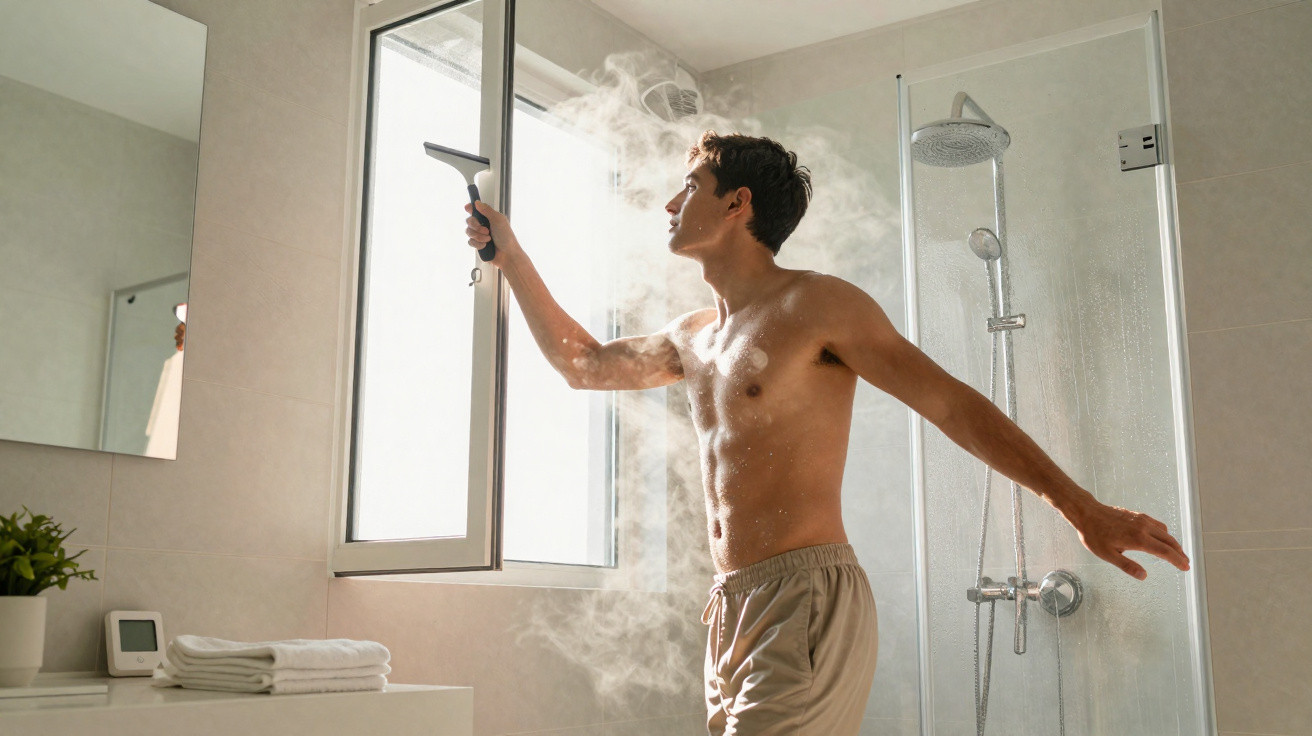
A quick pass with a squeegee over shower walls and glass can remove up to 75 % of surface water. Once it becomes routine, it takes 30 seconds. Then run a towel along the lower seal and through the corners where water gathers. Drying the basin and the area around the tap after brushing your teeth is another small habit that changes the moisture balance. Less standing water means less dampness that lingers.
Mistakes happen here too. Plenty of people wipe only the areas visible in the mirror, overlooking the top of the shower frame, the bottoms of bottles and the ledge behind the tap. These are exactly the places where black marks tend to show up first. The reassuring truth is that perfection is unnecessary. Even doing a “half job” after every second shower significantly reduces the time moisture remains. Think of it as bringing the room closer to dry again, rather than allowing it to remain in between.
“Bathrooms don’t grow mold because you’re dirty,” explains a building biologist I spoke to. “They grow mold because they’re wet for too long, too often, and the air has nowhere to go.”
To keep it practical, here is a straightforward checklist you can almost follow automatically when leaving the shower:
- Keep the bathroom door open and the fan running for 20 minutes.
- Fully open the shower door or curtain so the surfaces can dry.
- Use a squeegee on the glass and tiles, then quickly dry the corners and seals.
It may seem like extra effort, but it can spare you lengthy scrubbing sessions with harsh chemicals. A few easy, regular actions are more effective than one exhausting monthly “spring clean”. Your future self, on a Sunday afternoon, will quietly be grateful.
A bathroom that properly dries: changing the story at home
Once you understand moisture as a matter of timing and airflow, the way you see your bathroom shifts. It is no longer “that room that is always damp”, but a space where you can affect what happens every day. You begin noticing small signs: a mirror that stays misted for too long, a towel that never properly dries or a faint mark in an upper corner that was not there last month.
It also helps to share these small observations at home. Children can understand that the fan is not merely “noise”; it stops their favourite rubber duck from developing an odd smell. A partner may be more willing to leave the door open when they understand why paint keeps peeling above the shower. A little context often works better than nagging.
What appears to be a dull household detail has wider effects. A bathroom that dries correctly needs fewer chemical cleaners, fewer repairs and less time spent scrubbing on your knees. It can also mean less sneezing for someone sensitive to mould and fewer headaches caused by musty air. The next time you reach for the light switch and door handle after a hot shower, you might pause for a moment.
Is the mistake happening again, or will you give that steam somewhere else to go?
| Key point | Details | Why it matters to readers |
|---|---|---|
| Do not shut the bathroom immediately after a shower | Keep the door open and the fan running for at least 15–20 minutes after the water stops, even if the room “feels” dry. | It prevents humidity from becoming trapped in the walls and ceiling, reducing mould stains and that persistent musty smell. |
| Remove standing water from surfaces | Use a squeegee on tiles and glass, then wipe corners, seals and metal edges where droplets remain longest. | This cuts drying time by hours and deprives mould of the moisture it needs to return week after week. |
| Create proper air circulation, rather than just “a crack” | Pair an open bathroom door with a slightly open window in another room to draw damp air out instead of simply moving it around. | It helps keep the entire home drier and reduces condensation on windows, swollen doors and peeling paint beyond the bathroom. |




Comments
No comments yet. Be the first to comment!
Leave a Comment