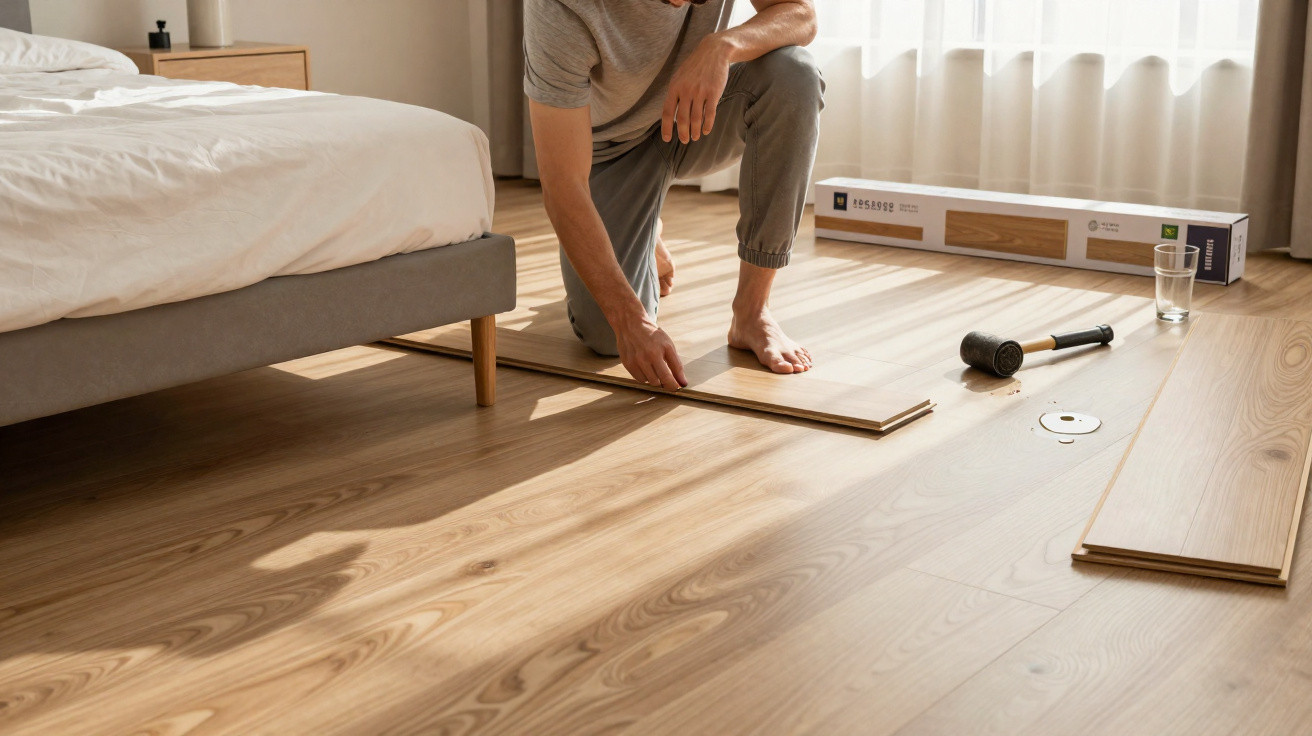
SPC vinyl flooring is becoming increasingly popular in bedrooms because it combines a wood-like appearance with floating installation and a rigid core that contains no wood fibres. This is particularly useful where water is spilt, damp cleaning takes place or minor leaks occur: while conventional laminate can swell when moisture enters through the joints, SPC planks are available in fully water-resistant versions.
What is SPC flooring, and why has it become an alternative to laminate?
SPC is a rigid-core vinyl flooring category. Its central layer is denser and more stable than that found in flexible vinyl products, with additional layers providing the pattern, finish and wear resistance. Manufacturers describe SPC as flooring with a solid polymer core, suitable for both residential and commercial settings.
In a bedroom, this construction makes it possible to achieve wood-effect planks without the HDF core commonly used in many laminate floors. The result brings together dimensional stability, impact resistance and options supplied from the factory with an attached underlay.
- Rigid, dense core;
- Planks in a range of wood patterns;
- Water-resistant models;
- Options with integrated acoustic underlay;
- Floating installation for many products.
Why is it less affected when water gets into the bedroom?
The key difference lies in the core. Traditional laminate flooring often uses HDF, a wood-fibre board, and prolonged moisture entering through its joints can cause the edges to swell. Water-resistant SPC does not contain the same fibre-based core, so spills do not trigger the same wood-expansion process. This does not mean every laminate floor is vulnerable: ranges are now available with protected HDF and locking systems designed to resist water for 24, 72 hours or longer, depending on the manufacturer’s specification.
Is SPC flooring genuinely quieter in a bedroom?
That depends on the selected construction. Simply being SPC does not guarantee reduced noise, as its dense, rigid core can transmit footfall sound. The difference is most noticeable with models featuring an acoustic underlay on the underside or those fitted over a compatible acoustic solution. Some SPC ranges are sold with an attached underlay specifically intended to reduce noise and improve underfoot comfort.
For that reason, anyone replacing laminate in pursuit of a quieter room should check the technical data sheet rather than relying solely on the SPC label on the packaging. Plank thickness, underlay type, subfloor levelling and installation method all affect the level of noise heard in the bedroom.
- Look for products with an attached acoustic underlay;
- Check whether the manufacturer allows an additional underlay;
- Avoid fitting over an uneven subfloor;
- Compare acoustic data between products before buying;
- Also consider sound transmitted into the room below.
How does click installation make renovation easier?
Many rigid floors use locking joints that allow planks to be assembled over the subfloor without gluing each piece. Manufacturers refer to systems of this kind as floating, adhesive-free installation, including over certain existing floors, provided the base is dry, clean, level and within the product’s required tolerances. This reduces renovation stages, although cutting, perimeter expansion gaps and subfloor preparation are still required.
- Check the level of the floor before starting;
- Maintain the expansion gaps specified by the manufacturer;
- Do not conceal leaks beneath the new planks;
- Confirm that the existing floor is suitable for installation;
- Follow the manual for the particular locking system purchased.
The subfloor remains crucial
A water-resistant plank does not turn the whole installation into protection against leaks. Water can pass through the edges, reach skirting boards or walls, or remain beneath the flooring after a larger leak. In addition, rigid SPC requires a sufficiently level base; some denser cores are less forgiving of imperfections and may reveal unevenness in the subfloor.
For a bedroom exposed to frequent cleaning, occasional dampness or the risk of spilt water, SPC vinyl flooring provides a clear advantage over many laminates with a wood-based core: the plank does not rely on HDF to retain its structure. The final choice should nevertheless take account of water resistance, the locking system, underlay, thickness and installation requirements, because these details determine whether the floor remains stable, comfortable and quiet after the renovation.














Comments
No comments yet. Be the first to comment!
Leave a Comment