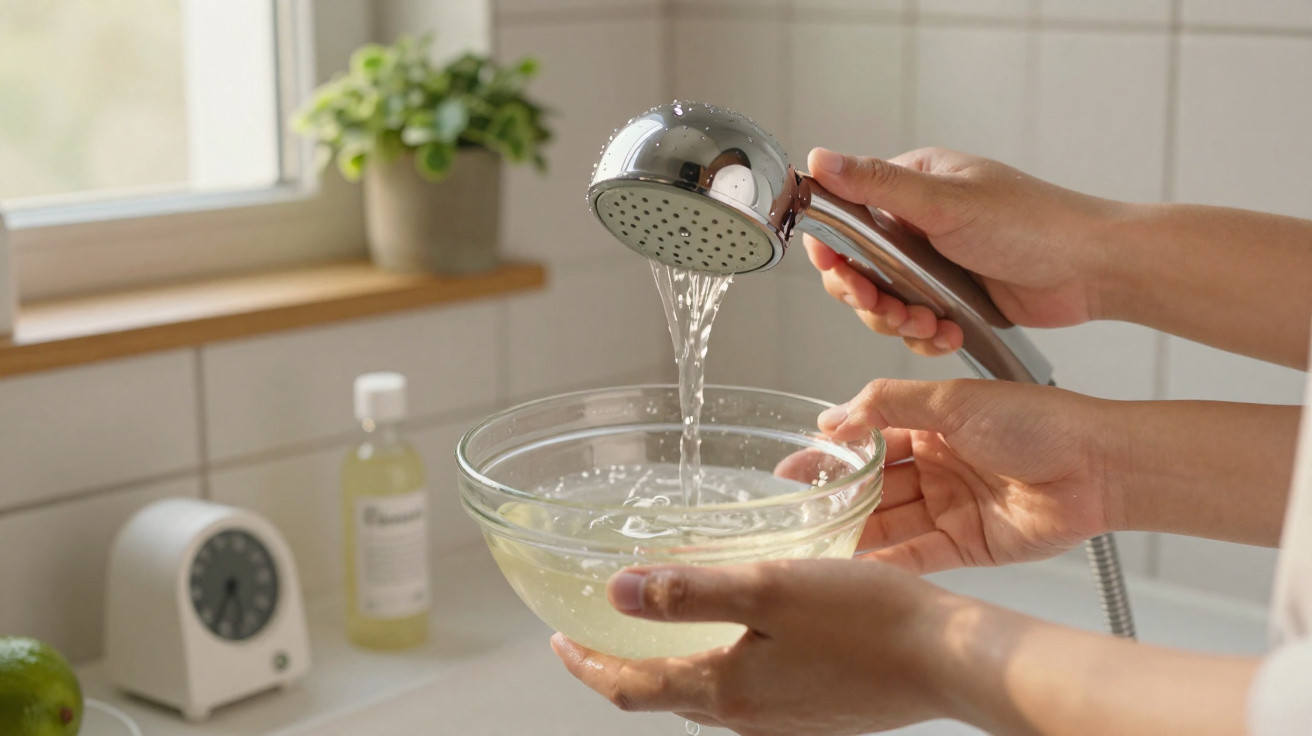
A shower can appear immaculate while concealing a small but persistent problem. Mine certainly did. The flow had become feebler, several jets were firing sideways, and rinsing out shampoo was taking far too long. One quiet evening, I secured a plastic bag filled with vinegar around the showerhead and left it there until morning. What came out the following day was genuinely startling.
As I removed the bag, the liquid swished around and released a faint, oddly homely pickled smell. I turned on the tap and a cloudy surge poured out: milky trails, pepper-like black specks and a few stringy fragments that looked like particularly spiteful confetti.
Some pieces landed in the bath with a muted tick, like tiny mineral skeletons finally breaking free. I stepped away, then moved closer again because I could not stop looking. I let out a yelp, then found myself laughing alone in the bathroom.
Honestly, I had neglected my showerhead for years. The water pressure returned almost at once, rather like breathing clearly again after a cold. Then the showerhead began revealing everything it had been holding.
The shock, the residue and the quiet science
What emerged looked as though a geology lesson and a biology experiment had collided in the drain. The pale granules were limescale: calcium and magnesium carried in hard water that settle inside the showerhead. The darker flakes were likely loosened manganese or iron staining, along with biofilm, the slimy microbial layer that forms wherever warm water meets plastic and metal.
There is evidence behind the unpleasant spectacle. The USGS estimates that around 85% of homes in the United States have hard water, helping to explain the chalky marks left on fittings and shower glass. Researchers at the University of Colorado also found that showerheads can contain communities of non-tuberculous mycobacteria, which thrive in the intermittent warm-water conditions of a household bathroom.
Acetic acid in vinegar reacts with calcium carbonate much like a key fitting a lock. It loosens and dissolves the crust, producing small carbon-dioxide bubbles that may cling to the nozzles before the loosened grit is flushed away. That is why an overnight soak can make an existing fitting feel new without having to buy a replacement. As the limescale breaks apart, biofilm also becomes easier to dislodge, and the first flush can carry away weeks, or even years, of deposits.
The showerhead vinegar method that works without special equipment
Take a zip-top bag and add sufficient plain white vinegar (5% acetic acid) to cover the showerhead. Place the bag over the head, then secure it with a rubber band or twist tie so that the nozzles remain submerged. Leave it for 30 minutes to 2 hours if the build-up is light, or overnight where limescale is heavy. Remove the bag, run hot water for one minute, then clean the nozzles using an old toothbrush or your thumb.
In reality, this is not something anyone does every day. For fittings finished in brass, gold, nickel or bronze, limit the soak to 10–15 minutes and rinse immediately afterwards, as extended exposure can dull delicate surfaces. Never combine vinegar with bleach or any cleaner containing chlorine. Rinse the showerhead first; if you also want to tackle germs, use a brief spray of 3% hydrogen peroxide afterwards and rinse once more.
If the showerhead can be unscrewed easily, remove it and soak it in a bowl for more complete contact. There is often a small mesh filter at the inlet. Gently tap out any debris, then backflush it under running water.
“Water writes its history in minerals. Your job is to proofread now and then.”
- Fast fix: Soak in warm vinegar for 60 minutes, then run hot water for 30 seconds.
- Heavy rescue: Leave it overnight, scrub the nozzles, rinse quickly and then flush for 2 minutes.
- Finish-safe: Use a brief soak, wipe with a soft cloth and avoid abrasive pads.
- No removal: The bag method is better than struggling with a seized fitting.
- Maintenance: A short monthly soak helps prevent a repeat performance.
What your showerhead can tell you about your home
Most of us have experienced a minor household task turning into an unexpectedly revealing discovery. A showerhead acts as a record of your water supply: its mineral content, the route it has travelled and your own routines. After watching that first milky plume spiral into the drain, you may start noticing the changes: a wider spray, noisier water and shampoo rinsing away more quickly.
This is not only about cleanliness; it is about resistance. Limescale constricts the channels and pushes droplets off course, creating the sensation of poor water pressure and slower mornings. Once those channels are clear, the same plumbing can suddenly seem far more cooperative. Five minutes of preparation the evening before can give you back minutes every day. On a busy Tuesday, even seconds matter.
There is a quiet satisfaction in these small victories. No visitor may ever notice them, but your shoulders will. Mention the trick to a neighbour or in a group chat, and photos of vinegar-filled jars and rubber bands may arrive within hours. The bathroom becomes a small laboratory that can be cleaned up in the time it takes to play one song.
A small ritual with a big payoff
Treat it as a reset rather than a chore. A vinegar bath helps return your home to its usual standard, while the stream of minerals going down the drain is a reminder of how much is happening inside pipes and behind walls. Try it once and you will notice the difference in the spray pattern and in the pace of the morning. The solution costs very little and requires more patience than effort. When the stream starts splitting or shampoo refuses to rinse away, you will know exactly what to do. You may even start looking forward to the reveal: the oddly satisfying moment when water seems to find its voice again.
| Key point | Detail | Why it matters to the reader |
|---|---|---|
| Vinegar dissolves limescale | Acetic acid breaks down calcium carbonate and loosens biofilm | Restores water pressure and the spray pattern without replacing the fitting |
| Brief soaks for delicate finishes | Restrict exposure to 10–15 minutes on brass, gold, nickel or bronze | Helps prevent dulling or etching of fittings |
| Bag method = no tools | A plastic bag, rubber band, white vinegar and toothbrush are all that is needed | Anyone can do it in minutes, including renters |












Comments
No comments yet. Be the first to comment!
Leave a Comment