Under the bluish light on the screen, the toilet seemed innocuous: nothing more than porcelain and water. Then she flushed. In slow motion, a cloud – an actual, visible cloud – burst upwards, sending thousands of tiny droplets into the air like unseen confetti. Some rose above the seat. Others floated slowly to the side, as though searching for somewhere to settle: a toothbrush, a hand towel, the corner of a phone left on the counter.
She looked at me and said only: “This is what happens every single time.”
I have not viewed a bathroom in quite the same way since.
The oddest thing is that most of us still flush while the lid is up.
What really happens when you flush with the lid up
Think about the bathroom in your home, the one you know without thinking. The stack of neatly folded towels, the tumbler holding your toothbrush, the moisturiser whose lid you always mean to fasten properly. Now picture everything within the reach of a microscopic storm. A toilet flush is not a mild circular movement of water; it is closer to a small indoor geyser – invisible to the naked eye, but entirely real.
Whenever you press the flush, a fast stream of water strikes whatever is inside the bowl. That impact propels minute droplets into the air. Scientists refer to this as a “toilet plume”. You call it your bathroom.
During a recent visit to a university fluid-dynamics laboratory, I saw researchers direct lasers through a transparent toilet model. It sounds like something from science fiction, but the outcome was unsettlingly familiar: this is everyday life, shown at one-thousandth of its usual speed. In under eight seconds, the flush created an aerosol fountain almost a metre high. Droplets moved around the room, suspended and drifting before gradually landing on nearby surfaces.
One study found that these droplets may contain traces of E. coli, norovirus and other unwanted passengers, even if the bowl “looks” clean. Researchers positioned plates around a bathroom, flushed the toilet, then returned later. Bacteria had settled discreetly everywhere: on the floor, walls and uncovered toothbrushes.
The most alarming detail is that many droplets are too tiny to notice. You may enter ten minutes later, smell fresh soap and assume all is well. Yet microscopic residue may be resting on the very objects you bring close to your mouth and eyes. The toilet is not merely where things are disposed of; it can also be the starting point for a brief airborne journey across the room.
How a closed toilet lid changes everything
The reassuring news is remarkably straightforward: lowering the lid before you flush provides a simple, low-tech barrier. There is no need to fit a HEPA filter or alter your plumbing. You are simply placing a solid cover between a pressurised spray of toilet water and the rest of your surroundings. The lid takes the force of the plume, so droplets strike its underside rather than flying into the room.
A number of experiments show that bacterial spread is greatly reduced when the lid is closed. It is not reduced to zero, but it is substantially lower. In practical terms, that means fewer germs settling on your towels, cosmetics, razor and children’s bath toys. A tiny hand movement can have a disproportionate effect on the hygiene of the room.
There is, however, a complication: most of us follow habits without much thought. In a shared flat, everyone tends to have their own unspoken rules. Some people always shut the lid, while others never do. Some do not even register whether it is raised or lowered; they simply flush and leave. The issue is greater in public toilets, where lids are often absent, damaged or disregarded. We hurry, touch as little as possible and assume that being quick will keep us safe. It will not.
When you begin to notice it, the same scene appears repeatedly: at work, in restaurants and in friends’ homes. Lids remain fully raised, toilets are flushed often, and bathrooms are compact spaces crowded with personal belongings. It is like watching someone prepare raw chicken and then dry their hands on the tea towel. People are so accustomed to it that hardly anyone responds.
The reasoning is difficult to dispute. If material from the bowl can become airborne, and the room holds items that touch your skin, enter your mouth or sit near your eyes, there is one sensible defence: interrupt that journey. A closed lid will not remove every germ from your bathroom, but it prevents the jet from dispersing them over your belongings.
Making lid-closing a daily reflex
If shutting the lid does not yet feel natural, approach it as you would any learned habit. Put a small note on the wall or cistern saying: “Lid, then flush.” Within a week or two, your hand may begin to do it with little conscious effort. The action takes a fraction of a second, while its effect remains long after you have left the room.
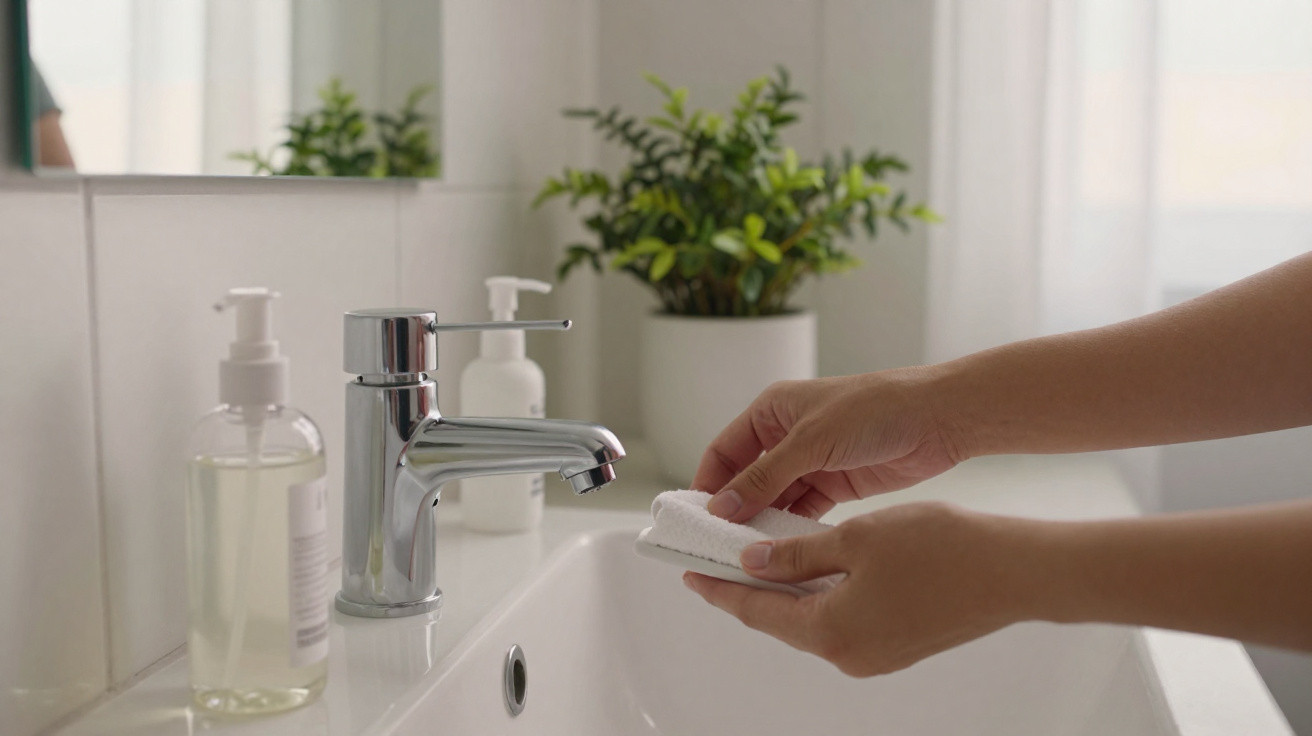
You can adapt the room to support this new routine as well. Put toothbrushes in a cupboard, store make-up sponges in sealed containers and use a simple protective cover for razor heads. None of this is elaborate. It simply recognises that a toilet is not an isolated fixture, but a device positioned in the middle of your hygiene routine.
There is a social element, too. In families and shared flats, raise the subject once without making a fuss. Rather than lecturing anyone, make it a casual “hey, I saw this” conversation. Few people object when the answer is easy and costs nothing. This is not about turning a bathroom into a sterile laboratory; it is about avoiding the spray of yesterday’s bowl contents onto today’s towel.
We should also address the small reassurances we give ourselves: “The bathroom looks clean.” “I use cleaning products, so it’s fine.” “I’m not ill, so the germs do not matter.” Germs are indifferent to our views. Flu viruses, stomach bugs and ordinary gut bacteria do not require a visible mark to travel around. They only need a lift on the next burst of droplets.
Let us be honest: nobody truly follows every hygiene instruction perfectly every day. That is not the point. The aim is to choose habits that provide the greatest protection for the least effort. Closing the lid is precisely that sort of action: one that quietly lowers risk without demanding that you change your life.
“When people see the toilet plume on camera for the first time, their behaviour changes instantly,” a microbiologist told me. “You can’t unsee it. From that moment, the lid isn’t optional anymore.”
To keep the principle straightforward, it helps to put it this way:
- Lower the lid before every flush – regard it as you would washing your hands.
- Keep personal items covered – toothbrushes, razors, make-up and even contact lenses.
- Clean frequently touched areas regularly – the flush handle, seat, sink area and door handle.
A small gesture that quietly transforms your bathroom
Once you begin closing the lid, you may notice modest changes in how the room feels. The bathroom no longer seems like somewhere everything is left exposed. The toilet becomes a contained area rather than a central fountain. It is a small boundary, but it alters how you move around the room, where you put your possessions and how you view that “clean” towel hanging beside the bowl.
There is something unexpectedly calming about the action, too. You go in, use the toilet, close the lid and flush. The order is straightforward, almost ritual-like. In a world where so much is beyond your control, this is one small factor entirely within it. It costs nothing, and it could mean fewer winter stomach bugs or fewer unexplained “24-hour” viruses passing through the household.
We have all seen a friend casually leave a toothbrush on the edge of the basin beside an open toilet. You spot it, pause and say nothing. Next time, you may interpret it differently. Not as paranoia, but as a quiet act of consideration: “Hey, perhaps close the lid before you flush. There’s this thing called a toilet plume…” This is not about embarrassing anyone. It is about sharing an invisible reality that affects every bathroom, from tiny studio flats to polished hotel suites.
Once you understand that flushing with the lid up can send bacterial particles throughout the room, it is difficult to forget it. That knowledge need not make you anxious. It can simply guide you towards a smarter, different routine. The lid is already there, as is the flush. Your habits are the only missing part.
| Key point | Detail | Why it matters to the reader |
|---|---|---|
| Toilet plume | Flushing produces an aerosol cloud that can rise more than a metre | Helps you picture how far droplets can move in a small bathroom |
| Lid as a barrier | Closing the lid before flushing greatly reduces bacterial spread | Offers a simple, free action with a genuine hygiene benefit |
| Bathroom routine | Store personal items away and clean touch surfaces regularly | Lowers everyday exposure to germs without making life feel like a laboratory experiment |


Comments
No comments yet. Be the first to comment!
Leave a Comment