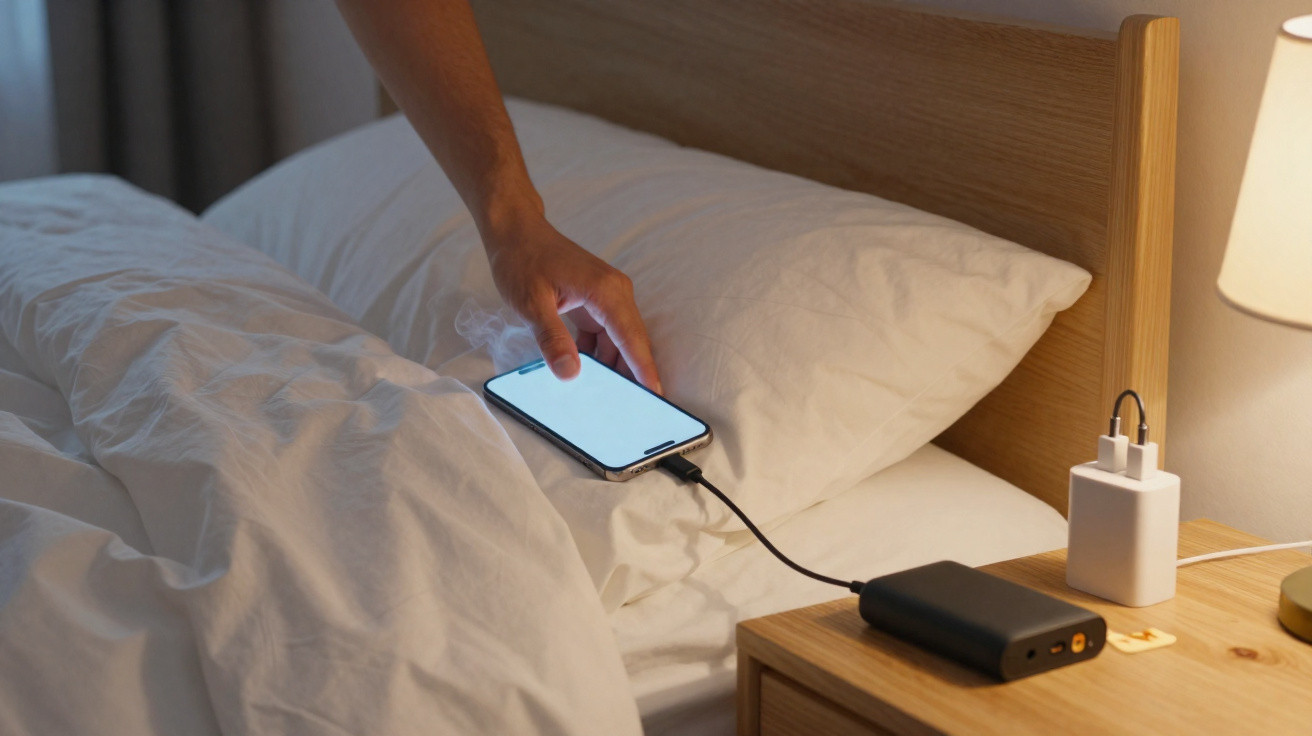
The bedroom is dark; time seems to stand still. Beneath a pillow, a phone screen gives off a faint glow, like a small hidden light. Someone makes one final scroll through TikTok, connects the charging cable with tired eyes, notices the battery is at 12%, and slips the phone under the pillow to “keep it close”.
The pillowcase dulls the quiet vibration of late-night alerts. Heat begins to accumulate unnoticed. There is no noise and no warning: only a plastic-and-lithium rectangle struggling for air inside a cotton enclosure.
By morning, it may all seem perfectly ordinary. Or it may not.
The risk begins well before any flames appear.
Why a phone under your pillow is a real fire hazard
Think about what a pillow is beneath its soft surface. It is a thick mass of fabric and filling made to retain warmth and air. Putting a charging phone underneath effectively surrounds a small, heat-producing device with insulation.
Today’s smartphones release heat through their casing, particularly around the rear and edges. In a sense, they need room to “breathe”. Once covered, that heat has nowhere to go. The temperature rises gradually, silently and persistently.
Your bed is not merely somewhere to sleep, either. It is an effective source of fuel: cotton, polyester, foam and wood. If one part ignites, the materials around it can catch fire within minutes.
Fire services worldwide repeatedly encounter the same aftermath: a burnt mattress, a melted charging lead embedded in a brown circular mark on a sheet, and pillow foam turned black like charcoal.
In 2023, a UK fire service published photographs of a teenager’s bed, showing a scorched pillow, a warped charger and a partly melted phone case. The teenager was fortunate to wake after smelling the burning; many people are not.
In the US, the National Fire Protection Association associates hundreds of house fires each year with small electronic devices placed on beds, sofas or beneath blankets. Most of these incidents begin at night, when people are in their deepest sleep.
There is also a technical explanation for this quiet threat. Lithium-ion batteries react badly to high temperatures. As they become too hot, chemical reactions inside their cells speed up. If the safety mechanisms fail, or if the heat remains trapped, a battery may enter what engineers call “thermal runaway”.
At that point, the battery effectively overheats itself from within. It can swell, release gas and then ignite like a miniature blowtorch. A visible spark is not required; excessive heat trapped in the wrong environment is enough.
Add an inexpensive or damaged charger supplying an unstable current. Add a bent or fraying cable. Add a soft, combustible pillow. What seems like a harmless routine can quickly become a textbook set of conditions for a bedroom fire.
Small, realistic habits that keep your phone - and you - safe at night
The most effective improvement is not an expensive MagSafe stand or a smart plug. It is simply changing the physical location of your phone. Place it on a firm, uncovered surface: a bedside table, wooden shelf or even the floor beside the bed. Choose somewhere with air around all sides.
Keep roughly a palm’s width clear around the phone. Do not put anything over it or wrap it up. A folded blanket should not hold it like a hot-water bottle.
If you worry about not hearing the alarm, leave the phone within reach and place the screen face down to reduce the light. The gap between keeping it beside your pillow and putting it beneath your pillow is enormous. The convenience is the same, but the level of risk is entirely different.
Everyone has had an evening when the battery is desperately low at 7%, the charging lead is too short, the socket is too far away and they are already half under the duvet. You stretch the cable, lean the phone against the mattress and assure yourself that it is “just for tonight”.
Yet “just for tonight” can easily turn into a nightly routine. You may tell yourself that you will buy a longer lead, a bedside shelf or a wireless charger one day. Let’s be honest: hardly anyone actually does that every day.
The answer is to alter one simple, low-effort part of the routine. Reposition the extension lead. Attach an inexpensive phone holder to the wall. Charge earlier in the evening while brushing your teeth or preparing dinner, so the bed does not become your charging station.
One fire investigator put it bluntly:
“I don’t care what brand your phone is - if you bury a charging battery in bedding, you’re building your own little oven.”
The wording may sound severe, but it is painfully accurate. Heat and fabric are a combination that does not compromise.
A useful rule is to think of your phone as a tiny heater that should never be covered. If it’s plugged in, it stays in the open. Full stop.
- Never charge a phone on or under a pillow, blanket or duvet - not even “for a few minutes”.
- Use original or certified chargers, and replace frayed leads without delay.
- Keep the phone out of the bed: use a table, shelf, chair or sturdy stand.
Living with your phone… without sleeping on a ticking time bomb
There is a human element that receives little attention. Many people keep a phone beneath the pillow not only because it is convenient, but because it feels reassuring. It can seem as though the world is right beside your ear should anything happen at 3 a.m.
At a deeper level, that small warm rectangle can become a night-light you would rather not admit you need. After a difficult day, it may be the last thing you touch before sleeping and the first thing you reach for on waking.
Emotionally, that response is understandable. Physically, it creates a trap. You can retain that sense of closeness without retaining the danger. A basic phone stand on the bedside table can interrupt the pattern without ending the ritual.
| Key point | Detail | Benefit for the reader |
|---|---|---|
| Trapped heat | A phone charging beneath a pillow cannot release its heat, greatly increasing the risk of overheating and fire. | Understanding the mechanism makes the danger tangible rather than abstract. |
| The “just for tonight” effect | A one-off exception quickly becomes a nightly habit, especially when the battery is low and the socket is too far away. | Recognising this instinct helps people change their habits without guilt. |
| One simple, lasting action | Moving the charging area to a clear, hard surface within reach already removes most of the risk. | It provides a realistic solution that can be used tonight. |













Comments
No comments yet. Be the first to comment!
Leave a Comment