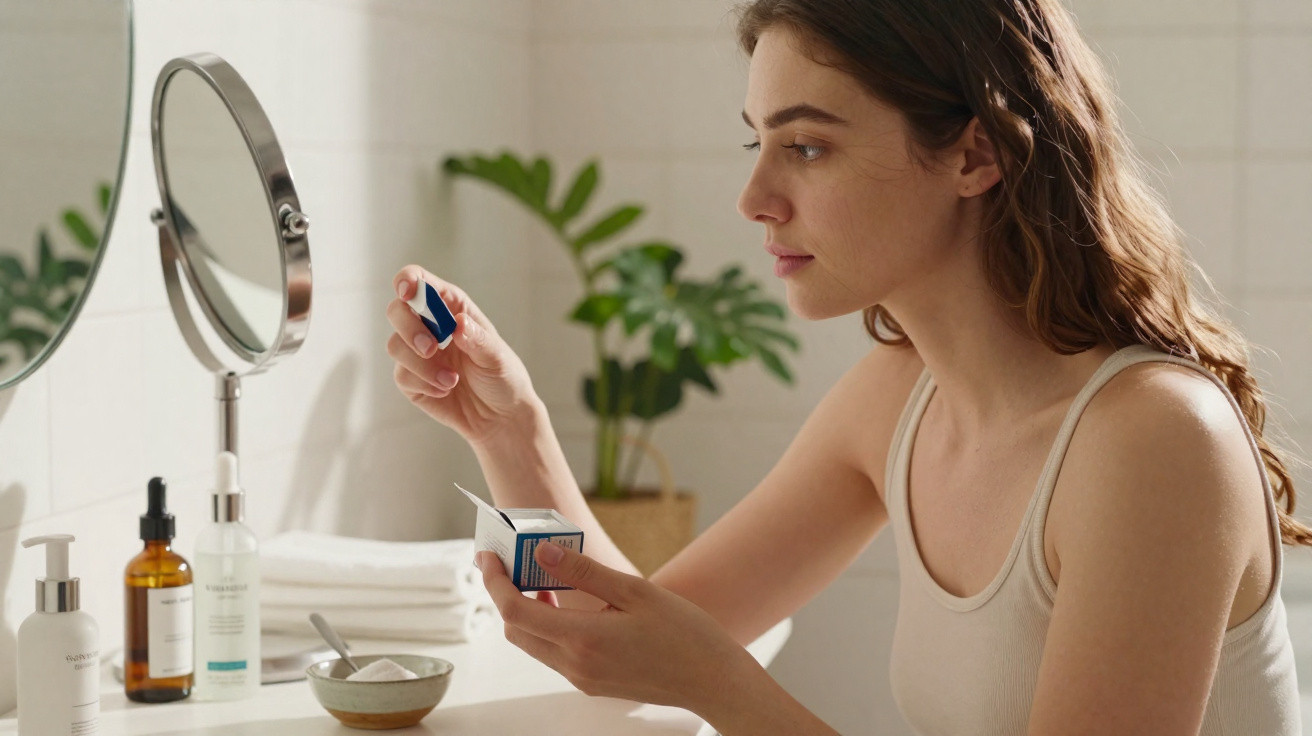
One Tuesday evening, with a Netflix series half-followed and a cup of tea gone cold, Léa flicks through beauty reels on her phone. A creator spreads a white paste beneath her eyes, grins into the camera, and a caption appears: “Baking soda = botox at home.” After two more swipes, a different video says precisely the reverse, cautioning against burns and early ageing. The comments resemble a battlefield: “Miracle!” “My skin peeled off!” “Dermatologists lie!” “You just don’t know how to use it!”
She heads into the kitchen, opens the cupboard and looks at the familiar orange box. A few spoonfuls of powder, five minutes on her face, and wrinkles gone… The claim is alarmingly effortless.
Certain trends do more than become viral.
They land directly on your skin.
Baking soda on the face: miracle filter or real skin hazard?
Search for “baking soda face mask” on any social platform and you quickly disappear down a rabbit hole. Foreheads look smooth, crow’s feet seem softened, and “before/after” images resemble beauty filters made real. The method is invariably similar: add a little water, apply the paste, leave it on, then wash it off. The promise is that wrinkles will lessen, pores will tighten and skin will become baby-soft by morning.
It appears almost absurdly straightforward on screen. That simplicity is exactly what persuades people to test it.
A 24-year-old French influencer recently presented her “grandma’s secret anti-wrinkle hack” to her two million followers. In the clip, she dabs baking soda beneath her eyes and across her smile lines, dismissing a mild burning feeling as “normal.” It reached more than a million views in less than 24 hours.
A fortnight later, a dermatologist posts another video: screenshots showing inflamed red eyelids, raw cheeks and broken capillaries. It is the same ingredient and the same trend, but an entirely different outcome.
At the heart of the disagreement is one fundamental point: baking soda is alkaline, at roughly pH 9, whereas skin is naturally mildly acidic, between 4.5 and 5.5. This acid mantle provides a protective barrier. Covering it with an overly alkaline substance, even briefly, interferes with the barrier that retains moisture and blocks bacteria. Some skin recovers rapidly. Other skin responds with tightness, peeling, inflammation and, at times, sensitivity that persists.
The danger rises further around the eyes, where skin is four times thinner.
What dermatologists say vs. what TikTok shows
In dermatology surgeries, the baking soda trend is not seen through polished clips, but in understated consultations. There is the woman in her forties who “only used it twice” and now cannot tolerate her normal cream. There is the student whose eczema patches spread suddenly after using a homemade exfoliating paste. There is the man who used a baking soda scrub for blackheads and was left with skin that felt sunburnt, despite no sun exposure.
Their explanation is always much the same: “But online, they said it was natural, so it must be safe.”
During appointments, some dermatologists are very direct. They use pH charts, describe how the skin barrier works, and discuss the cumulative effects of collagen loss and micro-inflammation. They liken baking soda to a powerful household cleaner used on delicate silk. It is not a message that is particularly viral, glamorous or “clickable.”
Meanwhile, the trend is sustained by “3-day miracle” accounts. No one makes a reel about an angry skin barrier that needs three months to settle.
Beneath it all lies confusion over what “anti-wrinkle” actually involves. Anything that mildly irritates or swells the skin may blur fine lines for a short time. That is not evidence that it is beneficial over time. Effective anti-ageing care focuses on restoring, moisturising and protecting collagen fibres, rather than assaulting them every Sunday with items from the kitchen. Skin doesn’t forget repeated aggression just because it came from an ingredient that sits next to the flour.
Dermatologists are not fixated on scaring people; their focus is on the long-term effects.
So how do people actually use baking soda on their face?
DIY beauty rarely happens exactly as instructed, and baking soda is no exception. The most widespread online approach is a basic paste: one teaspoon of baking soda combined with enough water to become creamy, then spread thinly over the face or placed directly on wrinkles. Some leave it for five minutes, while others wait for 15. A small number rub it in while rinsing to gain “extra exfoliation.”
The area beneath the eyes receives particular attention, despite being the one area that most dermatologists advise leaving entirely untouched.
There are also “recipes” combining baking soda with lemon juice, vinegar or toothpaste. It is a mix of acid and base, with fragrance and detergent added. The combination fizzes, tingles and stings. Users may convince themselves that a degree of pain proves it is effective. Realistically, nobody repeats this daily, because skin would object so strongly that even the most determined trend follower would stop.
When it burns, many people merely reduce the contact time and try once more, believing they simply “overdid it” initially.
Dermatologists and careful beauty professionals continue to give the same essential advice, often sounding both worried and resigned:
“Baking soda is a great cleaner for sinks, not for skin,” sighs Dr. Marion Lefèvre, a Paris-based dermatologist. “I understand the attraction of cheap, simple solutions. But the face, and especially the eye contour, is not a place for experiments with household powders. Once the barrier is damaged, it may take months to repair.”
To separate useful advice from the noise, many specialists set out firm boundaries:
- Never put baking soda directly on or around the eyelids.
- Do not combine it with lemon, vinegar or toothpaste for use on the face.
- Avoid using it as a scrub if your skin is dry, sensitive or prone to acne.
- Do not keep a baking soda mask on for more than a minute or two “to feel the tingle”, if you use one at all.
- Stop at once if you experience burning, severe tightness or redness that does not fade.
If not baking soda, then what for wrinkles?
Once the hype is removed, the question behind the trend is straightforward: how can wrinkles be softened without injections or huge expense? The unglamorous answer remains the strongest. Apply sunscreen every day to the face and eye area. Use a mild cleanser that does not leave cheeks feeling squeaky-clean. Choose a straightforward moisturiser and use it consistently, morning and night, rather than only when it occurs to you.
After that, perhaps consider a focused eye cream or serum containing ingredients such as peptides, low-dose retinol or hyaluronic acid.
Most people recognise the moment: zooming in on a selfie, noticing a fresh line beside the eye and feeling a brief rush of panic. That emotional opening is where these “magic tricks” find their way in. There is nothing wrong with wanting smoother-looking skin. The error is assuming that an inexpensive, harsh shortcut can outperform biology without consequences.
At times, the kindest choice for your future self is to stop damaging your skin barrier in pursuit of “natural” hacks.
Specialists instead recommend routines that can seem almost dull beside the spectacle of fizzing powder on the face:
- Daily SPF 30–50 around the eyes and over the entire face, including on cloudy days.
- A fragrance-free cleanser and simple moisturiser appropriate for your skin type.
- Mild active ingredients: low-strength retinol, bakuchiol or peptides introduced gradually.
- Occasional professional treatments if desired, including superficial peels, microneedling or laser treatment under medical supervision.
- Sleep, less smoking and less persistent stress – the familiar factors that quietly carve lines into the face.
None of these is likely to become as viral as “baking soda eye lift in 5 minutes.”
However, they are more likely to result in better skin in five years.
The new beauty divide: cheap hacks vs. skin peace
The baking soda trend points to a wider discussion, one that goes beyond a single ingredient. People are weary of costly creams and airbrushed promises. They are looking for shortcuts, kitchen-based remedies and practical advice that their grandmother might have used. The beauty industry offers a divided picture: dermatologists issuing warnings on one side, and creators pursuing views through increasingly extreme DIY “challenges” on the other.
In between sit your face, your eyes and all the years in which you still want to feel comfortable in your own skin.
| Key point | Detail | Value for the reader |
|---|---|---|
| Skin barrier and pH | Baking soda is highly alkaline and interferes with the skin’s naturally acidic protective film. | Explains why a “simple” powder may cause irritation or sensitivity that lasts. |
| Eye area risk | Under-eye skin is thinner and more delicate, creating a greater risk of burns and inflammation. | Prompts additional caution and helps prevent testing viral hacks too near the eyes. |
| Safer anti-wrinkle options | Mild skincare, sunscreen and established active ingredients such as retinol or peptides. | Provides practical alternatives to aggressive DIY techniques while safeguarding your skin’s future. |







Comments
No comments yet. Be the first to comment!
Leave a Comment