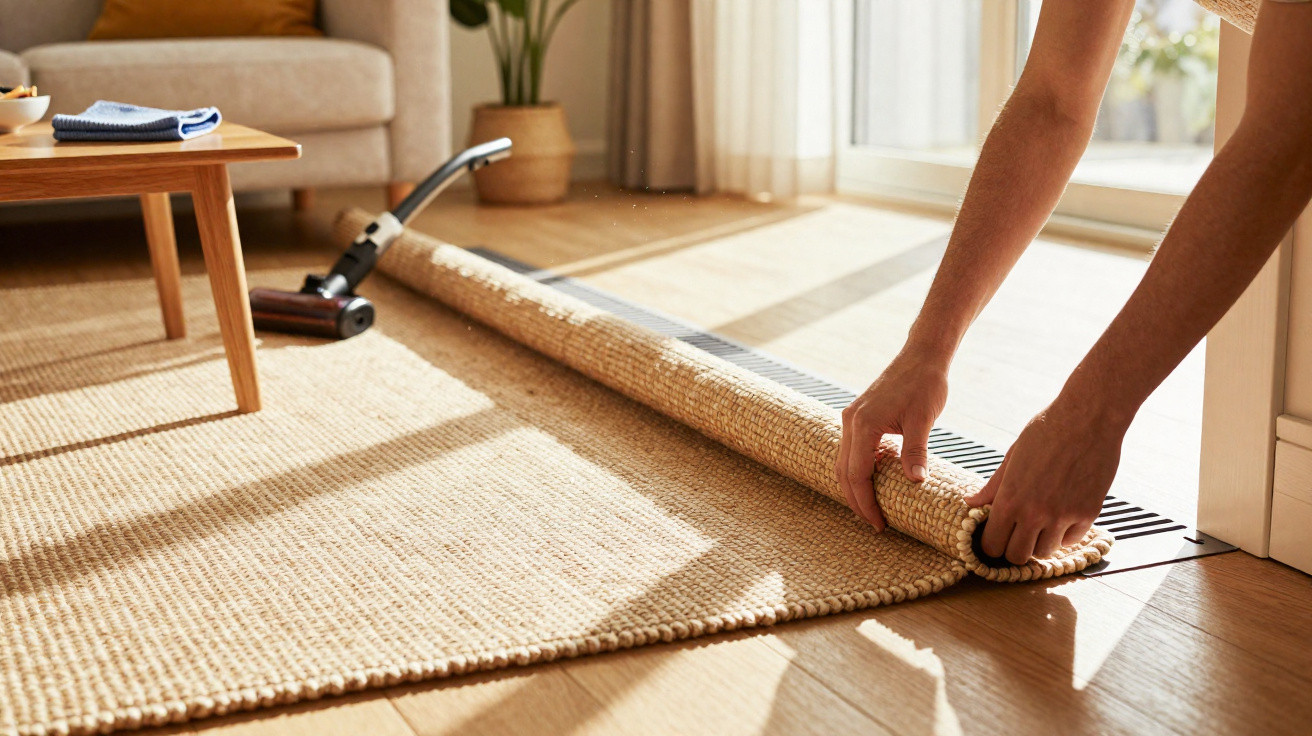
A fine, swirling haze hovers over the rug. Minute grey specks float up whenever somebody crosses the room, forming an uninvited, soundless storm. The home appears tidy and even carries the scent of washing powder, but the light tells a different tale.
Pause and look closely: your child races across the rug, the dog comes behind them, the door is opened, and the haze returns. It is a gentle burst that is barely noticeable in shadow but unmistakable in a shaft of sunlight. You vacuumed yesterday, and you vacuum every week. Why, then, does your home continue to seem dusty?
Perhaps dust itself is not the real issue. Perhaps the problem is the places where it prefers to settle and conceal itself.
When rugs quietly become dust machines
Many people assume that rugs capture dust and stop it circulating through the air. That is only partly correct. Less reassuringly, rugs positioned in the wrong places can function as enormous dust pumps. A footstep, a slamming door or a chair being dragged back can all send a small cloud into the room. Much of it remains unseen, but your nose, throat and allergies will notice it.
Dust gathers wherever airflow changes pace: beside doors, beneath windows and along lengthy corridors. Put a rug in one of these areas and you effectively create a dust filter that is repeatedly trodden on, shaken and disturbed. Its fibres hold on to particles, before feet and moving air propel them upwards again. It may look inviting, but it harbours dirt.
On a peaceful evening, the comfortable runner in your hallway can become a miniature storm beneath your feet. You step on it, and it responds with dust.
Consider a long corridor in a block of flats. It is common to lay a slim rug directly along the centre, running from the entrance to the sitting room. It softens the floor underfoot, reduces echoes and creates a homely look. Within a week, however, its edges may begin to turn up and a faint grey track can appear down the middle. Vacuuming improves its appearance, yet the vacuum may not penetrate the deepest fibres where fine dust sticks, particularly when there is no underlay or the underlay is too thin.
Whenever the front door opens, incoming air reaches the rug first. Shoes carry in outdoor debris, pet hair settles onto it and tiny flakes of skin drift down from clothing. Everything lands on that strip of fabric. The next person to pass through presses, compresses and releases that mixture into the air, at a child's chest height. You may hardly notice it unless sunlight falls across the hallway at precisely the right angle. Then it resembles glitter - the sort you regret ever buying.
The same effect can occur beneath a dining table, where chairs scrape and move, or beside the bed, where you step every morning and evening. Poorly positioned rugs make everyday movements into dust triggers.
The physics behind this domestic problem is straightforward. Dust is not simply “dirt”; it contains fibres, pollen, skin flakes, mites, soot and minute mineral particles. These materials respond to air movement and pressure. A rug lying in a busy route or a draught path occupies an area of constant pressure change. Every step squeezes its fibres before letting them spring back. That spring-like action sends dust into the air again.
Without a firm underlay, air can circulate freely below the rug. Each step then works like bellows, drawing air in and forcing it out with particles. Move the same rug away from draughts and main walking routes, and it will still collect dust, but it will not be “pumped” so frequently. The particles can settle deeper and remain there until intentional cleaning takes place. Rug placement can either settle dust or create a daily haze.
How to position rugs to settle dust rather than stir it
One straightforward principle can make a significant difference: rugs should interrupt traffic routes rather than lie directly beneath them. Move entrance rugs slightly away from the path of an opening door, so the first strong rush of air and contact from shoes reaches the floor instead of the fibres. Put a washable mat immediately inside the door for heavy dirt, then place a thicker decorative rug further into the room, where people walk more gently and slowly.
In corridors, skip the traditional long runner placed centrally from wall to wall. Choose several shorter rugs instead, leaving visible sections of flooring between them. This interrupts the repeated pressure pattern and limits the “pump” effect. Beneath a coffee table, allow the table to absorb most of the impact: where people rest their feet should have less cushioning, or be left uncovered where the room permits. A rug that outlines movement creates less disturbance than one placed directly in its path.
In a bedroom, slide the rug partly beneath the bed rather than centring it in front of the bed. The section underneath traps dust where airflow is slower. Its exposed edge still feels comfortable when you get up, while most of the particle-heavy surface stays away from constant foot traffic. In a child's bedroom, use smaller rugs as defined “play zones” and leave the main route through the room clearer and easier to deep-clean.
Rugs are often spread simply to fill bare areas: a large one in the sitting room, another in the hallway and one under the table. What tends to be overlooked is the route air actually takes. Frequently opened windows, radiators, vents and even the gap below the front door generate small air currents. When a rug lies directly in one of these routes, dust has no real opportunity to settle. It is lifted, deposited and lifted once more.
Many homes also contain layered arrangements: a rug on a slippery floor with no underlay and furniture resting only partly on it. Every wobble produces extra movement, friction and upward-pushing dust. Let us be honest: nobody really carries out that thorough daily clean involving turning over the rug and cleaning it meticulously. As a result, unsuitable placement quietly increases the dust burden from one week to the next.
Most of us have rolled up a rug “just to clean underneath” and ended up coughing because of the unseen cloud. That cloud was not created overnight. It developed through months of small choices about where and how the rug was used in the room.
“The way a rug sits in a room decides whether it becomes a soft filter or a dusty trampoline.”
- Avoid: putting thick rugs directly at entrances, beneath doors that swing open or across principal walkways.
- Prefer: positioning rugs partly beneath stable furniture, which anchors the fibres and limits movement.
- Upgrade: choose dense underlays that prevent air being pumped up from below and stop rugs flexing excessively.
Living with less dust without creating a showroom
There is something surprisingly satisfying about reconsidering a room from the perspective of dust. The aim is not to make your home resemble a sterile hotel; it is to decide where the everyday disturbance takes place. Move a hallway rug 30 cm away from the door. Reposition the sitting-room rug so that the main walking route runs beside it rather than across it. The home can suddenly seem calmer, even if nobody can explain exactly why.
For households affected by allergies, asthma or a child with a permanently sniffly nose, where rugs are placed becomes a health consideration as well as a decorating choice. Even minor adjustments can genuinely make the air feel lighter. On an afternoon with bright daylight, observe your rooms. Notice where dust starts to dance when somebody walks and where a sunbeam exposes a concealed mist. That is your guide. From that point, rugs become more than decoration: they act as quiet partners in how your home breathes.
| Key point | Detail | Benefit for the reader |
|---|---|---|
| Rugs in traffic routes pump dust | Every footstep compresses fibres and sends particles into the air | Explains why a “clean” home may still seem dusty |
| Airflow matters as much as cleaning | Doors, windows and vents create currents that disturb dust held by rugs | Provides practical pointers for moving or reducing rugs |
| Placement can settle or amplify dust | Rugs that frame, rather than sit beneath, main movement retain more dust safely | Suggests simple layout changes without purchasing new décor |


Comments
No comments yet. Be the first to comment!
Leave a Comment