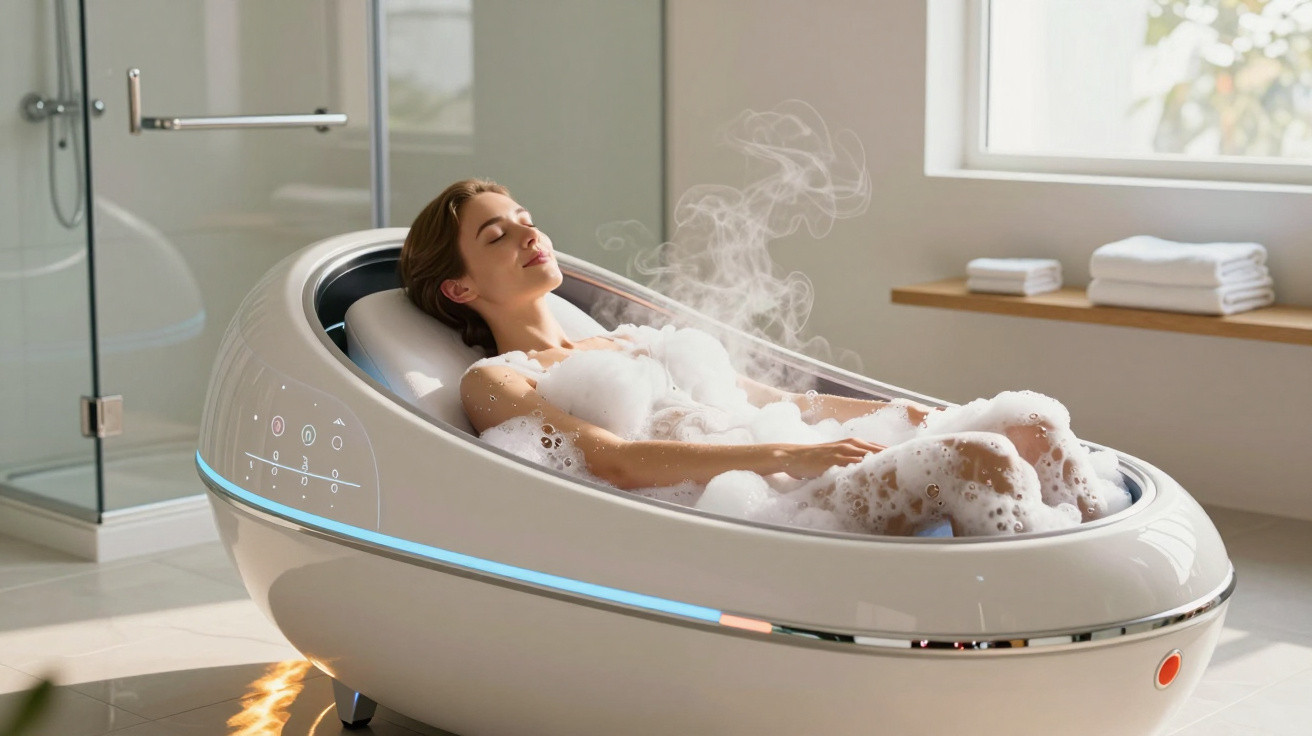
In Japan, a futuristic washing capsule is currently making headlines. It is designed to wash and dry the body completely within minutes, operating automatically with artificial intelligence and a wellness element. The idea may sound like science fiction, yet it could soon challenge the conventional shower enclosure in modern bathrooms.
The idea: washing like a human washing machine
The concept comes from Science Co., a Japanese company based in Osaka. Its machine is called “Mirai Ningen Sentakuki”, which loosely translates as a “washing machine for the human of the future”. Visually, it resembles an enclosed walk-in capsule where users sit comfortably.
The process appears remarkably straightforward: step inside, close the door and sit down – the machine takes care of everything else.
- The water supply begins automatically
- Billions of microbubbles clean the skin
- Sensor data controls temperature, pressure and lighting
- Built-in drying removes the need for towels
The full process is intended to take around 15 minutes. According to the promise, users emerge clean, dry and considerably more relaxed.
How microbubble cleaning works
At the heart of the system is water technology that uses exceptionally tiny air bubbles. These microbubbles circulate through the capsule and settle across the skin’s surface.
“The tiny bubbles are intended to loosen dirt particles and sebum from pores without the user needing to scrub or rub.”
Microbubbles are already used in wellness baths and specialist spa treatments. The new capsule turns this principle into a fully automated device for everyday use. Its aim is thorough yet especially gentle cleaning, which is also intended to suit sensitive skin.
A spa experience rather than a quick obligatory shower
The developers do not simply want to clean the user; they want the entire washing cycle to feel like a brief spa visit. Science Co. has therefore incorporated several layers of technology:
- Biometric sensors record heart rate and other body data.
- An AI system analyses these readings in real time.
- Water and air pressure adjust to the user’s physical condition.
- Lighting and sound can be controlled to encourage relaxation or stimulation.
Someone entering while stressed is intended to be welcomed by dimmed lighting, a gentler water flow and calming sounds. Those wanting to wake up in the morning may instead receive brighter lighting and stronger water pulses. The machine is designed to offer an experience closer to a personalised spa treatment than a purely functional shower.
Health monitoring: what the capsule measures
The concept becomes particularly interesting where hygiene and health monitoring meet. Throughout the washing cycle, the system continuously collects body data and may identify patterns.
“Over the longer term, the capsule is intended to provide indications of stress levels, recovery status and changes in key vital parameters.”
It is envisaged for, among others:
- older people wishing to keep a regular eye on their readings
- people with cardiovascular problems
- those with highly stressful everyday lives who want to understand their body better
For now, it remains a development project, but the vision extends much further. One day, the data could be sent to health apps or a treating doctor to spot trends early, such as a persistently raised pulse, unusual recovery patterns or periods of intense stress.
Towel-free drying: a complete cycle in 15 minutes
Once cleaning is complete, drying begins immediately inside the same capsule. An internal system directs warm air around the body and is intended to remove moisture from the skin quickly.
Based on the information available so far, the entire cycle – from stepping in to leaving the capsule – takes roughly a quarter of an hour. In theory, there is no need for towels, a hairdryer or a bathrobe. This could be a crucial advantage for people with reduced mobility, including older adults: less risk of slipping, no bending down and no rubbing dry.
Goodbye shower enclosure? What could really change in the bathroom
Naturally, the traditional shower enclosure will not disappear overnight. However, the project illustrates how significantly the bathroom’s role is changing. It is becoming less about basic personal hygiene alone and increasingly about a combination of:
- hygiene
- stress reduction
- digital health checks
Where a shower head, tap and glass door were once sufficient, terms such as sensors, AI and personalised programmes are now entering the conversation. The bathroom is turning into a high-tech space where wellness, care and data analysis come together.
Who would a human washing machine capsule suit?
Many issues remain unresolved, including price, space requirements, maintenance, and water and electricity consumption. However, the likely target groups are clear:
- Luxury hotels and spa facilities seeking to offer guests a spectacular point of difference
- Care homes and care facilities, where staff could save time and residents could be washed more safely
- Technology-minded households wishing to extend their smart home into the bathroom
For small city flats with limited bathroom space, the capsule is unlikely to be realistic at first. In new-build properties or high-end wellness bathrooms, however, it could appear sooner than expected.
Retro-futurism: the idea is older than many think
The dream of an automatic body-washing machine is not entirely new. A similar prototype was already exhibited at Expo in Osaka during the 1970s. At the time, the idea was held back by technological limitations and cost.
Conditions look different today: sensors are cheaper, compact computing power is widely available, and wellness has gained much greater social importance. The current capsule therefore revives an old vision with modern technology, reaching an audience already accustomed to smart everyday devices.
Opportunities, risks and unanswered questions
The potential benefits are obvious: less physical effort when washing, greater comfort, individually tailored programmes and a closer connection to personal health. People with disabilities or those of advanced age in particular could benefit greatly from such a solution.
At the same time, several concerns remain:
- Data protection: Where will the collected vital data go, and who will analyse it?
- Dependence on technology: What happens if there is a malfunction or software error halfway through a washing cycle?
- Resource consumption: Is the capsule genuinely more economical than an efficient shower?
- Acceptance: Will users feel comfortable inside an enclosed capsule, or will it cause unease instead?
There is also the question of whether a machine should take over personal care entirely. Many people deliberately see showering as a short moment to themselves, shaped by rituals and habits. A fully automated solution could alter that feeling, either positively or negatively depending on the individual.
How realistic is everyday life with the “human washing machine”?
Realistically, the conventional shower enclosure will remain dominant in ordinary bathrooms across German-speaking countries for a long time. At present, the new technology feels more like a glimpse of tomorrow’s premium hotels or care facilities with a high level of digitalisation.
It will be interesting to see how individual elements of the capsule develop independently. Health-monitoring sensors could, for instance, make their way into standard shower systems. Intelligent lighting and sound concepts can already be integrated relatively easily. Fully automated seated body washing would then represent the luxury end of this development.
Anyone planning a new bathroom in a few years’ time may increasingly ask themselves: do I really need only a simple shower enclosure, or should the room also serve as a wellness area, health station and technology playground? It is precisely at this intersection that the “human washing machine” is positioned, already prompting people to rethink the bathroom entirely.
Comments
No comments yet. Be the first to comment!
Leave a Comment