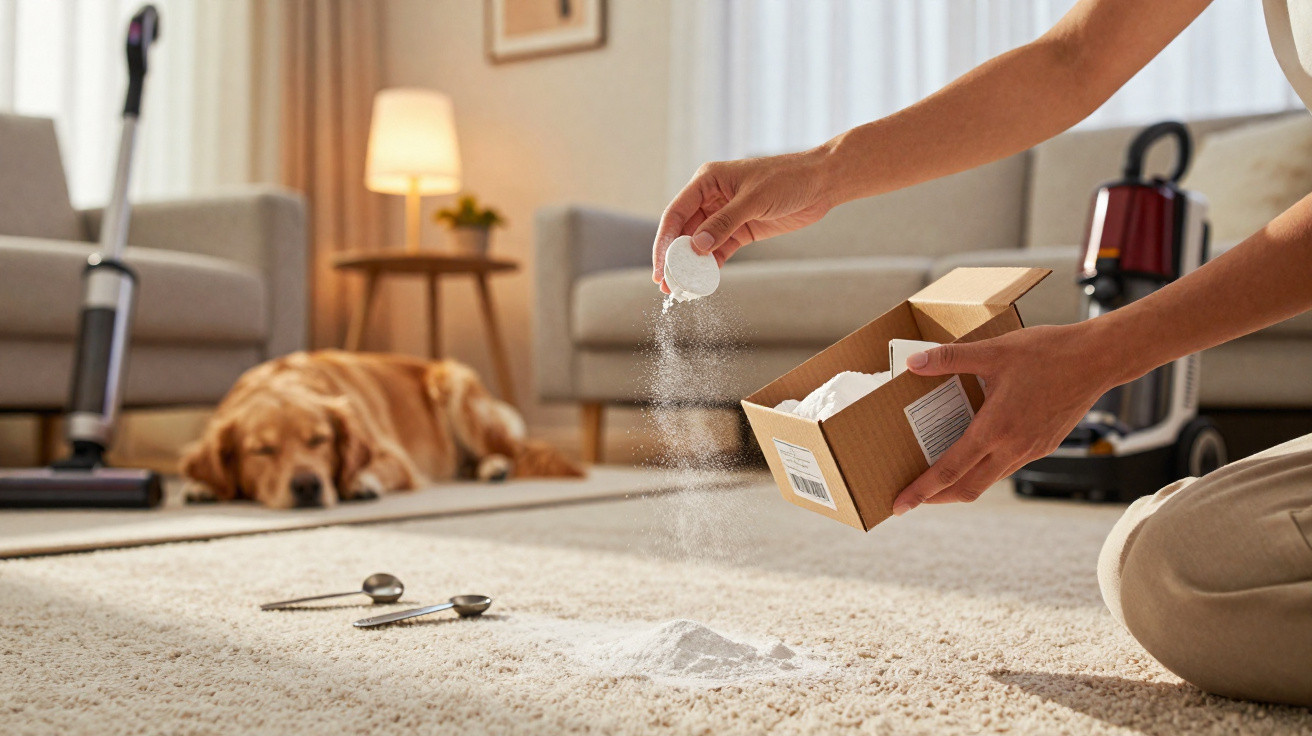
Sprinkling bicarbonate of soda over the living-room rug at night is a long-standing trick for cutting down odours, slight dampness and that stale, closed-in smell. The powder works while everyone is asleep, leaving the fibres with a more neutral aroma by morning.
Why does bicarbonate of soda help remove smells from a rug?
Rugs collect dust, perspiration from feet, hair, moisture in the air and pet odours. When these particles become trapped in the fibres, the living room can develop a stuffy smell, even after surface cleaning.
Bicarbonate of soda is a chemical compound with the formula NaHCO3 and is usually sold as a fine white powder. In the home, it is valued for helping to neutralise odours and absorb slight moisture.
This method is recommended for the following reasons:
- Odours: it can help lessen smells caused by mildew, dust and everyday use.
- Night-time: leaving it to work for several hours can improve the effect on the rug.
- Moisture: it absorbs some of the slight moisture held within the fibres.
- Pets: it softens mild smells, but does not replace washing where urine is present.
- Care: use only a small amount and vacuum it away completely afterwards.
How should you apply bicarbonate of soda to a rug at night?
Before sprinkling it on, remove any items from the rug and use a soft brush or vacuum cleaner to lift away loose dirt. Then distribute a thin layer of bicarbonate of soda across the area, without creating piles of powder or using an excessive amount.
It is best to apply it once nobody will be walking through the living room, and to keep children and pets away until vacuuming is complete. This prevents the powder from being carried around the home and improves contact between the bicarbonate of soda and the rug fibres.
How long should bicarbonate of soda be left to work?
For a noticeable result, leave it in place for at least 6 hours, although overnight is usually the most convenient option. On rugs with a stronger smell, 8 to 12 hours may be helpful, provided the room remains dry and well ventilated.
A rug with a more neutral smell
The key is allowing enough time for it to work while using only a small quantity.
A light coating performs better than a large amount of powder trapped between the fibres.
The following morning, slow vacuuming matters just as much as the application itself.
Do not use this method on wet rugs, as the bicarbonate of soda can turn into a paste and become difficult to remove. If there is a damp patch, dry it first, ventilate the room thoroughly, and only then use the product to control odour and residue.
The recommended process is:
- Vacuum the rug first to remove loose dust.
- Sprinkle a thin layer of bicarbonate of soda over the fibres.
- Leave it to work for at least 6 hours, preferably overnight.
- Keep children and pets away during this period.
- Vacuum carefully in the morning, ensuring no powder is left behind.
How do you vacuum properly the following morning?
In the morning, move the vacuum cleaner slowly in overlapping lines to draw out the bicarbonate of soda that has settled between the fibres. If the rug has a deep or shaggy pile, vacuum again in the opposite direction to remove deeper residues.
Afterwards, check for any white powder remaining on the surface or around the edges. If residue is visible, gently beat the rug outside or vacuum it once more, because built-up bicarbonate of soda can make it feel rough and give it a dull appearance.
To avoid leaving residue behind, do the following:
- Use a suitable attachment for rugs and carpets.
- Vacuum slowly rather than making overly quick passes.
- Go over the rug in two directions if it has a deep pile.
- Clean the vacuum filter if the machine loses suction.
When does this trick not replace a deep clean?
As with the warning that a washing-up sponge can build up dirt, bicarbonate of soda is useful for maintenance but cannot solve every problem on its own. Strong odours, visible mildew or organic stains require more careful cleaning.
Use this trick once a week, or whenever the rug starts to seem stuffy, without overdoing the quantity. With ventilation, regular vacuuming and prompt attention to stains, the living room will remain more pleasant, drier and have a cleaner smell.






Comments
No comments yet. Be the first to comment!
Leave a Comment