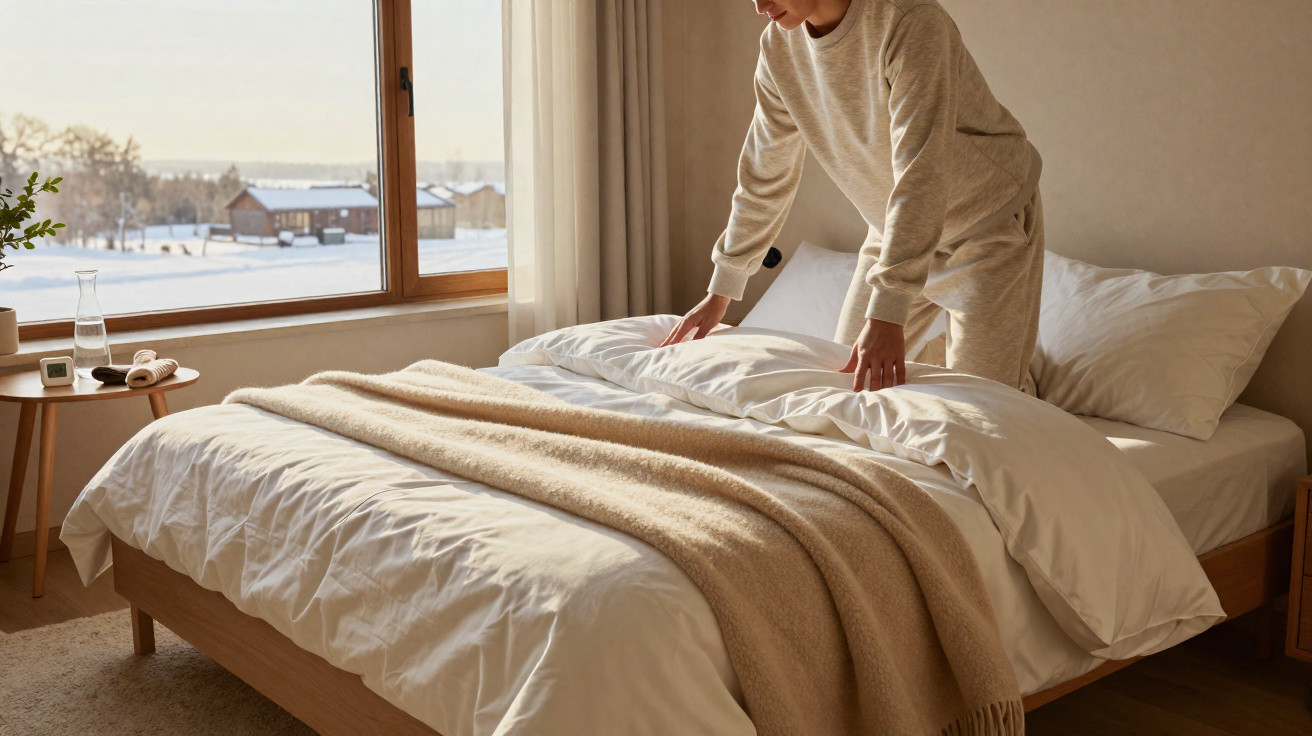
The bedroom is dark, the heating switched off an hour ago, and beyond the window you can almost imagine frost settling on the cars.
You get into bed looking for warmth, only to wake at 3am tangled in a sweaty duvet and socks. First you are freezing, then you are far too hot. The thermostat reads 18°C, yet your body plainly has other ideas.
Sleep specialists say this small choreography of sheets, blankets, pyjamas and bedroom temperature can determine the quality of your sleep right through to March. It is not the scented candle or the magnesium gummies. It is how you make up your bed. Seeing what experts genuinely do at home during winter is reassuringly ordinary: less of a flawless wellness ritual, more of a handful of sensible measures used every night.
One of those measures challenges the way most of us have always done things.
The understated science of a warm, non-sweaty winter bed
Picture a London sleep clinic at 10pm in January. People arrive cocooned in scarves and padded coats, before being asked to sleep beneath a duvet that appears unexpectedly light. There are no weighty throws or electric blankets, only layers with an almost minimalist look. The specialists focus on one issue: not whether the bed feels warm at 10pm, but whether your body temperature remains steady at 3am.
They discuss “thermoregulation” with the zeal football supporters usually save for the Premier League. They explain that your core temperature needs to fall slightly for sleep to begin, while your skin should remain pleasantly warm. If too much heat is held in, your body triggers micro-awakenings: brief disturbances you may not recall in the morning, but which can still leave you exhausted. Your bedding either supports that sensitive cooling process or works against it.
In one laboratory test shared with us, people sleeping beneath heavy synthetic duvets woke, on average, 2.3 times more often during the night than those using breathable bedding layers. There was no dramatic tossing and turning, merely small movements: a foot emerging from the covers, a duvet being shoved aside, or the brain being eased out of deep sleep. One researcher likened it to “trying to nap in a parked car with the heater on full blast” – comfortable initially, then strangely stifling.
The surprising part is that hardly anyone holds their bedding responsible. Instead, we blame the room, central heating, stress or late-night scrolling. But when clinics ask patients with insomnia to maintain a detailed sleep diary, a pattern emerges. Nights when they go to bed “a bit chilly but comfortable”, with lighter layers that are easy to alter, almost always receive better ratings. Nights with electric blankets on full power or duvets too thick for the season tend to include notes such as “woke up boiling at 4am”, “kicked duvet off” and “weird dreams, restless”. Put simply, staying warm without overheating often starts with being a little less warm at bedtime.
The winter bedding routine sleep experts really use
Ask a sleep scientist about their own winter habits and the reply is often disarmingly straightforward. They approach the bed like an onion: layers rather than thickness. That means a breathable fitted sheet, a lightweight flat sheet, a medium-weight duvet and a lighter blanket folded at the foot of the bed. Nothing more. The reasoning is simple: with one sleepy arm, you can push aside a layer instead of battling a huge 13.5 tog duvet in the dark.
Several experts advocate creating a “temperature gradient” in the bed: warmer at the core and cooler at the extremities. One Manchester-based specialist deliberately keeps her feet slightly cooler, wearing thinner socks or none at all, while adding more warmth around her torso and hips. Her body interprets this as secure and settled without crossing into sauna territory.
Their key principle is to begin the night just slightly cool, then treat the layers as a dimmer switch.
One sleep physiologist we spoke with recalls his first winter in a poorly insulated shared house in Leeds. The windows shook, his breath clouded the air, and he wanted to pile every available item onto the bed: two duvets, throws and a wool blanket passed down by a grandparent. Yet he woke drenched every night, stripping off layers as though he had completed a spin class.
Fed up, he turned his bedroom into a personal experiment. On the first night, he used one enormous winter duvet with no sheet. On the second, he tried a lighter duvet with a blanket. On the third, he chose a cotton sheet, mid-weight duvet, thin wool throw folded at the bottom and lighter socks in place of thick ones. The third arrangement was less “cosy” for Instagram, but it gave him his first uninterrupted night’s sleep in weeks. The throw remained untouched; the difference was that the cotton sheet allowed his body to release heat quietly.
In another small survey carried out at home, a sleep coach asked 40 clients to assess their winter sleep for two weeks with their usual bedding. She then asked them to switch to natural-fibre sheets and a slightly lower-tog duvet, with a throw added for flexibility. Around 70% said they had fewer night-time awakenings. This was not because their rooms were warmer – she had in fact asked them to lower the thermostat by one or two degrees – but because their beds changed from a “hot box” into an “adjustable nest”. It is a small sample, certainly, but the trend is notably consistent among people who monitor such things professionally.
Why might this help? One explanation lies in the way the body sheds heat. Your head, hands and feet work as remarkably effective little radiators. When they have light coverage, excess warmth can escape without affecting your core temperature too much. Encase them in thick, non-breathable materials, however, and your body has nowhere to direct surplus heat. It wakes you just enough to resolve the issue.
Experts also highlight moisture. It may not be pleasant to consider, but each night we lose roughly 200–400ml of water through breathing and sweat. With dense synthetic bedding, that moisture cannot escape effectively. Microclimate studies – using sensors placed beneath the duvet – show that humidity rises over the course of the night where airflow is poor. That sticky sensation of being “too warm and weirdly clammy” at 4am is not imagined.
The best winter bedding routines encourage a mild, continuous transfer of heat and moisture, rather than creating a sealed tent that holds warmth in. Think of a good winter coat that you can unzip once you board a packed bus. Adaptability is more useful than sheer force.
How to recreate the experts’ winter bedding routine at home without replacing your whole bed
Begin by making your winter bed with distinct, adaptable layers rather than a single solid mass of warmth. Most sleep specialists we spoke to prefer natural fibres against the skin: cotton or linen sheets, a light breathable duvet – commonly 7–10.5 tog instead of the heaviest option available – followed by a medium blanket or quilt that can be moved down the bed in moments.
Consider where you truly feel cold. If your shoulders and upper back need more warmth, place a lightweight throw there rather than increasing the tog across the entire duvet. If your feet are cold, use a hot water bottle at the bottom of the bed instead of wearing thick socks that retain heat all night. Many experts warm the bed rather than the room – with a hot water bottle or an electric blanket set on a 15-minute timer, then switched off before bed so it does not continue producing heat until morning.
Try to keep the bedroom a little cool when you enter it, while making the bed feel welcoming rather than scorching. That subtle contrast can set the tone for the night remarkably well.
There are also habits the experts quietly avoid. Many of us turn up the heating late in the evening “just to take the edge off” and leave it running until morning. The sleep specialists we interviewed generally do not do this. They favour a consistent, slightly cooler room – approximately 16–19°C – and let the bedding provide the warmth. Before adjusting the thermostat, they would add heavier curtains or a draught excluder.
The first common error is compensating for a cold flat with one huge, extra-thick duvet and flannel pyjamas, then wondering why you wake as if you spent the night in a greenhouse. The second is choosing synthetics for everything: polyester sheets, a microfibre duvet and fleece throws. They feel cosy at first, but become stuffy by 2am. If this is your current arrangement, there is no need to throw it all away. Replace either the sheet or duvet cover with cotton first, then notice how much more the bed can “breathe”.
On a personal level, they are not striving for perfection, either. One specialist told us she owns a fluffy oversized throw that is “terrible” for sleep, but perfect when you are ill or heartbroken. Let’s be honest: nobody really does this every single day. Even sleep scientists enjoy a lazy Sunday nest.
“Your winter bed shouldn’t feel like a fortress,” says Dr Hannah Lewis, a behavioural sleep expert. “It should feel like a conversation with your body. Warm enough to say ‘you’re safe’, light enough to say ‘you can change your mind at 3am’.”
For a more practical version, here is the shorthand many use when helping friends arrange a winter bed for the first time:
- One breathable fitted sheet, preferably cotton or linen
- One lightweight flat sheet, optional but favoured by most experts
- One medium-weight duvet, rather than the thickest available
- One or two lightweight blankets or quilts that are easy to move
- A slightly cool room and a bed that feels just warm enough when you get in
They also mention something less tangible: how it feels to get into bed. That initial contact is important. If it is too cold, your body tightens; if it is too hot, you can almost anticipate the burden of the weight. Between those extremes lies the quiet “ahhh” moment, when your shoulders immediately relax. During a difficult week, that small piece of comfort may matter as much as any sleep statistic.
The winter bed as a small act of self-respect
Once you begin paying attention to winter bedding, it becomes difficult to ignore. You see how much of the night can be spent bargaining with the duvet: one leg out and then back in; blanket on, then blanket off; pillow turned over to the cool side for a third time. Altering your routine is not about pursuing a perfect eight-hour chart on your sleep app. It is about making fewer bargains.
On a dreary Tuesday in February, when the sky has stayed the same shade of grey for nine uninterrupted hours, that can matter. You arrive home, take off your coat, and the sight of a carefully layered bed – neither chaotic nor overloaded – conveys a surprisingly powerful message. You did not simply throw it together. You made a modest plan for your own comfort.
We have all had the experience of climbing into bed and immediately knowing it is wrong for the night: too hot, too cold, too rough or too heavy. The routine sleep experts use does not remove that possibility altogether, but it makes the distance between “wrong” and “right” far smaller. Remove one layer or add one, and the bed changes with you.
What is interesting is how individual the approach becomes. Two people in the same home, sleeping side by side, might establish entirely different mini-routines: one uses an extra blanket, while the other has a lighter side of the duvet or chooses no socks rather than thermal ones. The shared principle is flexibility. The precise formula is your own.
| Key point | Detail | Why it matters to the reader |
|---|---|---|
| Prioritise layers | Layer a sheet, medium-weight duvet and lightweight blankets | Adjust warmth within seconds during the night |
| Breathable fibres | Use cotton, linen or fine wool next to the skin | Reduce night-time sweating and the sensation of stale air |
| Cool room, welcoming bed | Keep the room at 16–19°C and pre-warm the bed if needed | Sleep deeply without awakenings caused by overheating |
















Comments
No comments yet. Be the first to comment!
Leave a Comment