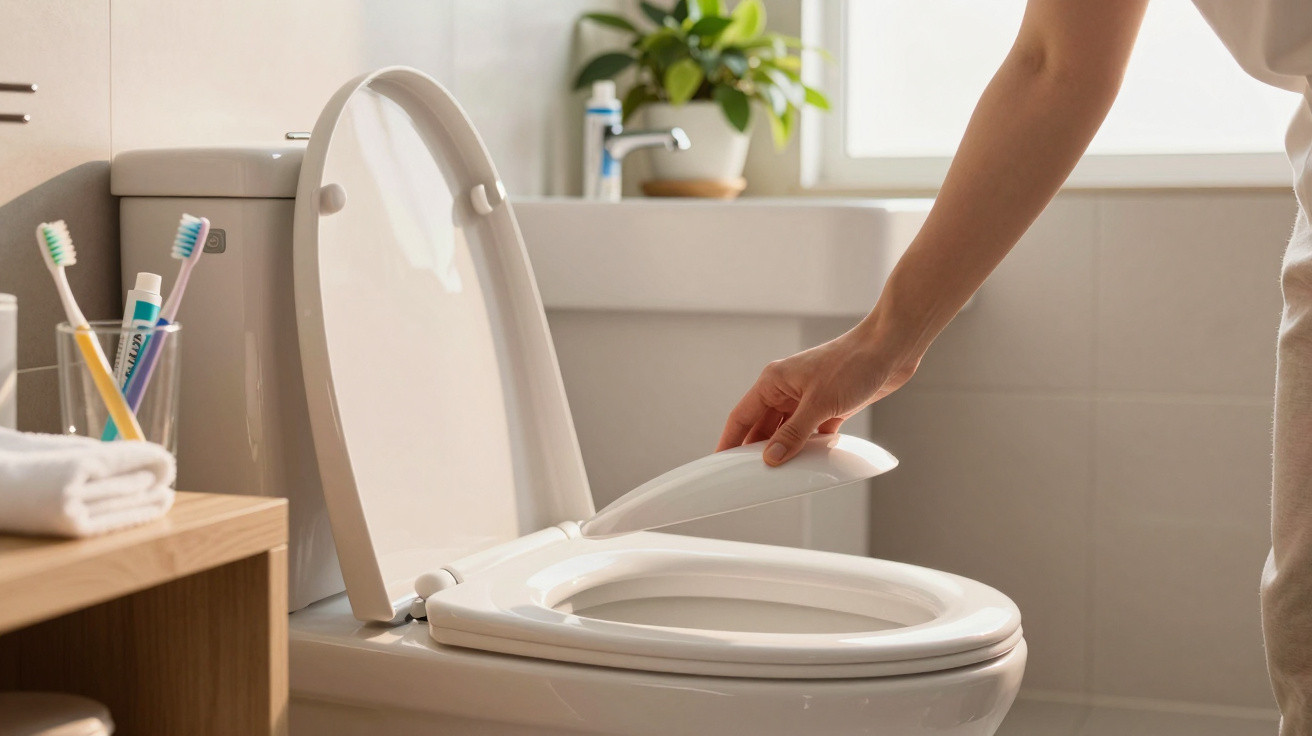
You are brushing your teeth at night, only half awake and scrolling through your phone with your free hand. The bathroom lighting is slightly unforgiving, but the routine is familiar: rinse, spit and take a quick look in the mirror. You put the toothbrush back in its holder and, without a second thought, reach for the flush with the lid fully raised. The water rushes away, you wash your hands, switch off the light and leave feeling fresh.
But behind you, something happened that you neither saw nor felt - and certainly did not invite.
A tiny, invisible storm has just settled where your toothbrush is kept.
What really happens when you flush with the lid up
The next time you flush, think of the bowl as a miniature volcano. That surge of water does not simply travel downwards: it also shoots upwards. Far upwards.
Researchers have a suitably polite term for it: “toilet plume”. It sounds almost harmless until you remember that it is a haze of microscopic droplets which may contain traces of urine, faeces and the bacteria found within them.
You cannot see or feel it, but your toothbrush - waiting patiently on the sink a metre away - sits directly in its landing area.
A University of Colorado team recently used lasers to follow what occurs when a public toilet is flushed. Their footage is fascinating, if also rather unsettling. Within just 8 seconds, droplets can rise as high as 1.5 metres, with some remaining in the room for minutes afterwards.
Now picture your compact bathroom at home, perhaps with limited ventilation and everything close together: towels, a make-up bag and the children’s bath toys.
Toilet plume does not observe personal boundaries. It simply disperses.
Here is the straightforward reality: your mouth should not be where what leaves that bowl ends up. Even a toilet that appears spotless has water and surfaces disturbed by every flush. The force breaks material into micro-droplets that may carry bacteria such as E. coli, along with other unwanted visitors.
Those particles require very little opportunity. They drift, land on level surfaces and attach themselves to toothbrush bristles that can remain damp for hours.
You will not taste or smell them. Still, over time, you are brushing your teeth in a room where an open toilet has effectively seasoned the air.
How to protect your toothbrush (and your mouth) starting tonight
The first step is surprisingly easy: shut the lid before flushing. Do it every time - in the morning, at night or after a quick wee between Zoom calls. Make it part of the same action.
When you have finished, reach for the lid, close it and then flush. It adds one second to your routine while preventing an entire invisible display of airborne droplets.
Is it flawless protection? No. However, studies indicate that it greatly reduces the spray, particularly droplets travelling the furthest.
The second step is reconsidering where, and how, your toothbrush is stored. If it is positioned beside the toilet, as it is in many small bathrooms, move it further away. Keeping it at least one metre from the bowl is a sensible guideline.
Better still, use a ventilated cover or store the brush in a cupboard where it can dry while the door is left slightly ajar.
Honestly, few people manage this perfectly every day. We forget, get rushed and decide it is probably all right. The aim is not perfection; it is reducing the everyday exposure to “toilet plume” that your mouth never requested.
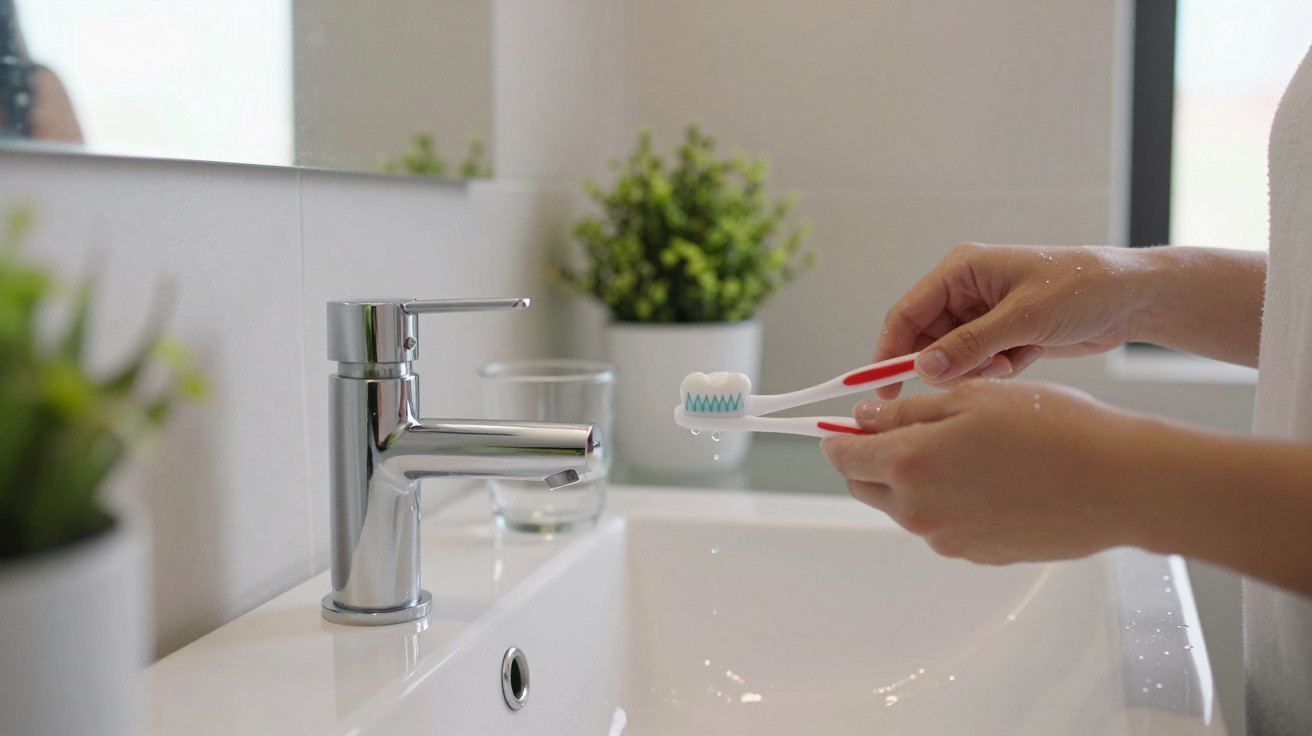
Your toothbrush itself also needs attention. Dentists recommend rinsing it well after use, shaking away surplus water and allowing it to air-dry upright. Do not share brushes, throw everyone’s brushes into the same murky holder or keep one indefinitely “because it still looks okay.”
Your toothbrush is a tool that regularly enters your body by the front door: your mouth.
“Most people would be shocked to learn what can end up on a toothbrush stored in a bathroom with an uncovered toilet,” says one dental hygienist I spoke to. “Closing the lid is one of the simplest hygiene upgrades you can adopt at home.”
- Close the toilet lid before every flush
- Keep toothbrushes as far from the bowl as possible
- Choose a ventilated cover or cupboard rather than an airtight box
- Rinse and dry brushes thoroughly after every use
- Replace your toothbrush about every 3 months, or after illness
Rethinking the bathroom as a shared ecosystem
When you begin to view your bathroom as a small ecosystem rather than a neutral white room, your perspective shifts. The toilet, sink, skincare products, children’s step stool, razor and towels all occupy the same air.
That does not mean becoming anxious or entering the room wearing gloves and a mask. It means adopting one quiet, sensible rule: keep the bowl closed when it erupts.
Closing the lid before flushing is a small act of setting boundaries. It says: the toilet remains the toilet. My mouth remains my mouth.
People who discover toilet plume often start spotting other habits too: leaving the lid open throughout the day, keeping make-up brushes beside the bowl or placing a phone on the cistern before later holding it against their cheek.
There is nearly always an inexpensive, straightforward solution. Relocate an item, wipe a surface more frequently or replace an ageing toothbrush.
None of these steps will turn your bathroom into a sterile space, and that is not the objective. The objective is to stop bacteria having a VIP route from the toilet directly to your toothbrush.
This subject often provokes powerful reactions - disgust, disbelief and “great, one more thing to worry about.” But once that initial reaction fades, one practical truth remains. You can’t control every germ in your life, but you can close a lid and move a toothbrush.
Perhaps you will do it tonight. Perhaps you will share this with the person who always forgets.
Either way, when you next hear water rushing through the bowl, you may imagine that unseen fountain in the air - and quietly choose to keep it away from your toothbrush.
| Key point | Detail | Value for the reader |
|---|---|---|
| Closing the lid reduces spray | Restricts “toilet plume” droplets from spreading around the bathroom | Less unseen contamination on toothbrushes and personal belongings |
| Storing brushes away from the bowl | Keep them at least 1 metre away, ideally in a cupboard or beneath a ventilated cover | Lowers everyday exposure to airborne bathroom bacteria |
| Simple care habits | Rinse, dry upright and replace every 3 months or after illness | Supports oral health and reduces the risk of repeated infections |



Comments
No comments yet. Be the first to comment!
Leave a Comment