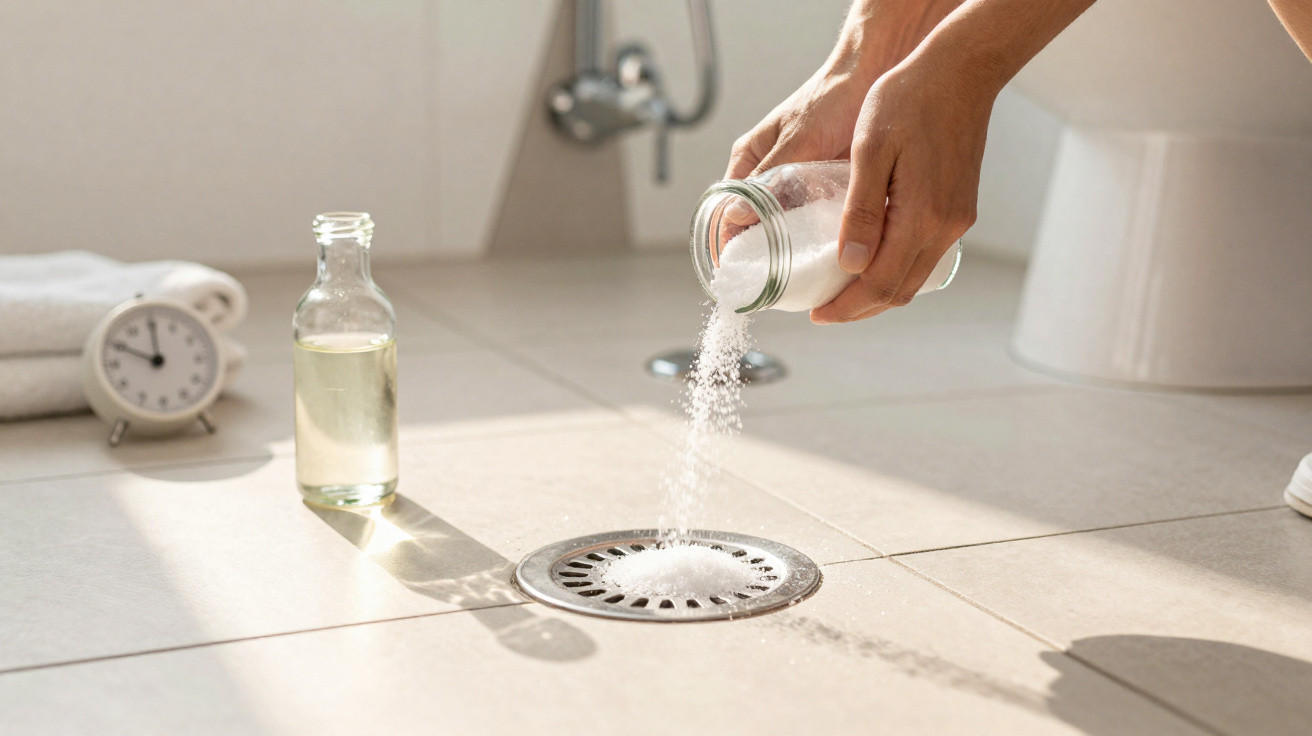
Sprinkling coarse salt down the bathroom drain once a week can help cut down unpleasant smells, loosen light build-up and keep the pipework cleaner between proper cleans. The salt provides gentle abrasion against the inside of the pipe and can help draw moisture out of some of the organic grime that collects there. It works best as routine upkeep rather than a fix for a serious blockage.
What does coarse salt solve in a bathroom drain?
Bathroom drains commonly collect hair, soap residue, body oils, creams, dust and biofilm - a sticky layer that traps odours inside the pipework. Scented products may mask the smell for a few hours, but they often do not reach the grime stuck to the inner walls.
Coarse salt is useful for this kind of maintenance. Dropped into the drain dry and followed by hot water, it can help shift recent residue, reduce stagnant dampness and lessen the odour that rises from the drain after a shower.
What is the ideal amount to use?
For a typical bathroom drain, the safest guideline is 1 to 2 tablespoons of coarse salt. That amount is enough to work without risking build-up inside the pipe.
Use it in this straightforward order:
- Remove hair and any visible dirt from the drain cover.
- Tip 1 or 2 tablespoons of coarse salt straight into the drain.
- Pour in about 500 ml of hot water (hot, but not boiling).
- Leave the drain unused for 15 to 30 minutes.
- Rinse through with running water to flush away the loosened residue.
How long should you leave it to work?
Allow at least 15 minutes so the salt can contact the damp grime and the hot water can soften soap scum and oily residue. If the smell is stronger, you can leave it for up to 30 minutes before rinsing.
There is no need to leave the salt in overnight every week. If your bathroom has older plumbing, metal pipes or a history of blockages, repeated long soaks may not be the best approach. In those situations, mechanical maintenance and cleaning the trap usually give better results.
How to combine it with other ingredients without damaging the plumbing
Coarse salt can be paired with bicarbonate of soda to boost its effect against odours and light organic grime. White vinegar can also be used occasionally, but sparingly - and never alongside harsh products.
For a more thorough clean, do it like this:
- Add 1 tablespoon of coarse salt to the drain.
- Add 1 tablespoon of bicarbonate of soda.
- Pour in about 120 ml of white vinegar and wait for the fizzing to subside.
- Leave for 15 minutes, then finish with hot water.
- Never combine this with bleach, chlorine or chemical drain cleaners.
How often should you repeat this in the bathroom?
Once a week is a sensible routine for drains used daily, especially in the shower. In a guest bathroom or a space used less often, doing it every two weeks can be enough - but it is still important to run water occasionally so the water seal does not dry out and release unpleasant smells.
Coarse salt works best alongside hands-on cleaning of the drain cover, removing hair and flushing through with hot water. If water drains slowly, backs up through the drain, or the smell is more like strong sewer odour, the issue is no longer light residue: there may be an obstruction, a dry trap, a sealing fault or inadequate ventilation in the pipework.













Comments
No comments yet. Be the first to comment!
Leave a Comment