The first thing that registers is not the chilly tile beneath your feet.
It is the feeble trickle landing on your shoulders like weary summer rain. You turn the control a little further, waiting for a miracle, but the water simply… gives up. Rather than properly waking you, the shower leaves you partly rinsed and thoroughly irritated, watching a spray that seems stuck in forced eco mode.
Naturally, you blame the showerhead. You browse online, compare “high pressure” options with bold, aggressive names and ask yourself whether the £80 model could transform your mornings.
But in many bathrooms, the fitting itself is not the real issue. Its height is. Where the showerhead is placed on the wall can quietly undermine your water pressure, and this seemingly minor detail can make a remarkably large difference.
Why showerhead height quietly reduces water pressure
Take a proper look at the showerhead in your bathroom. Ignore its styling and the number of jets for a moment; focus on its position on the wall. Set too high, the spray drifts down as a loose mist. Set too low, it strikes your chest before it has had the chance to spread.
Shower pressure is influenced by more than the pipes and the local water supply. Distance, angle and gravity matter too. When the head is mounted too high, water has extra room to fan out and break into softer droplets before reaching your skin. Position it nearer and align it more effectively with your body, and exactly the same flow can feel fuller, denser and more like a hotel shower.
In certain homes, the actual water pressure is perfectly adequate. The installation is simply wasting it. An unsuitable height quietly takes away the force you are already paying for.
A London plumber told me that he encounters the same situation every week. A homeowner calls, convinced that their pressure is dreadful, and shows him a drawer full of showerheads that failed to solve the problem. He uses a basic tester to check the pipe flow, and the readings are normal. Then he looks upwards: the showerhead is almost touching the ceiling and aimed towards the opposite wall.
He drops it by 20–30 centimetres, changes the angle and asks the owner to try it. The response is nearly always identical: widened eyes, followed by a brief laugh and, occasionally, a mild swear word about the money spent on expensive chrome fittings.
A US survey carried out by a bathroom fittings retailer reached a similar conclusion in numerical form. Of the 500 respondents complaining of “low pressure”, more than a third were facing height and angle problems rather than a genuine pressure fault. They had sufficient water; they were simply not directing it effectively.
Picture the water leaving your shower as energy travelling towards you. The longer it travels before making contact, the more it spreads and loses strength. Raising the head excessively gives that energy more time to disperse through the air. Lowering it shortens the route.
The spray pattern also plays a part. Many showerheads release water in a cone. The farther that cone travels, the broader it becomes, leaving more noticeable “gaps” between the jets. With the showerhead closer, the cone remains tighter, droplets are more concentrated and your skin perceives greater pressure.
Gravity has a subtle effect as well. When water falls from a considerable height, droplets can break apart and scatter, reducing their impact. A position around shoulder level or just above head height often delivers a denser, more targeted sensation. The litres per minute remain the same, but the feeling across your back is very different.
How to adjust your showerhead height for noticeable results
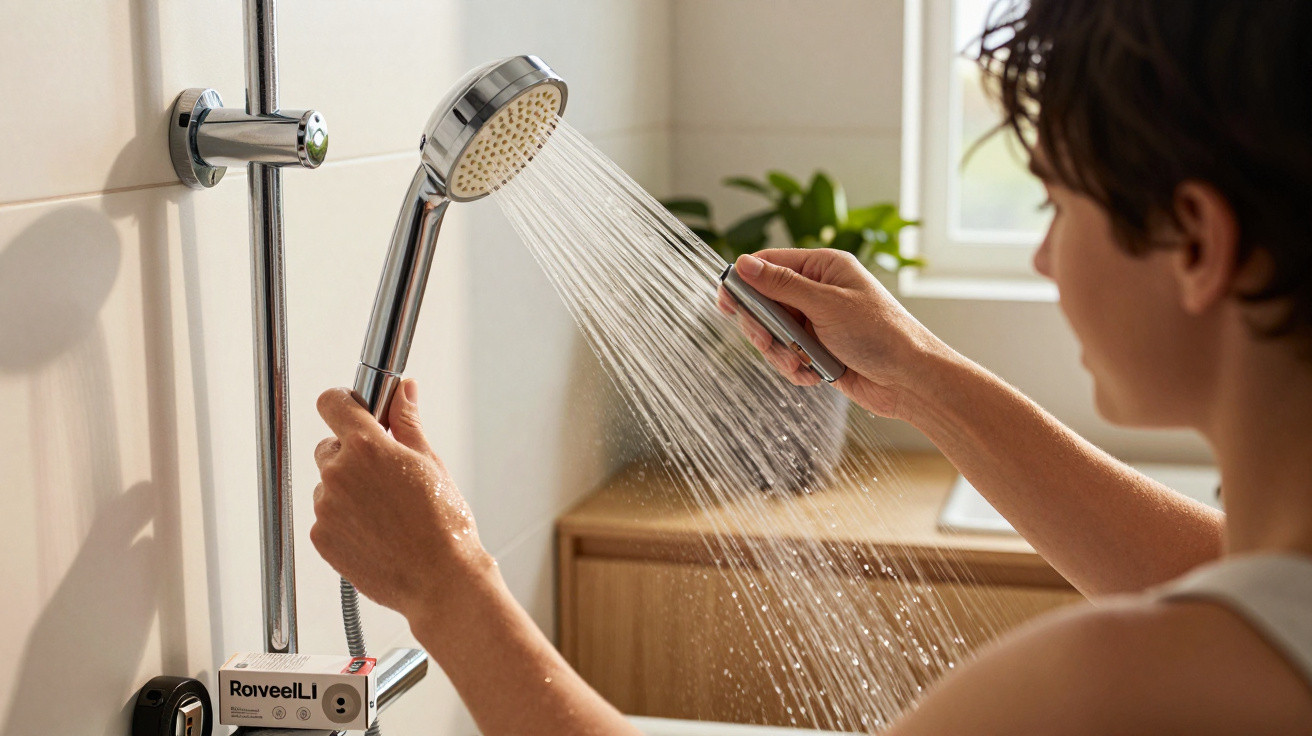
Usually, the easiest solution is not to replace anything, but to reposition what you already own. Stand where you would normally shower, then imagine a straight line from your nose to the wall. The best showerhead height will often be somewhere between the top of your head and 15–20 cm above it.
If your shower has an adjustable rail, move the holder down and try it during a shower. Put the theory aside and pay attention to the result: do the droplets seem denser? Does shampoo rinse away in fewer seconds? Lowering it by only the width of your hand can sometimes turn a disappointing trickle into a shower that genuinely wakes you up.
No rail installed? A basic swivel-arm extender may make all the difference. These small S-shaped or L-shaped arms bring the head a little lower and farther forward, allowing water to reach your body directly instead of disappearing into the middle of the bath.
This is also where the emotional element comes in. We rarely challenge the arrangement of a bathroom because it feels as though it “came like that” and must simply be accepted. On a Monday morning, nobody is keen to unscrew fittings or reconsider spray angles. Let’s be honest: nobody really does that every day.
That is precisely why small, one-off adjustments can be so effective. Lower the showerhead once and you benefit from a better shower every day afterwards. Taller people may need to balance headroom with water force. For shorter people, bringing the head down can be an immediate improvement.
A frequent mistake is pointing the spray too horizontally in an attempt to keep your hair dry. This commonly causes the water to spread and lose its impact. Instead, try a more vertical setting, closer to a gentle “rainfall” that falls directly onto your shoulders. It may feel much more powerful without any plumbing work at all.
“Nine times out of ten, I don’t ‘fix’ the pressure,” says Marc, a French plumber who works in small Paris flats. “I fix the geometry. People think they need new pipes. Most of them just need the water to hit where their body actually is.”
A few straightforward checks can prevent frustration and unnecessary spending:
- Measure your existing flow by filling a 1-litre jug beneath the showerhead and timing it.
- Change the height and angle first, then test again before purchasing a replacement head.
- Select the narrowest spray mode whenever you want the greatest “kick”.
- Check where the most concentrated section of the spray falls: on your head, neck, chest or into empty space.
- Where several people use the same bathroom, identify a “sweet spot” on the rail that suits most users.
Rethinking what “bad pressure” actually means
After experimenting with the height, you may notice something interesting: your idea of “good pressure” shifts. It becomes less about sheer force and more about the way water reaches your body. A slightly lower showerhead that directs a focused stream onto your shoulders or upper back will often feel much better than a harsh spray that splashes across half the bathroom.
We have all stepped into a hotel shower and wondered: “Why does this feel so much better than at home?” The explanation is often not a concealed high-tech system. More commonly, it is a well-positioned showerhead at the correct height, with a spray that does not waste water as a thin mist around you.
Changing showerhead height is one of those modest household adjustments that can quietly improve your day without requiring a large budget or renovation. You loosen a screw, move a rail or tilt an arm. Suddenly, the same water you used yesterday feels fuller, warmer and more enveloping. It is the sort of difference you notice at 6:45 a.m., when your mind is still half asleep and you appreciate anything that makes getting up a little easier.
| Key point | Detail | Benefit for the reader |
|---|---|---|
| Ideal height | Between head height and approximately 20 cm above it | Helps concentrate the spray and creates the sensation of greater pressure without altering the pipes |
| Spray angle | Slightly downward, directed towards the shoulders/torso | Limits dispersion, improves rinsing and increases comfort |
| Adjust before replacing | Test repositioning, a shower arm or a rail adjustment | Prevents unnecessary purchases and can produce immediate results |

Comments
No comments yet. Be the first to comment!
Leave a Comment