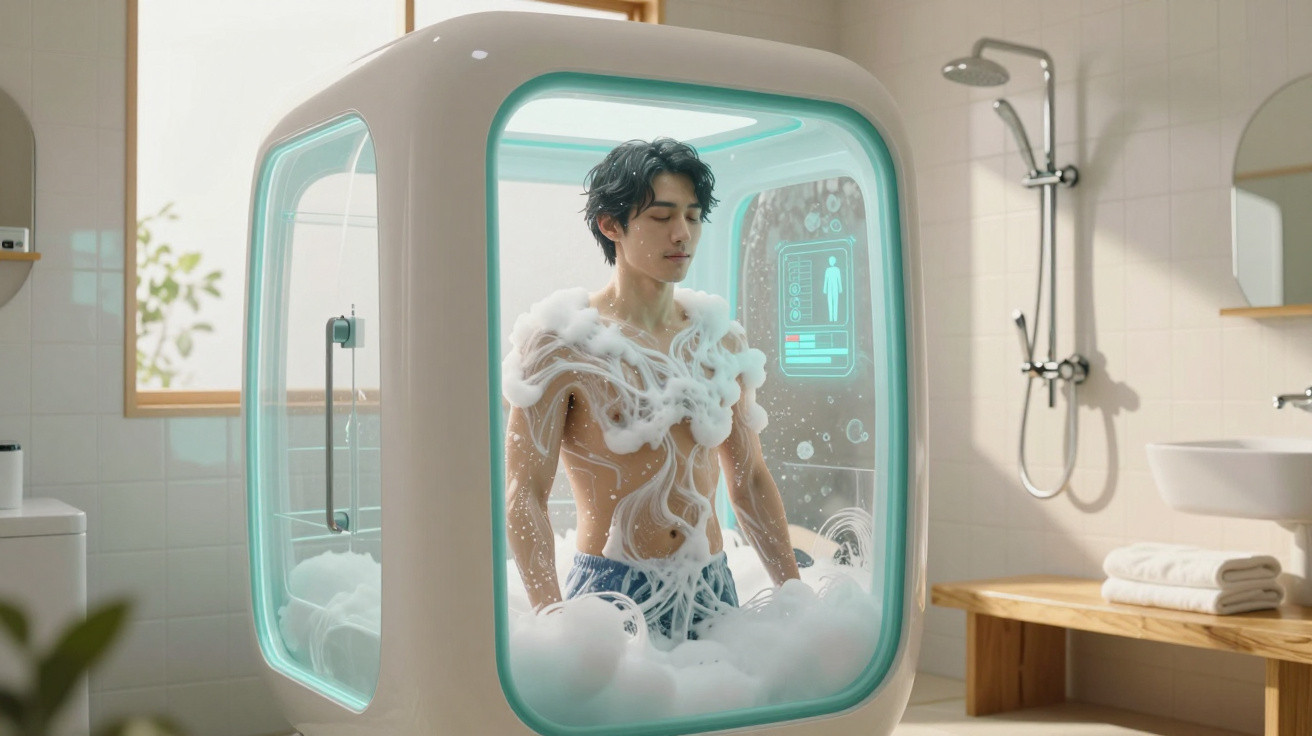
Engineers in Osaka are developing a futuristic washing capsule that could replace the conventional shower area in modern bathrooms. The machine is intended to cleanse and pamper the body in around 15 minutes while also recording important health data – all controlled by Artificial Intelligence.
What is really behind the “human washing machine”
The machine is called “Mirai Ningen Sentakuki”, loosely translated as “washing machine for the human of tomorrow”. Essentially, it is an enclosed capsule in which a person sits upright in relative comfort while the entire washing process takes place automatically.
Step inside, close the door and press start: from that point, the system takes over. The capsule fills with water, specialised jets activate a microbubble system, sensors monitor body data, and an AI system tailors every stage to the person inside.
The vision: body care, wellness and a health check combined in one 15-minute “wash programme”.
How a wash cycle works inside the capsule
1. Entering the capsule and automatic adjustment
At the start, the user takes a seat inside the capsule. Biometric sensors record heart rate, skin temperature and other parameters. This information forms the basis of a personalised programme – for example, gentler water jets for sensitive skin or more calming lighting effects when stress levels are elevated.
2. Cleansing with microbubbles rather than scrubbing
At the heart of the technology is a bath containing extremely fine air bubbles. These microbubbles are designed to reach even the smallest creases in the skin and lift away dirt and sebum particles without vigorous rubbing or harsh cleansing products.
- gentle removal of dirt from the skin
- potentially reduced use of soap and shampoo
- less friction, making it potentially more suitable for sensitive skin
- even cleansing, including areas that are difficult to reach
Comparable systems are already used in spa facilities and specialist wellness baths, although here they are consistently automated and combined with sensors.
3. A wellness programme included
The developers do not want the machine to be seen solely as a cleaning device. A compact wellness programme runs alongside body care. Depending on the user’s condition, the AI system controls:
- the water temperature
- the force and direction of the water jets
- the colour and brightness of the interior lighting
- ambient sounds such as ocean waves or quiet music
This makes the wash cycle feel more like a private spa treatment than a conventional shower. At the same time, the system continues gathering health data in order to identify trends and changes.
4. Drying inside the capsule
Once cleansing is complete, a drying cycle begins. Warm air and directed airflow are intended to dry the whole body, eliminating the need to use a towel. On leaving the capsule, the user is – at least according to the concept – clean, dry and ideally more relaxed than before.
Why the traditional shower cubicle is under pressure
Bathroom design has already been moving away from cramped shower cubicles towards open, level-access solutions. A fully automated capsule would shift the bathroom’s role even further: from a purely functional room to a connected health and wellness space.
Several developments support this direction:
- Convenience: Households are automating more and more tasks, from robot vacuum cleaners to smart heating systems. A “washing machine for humans” fits this trend.
- An ageing population: Showering independently can be tiring and risky for older people or those with impairments. A seated, guided washing process could offer greater safety.
- Everyday health data: Wearables have long tracked pulse and sleep. A washing capsule that also records vital signs while the user is at rest would add another source of data.
Whether such devices make their way into private homes will depend heavily on cost, space requirements and safety standards. Initial applications appear more likely in care homes, rehabilitation clinics, high-end hotels or exclusive spa settings.
What sensors could measure during a body wash cycle
The capsule does more than clean the body’s surface. It continuously collects data that could become medically relevant, or at least useful for preventative purposes, in future.
| Measurement | Possible benefit |
|---|---|
| Heart rate | Assessing physical strain, stress levels and recovery capacity |
| Skin temperature | Identifying indications of infections or circulation problems |
| Breathing rate | Detecting stress patterns or breathing irregularities |
| Movement data inside the capsule | Monitoring instability while seated, tremors or pain responses |
With regular use, this information could reveal trends – such as whether someone appears increasingly stressed over several weeks or whether their circulation is becoming less stable. For hospitals, care providers or supported living schemes, it could provide an additional source of information.
Opportunities and risks in everyday use
The concept sounds appealing, but it also raises questions. First, there is reliability: water, electronics and AI systems inside an enclosed space require rigorous safety standards and extensive maintenance. A malfunction during a wash cycle would not merely be inconvenient; depending on the user group, it could also be dangerous.
Data protection is another issue. Health information is regarded as particularly sensitive. Anyone using such a capsule needs to know where the readings are stored, who can access them and whether they might be linked to other services.
Psychologically, the idea will not appeal to everyone either. Not everybody wants to sit in an enclosed capsule controlled from outside. Claustrophobia, a sense of losing control, or simply a preference for a conventional quick shower all remain arguments for the familiar shower head.
Who could benefit most from a “human washing machine”
Despite these concerns, the technology could offer genuine value for certain groups:
- older people who feel unsteady when standing in the shower
- people requiring care who need support with washing
- rehabilitation patients recovering from operations or accidents
- luxury hotels and spa businesses focused on high-tech wellness
- people who want to optimise their everyday routines to an extreme degree
Especially in professional settings, a standardised, documented washing procedure that is less physically demanding could ease the burden on staff and help maintain hygiene standards.
How realistic is a human washing machine in the home bathroom?
For now, this remains an ambitious project rather than a mass-market product. Although some of the technology is based on established methods, bringing it together in a compact capsule appears complex and expensive. Manufacturers still need to address maintenance, electricity and water consumption, cleaning the machine itself and long-term reliability.
It also raises further practical questions for ordinary homes: would such a capsule fit into a standard bathroom at all? How heavy would it be, what connections would it need, and how noisy would it be in operation? In rented flats especially, noise and vibrations could quickly become an issue in a block of flats.
It will also be interesting to see how energy use compares with that of a shower or bath. Microbubbles may reduce water consumption, but sensors, controls and drying require more electricity – and ultimately, acceptance will depend on actual efficiency.
What terms such as microbubbles and an AI capsule mean
The term microbubbles refers to tiny air bubbles that are significantly smaller than those in an ordinary bubble bath. Their larger surface area per volume of water allows them to capture dirt particles more efficiently. The water also feels softer, which many people find more pleasant.
Describing it as an AI-controlled capsule does not mean that the machine “thinks” like a human being. Instead, it uses algorithms to identify patterns in measurement data and adjust settings automatically: for instance, slightly lowering the water temperature if heart rate and skin temperature rise, or dimming the lighting to create a more calming effect.
Whether this technology will ultimately displace the traditional shower area remains uncertain. What is clear is that the bathroom is increasingly becoming a place where high technology and hygiene meet – and where a “human washing machine” from Japan offers at least a glimpse of possible future scenarios.

Comments
No comments yet. Be the first to comment!
Leave a Comment