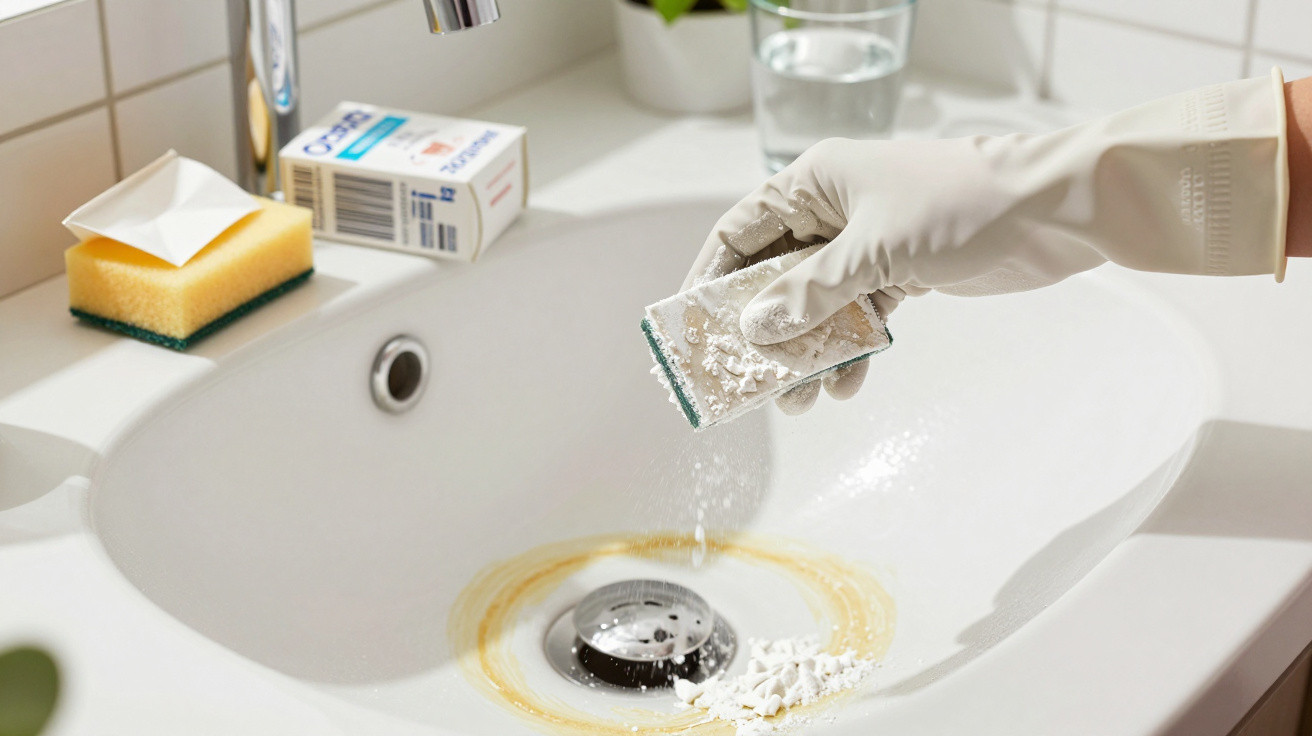
You have tried everything already: expensive bathroom spray, scrubbing until your fingers ache, even briefly wondering whether you are the problem. Then someone casually places a small, unremarkable tub on the edge of the basin: baking powder. The stuff that is meant to make cakes rise. You inwardly scoff, yet sprinkle some over the stain, dampen it slightly – and, a few minutes later, see the dull discolouration breaking up, becoming lighter and losing its sharp edges. Suddenly, the washbasin looks as it always does in the adverts. And you wonder: why does nobody tell you about this sooner?
The everyday creep of yellow staining
We all know those yellow marks that quietly establish themselves in the washbasin. At first, there is only the faintest tinge: a trace of tea, coffee or toothpaste around the plughole. A few weeks on, the white surface looks tired, as though the basin has not slept well. You wipe across it, water beads away, yet the colour remains like a shadow. This is exactly when you start feeling a little embarrassed about your bathroom.
Many homes have that one particular problem area. A flatmate in a shared house in Cologne once told me that, before every date, she would quickly run a damp cloth around the basin. The yellow ring around the plughole refused to budge – a combination of hard tap water, toothpaste residue and make-up traces. According to a representative survey, people spend more than an hour a week cleaning their bathrooms on average, yet many still say that marks in the washbasin never fully disappear. Eventually, you almost accept the yellow tinge as one of the home’s quirks.
That is where baking powder comes in, in a way that is almost outrageously simple. At its heart, this powder is simply a blend of sodium bicarbonate and an acidic ingredient. When it meets moisture, small reactions take place that tackle grease, colour pigments and deposits. The powder works like gentle, microscopic sandpaper: not harsh, but persistent. This is why yellow marks in the washbasin can visibly brighten, often without hours of exhausting effort.
How baking powder works in the washbasin
Trying it requires remarkably little: one teaspoon of baking powder, a little warm water, and a soft cloth or old toothbrush. Sprinkle the powder straight onto the yellow mark, moisten it lightly until it forms a creamy paste, then leave it for a few minutes. During that time, the mixture works its way into the pores of the ceramic or washbasin surface. Next, rub the area using gentle circular movements and rinse thoroughly. The surface will often look noticeably clearer straight away.
Many people make the same mistake at first: too much force and too little patience. Thinking harder scrubbing will deliver faster results, they may reach for a rough sponge as well. Let’s be honest: nobody really does that every day. The key is allowing the baking powder to sit, rather than relying on muscle power. If you only clean the bathroom “quickly”, the baking powder has no chance to loosen the deposits. Sometimes it makes more sense simply to repeat the process a second time than to wear yourself out on the first attempt.
“Baking powder is not a magic wand, but a quiet ally against those small moments of resignation in the home,” an older neighbour once told me as she calmly dusted her washbasin with powder, much as she used to powder her face.
- A gentle paste instead of aggressive chemicals – kinder to ceramics and taps, with less risk of dull patches.
- Targeted use – apply it only where the yellow tinge persists rather than spraying the entire basin.
- Affordable and readily available – baking powder is often already in the kitchen cupboard.
- Flexible to combine – for tougher cases, it can be supplemented with a little vinegar or washing-up liquid.
- Greater control – you choose the contact time, amount and intensity instead of trusting an anonymous spray bottle.
What yellow stains say about our homes
Yellow stains in the washbasin are rarely just dirt. They form a quiet record of daily life: the first coffee of the morning, a hurried late-night face cleanse, a child experimenting with finger paints before washing their hands in the bathroom. Over time, all of this settles into subtle rings and shadows, showing that the bathroom is used rather than merely decorated. When baking powder gradually dissolves these traces, it can feel like revealing the canvas again without denying the story that was on it.
At the same time, this straightforward method offers a small sense of control. In a world where so much feels big, noisy and complicated, it is almost soothing when a spoonful of powder visibly restores order. No high-tech cleaner and no super-detox for the bathroom – just a kitchen staple quietly standing up to yellowing. Perhaps that is its real appeal: the experience of seeing small, unremarkable remedies make a tangible difference to our surroundings. A washbasin that shines white again can feel more significant on a grey Monday than we might care to admit.
| Key point | Detail | Benefit for the reader |
|---|---|---|
| Baking powder brightens yellow stains | Its mildly alkaline action loosens colour pigments and surface deposits | Explains why a household product can visibly help with yellowing |
| Gentle application is enough | Leave a paste of baking powder and water to work, then rub with minimal pressure | Saves effort, protects the material and improves the chance of success |
| A practical everyday routine | Occasionally “dust” the problem area instead of undertaking drastic cleaning sessions | A realistic approach to keeping the washbasin brighter over time |





Comments
No comments yet. Be the first to comment!
Leave a Comment