The plumber had hardly crossed the bathroom threshold before letting out a sigh.
He raised the porcelain toilet tank lid with the air of someone opening a mystery box whose ending was already obvious. Inside sat beige sludge, rust-coloured streaks and a slight marshy odour. “Hard water,” he muttered, prodding the slimy chain with a screwdriver. “You’re lucky it still flushes.”
It felt unfair. The toilet bowl gleamed and the tiles had been cleaned, but the unseen section was steadily becoming a science experiment.
As he was leaving, he made one odd remark that stayed with me: “There’s one rule people never follow that would stop all this.”
At first, I assumed he was overstating it.
He was not.
The hidden battle inside your toilet tank
Lift the lid from almost any toilet tank left unchecked for a while and the signs are there: pale crust around the fill valve, an orange-tinted coating on the walls and perhaps black specks stuck to the flapper. It may appear harmless, yet this gradual accumulation can lead to weak flushes, continuous running and unexplained water noises during the night.
Most people do not inspect the tank until a fault has already developed. Because it cannot be seen, it is easily forgotten. What is surprising is the speed at which it deteriorates: clear water can become chalky residue and failing rubber components within only a few months.
All of this happens in a place that is meant to contain “just clean water”.
Speak to any plumber and the pattern will sound familiar. A household calls because a toilet “randomly runs” or “doesn’t flush right anymore”. They often suspect a complicated mechanism or an advanced part that needs replacing.
Then the plumber removes the tank lid and spots the real culprit immediately: years of scale and slime coating every surface exposed to water. In hard-water areas, the deposits can become almost sculptural, as though limestone had been poured into the tank. In older properties, rust marks, sediment and deteriorating rubber are often mixed together.
A large number of these toilets are not genuinely faulty. They are simply clogged up.
The process itself is rather straightforward. Each flush refills the tank with water containing dissolved minerals, including calcium and magnesium. While the water remains in the tank, a small amount evaporates. The remaining water holds a greater mineral concentration, and those minerals attach themselves to metal and plastic components.
Over time, the layers solidify into limescale. Add bacteria that thrive in damp, stagnant spaces, and slimy films begin quietly spreading across parts designed to move without resistance. Float arms stop sliding smoothly, chains catch and flappers no longer form a proper seal.
The outcome is a toilet that requires increasing amounts of water to achieve the same result.
The little-known toilet tank rule that keeps it almost spotless
The plumber’s advice sounded almost ridiculously easy: do not leave your toilet tank unused for weeks. Not the bowl - the tank. Use the toilet. Flush it. Keep the water moving. For a guest bathroom, flush every few days. If you are away from home, ask somebody to do it for you.
The reasoning is simple, even if the process is barely noticeable. Water that moves has less opportunity to deposit and harden minerals. Frequent flushing replaces concentrated water with fresher, less saturated water, preventing the “slow-cooker” effect that sets limescale into every corner. It also interrupts the bacterial film that settles onto surfaces when the tank effectively becomes a small stagnant pond.
Consider it a brief rinse cycle for the components that almost always receive no attention.
Many of us make the mistake of treating little-used toilets as display pieces. A guest bathroom, a downstairs cloakroom or an upstairs toilet nobody uses during the week can remain full and untouched, gradually becoming a showcase for mineral deposits. Meanwhile, the main hallway toilet is normally flushed repeatedly, so buildup forms more slowly and is spread more evenly.
The quiet guest bathroom is where the worst of it tends to develop. A persistent ring emerges around the water line. A chalky band forms on the fill valve. Open the lid a year later and it can feel as though you have found an entirely new ecosystem. More emotionally, no one enjoys the surprise of finding something unpleasant in a bathroom intended for guests.
The reality is that most people neither have the time nor the inclination to scrub inside toilet tanks as if preparing them for a laboratory inspection. A simple rule to “flush it regularly” is the sort of low-effort habit that fits real life.
How to prevent toilet tank buildup without making a fuss
The simplest way to follow this rule is to attach it to an existing task. Watering the plants? When you finish, pass the guest bathroom and flush the toilet. Taking the bins out? Give the downstairs toilet a flush when you come back inside. Going on holiday? The day before departure, add two firm flushes for every toilet to the mental checklist alongside emptying the fridge and putting out the rubbish.
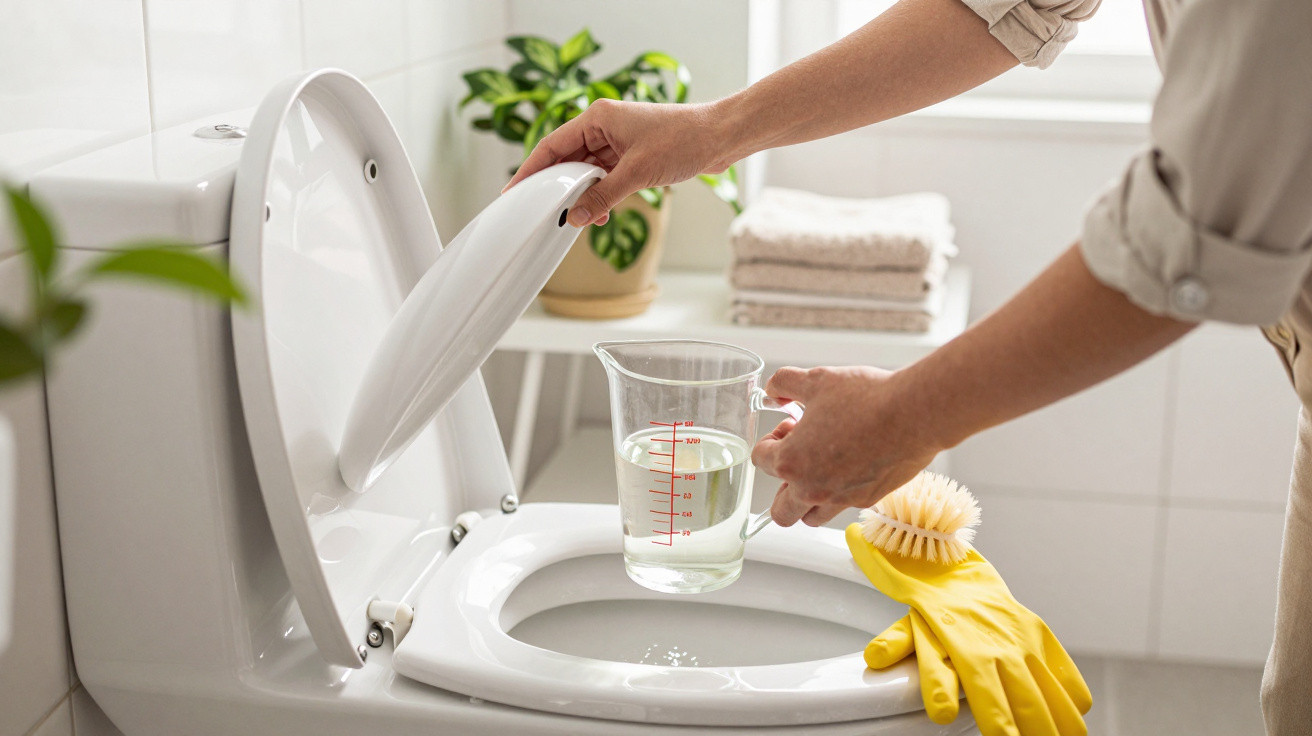
If the tank is already looking neglected, expensive cleaning products are unnecessary. Turn off the water supply, flush the tank empty and leave a small amount of white vinegar in the base for a while. It is not a spa treatment, more a reset. Then restore the water supply and return to the “flush it regularly” habit.
The aim is not immaculate perfection. It is gradual, unobtrusive prevention.
The main pitfall is using a blue tablet or drop-in cleaner that remains in the tank for the sake of “convenience”. Plumbers generally dislike them. A continuous supply of chemicals can damage rubber seals, distort plastic components and accelerate wear. The tank may appear fresher for a time, but its internal mechanics age more quickly behind the blue water.
Another frequent error is putting off action when minor odd symptoms appear. That occasional faint hissing sound at night? A handle that only works when pressed in exactly the right way? These can be early indications that deposits are affecting movement and seals. Leaving them alone allows the tank to keep concentrating minerals and growing more slime on parts that are already under strain.
Let’s be honest: nobody really does this every day.
Even so, a casual weekly flush for every rarely used toilet is a huge improvement on leaving one untouched for months.
“People think toilets just wear out,” one veteran plumber told me. “Most of the time, the toilet isn’t old. The neglect is.”
There is reassurance in knowing that avoiding this does not require becoming a DIY expert. One small routine and a few minutes of attention each month handle most of the work. If visual prompts help, place a small sticky note inside the bathroom cupboard: “Guest toilet? Give me a flush.”
- Flush infrequently used toilets at least once every 3–4 days
- Avoid blue tank tablets that remain directly in the water
- Use occasional vinegar soaks to tackle existing scale
- Pay attention to unfamiliar sounds, including hissing, trickling and gurgling
- Use holiday departures and returns as opportunities to reset the tank
A small toilet tank habit that improves the whole bathroom
There is something unexpectedly satisfying about raising a toilet tank lid and finding nothing remarkable at all: only clear water, clean components, no mysterious film and no unpleasant smell. It is hardly a dinner-party topic, but it changes the feeling of fixing a handle or checking for a leak. More deeply, it means one less area of the home is quietly deteriorating in the background.
We spend plenty of time discussing what is visible: the bowl, basin and mirror. The tank is the reverse: essential but rarely seen. That is likely why this small “use it or lose it” rule remains unfamiliar. There is no eye-catching product to market and no dramatic before-and-after transformation. There is simply water moving as it should.
During a busy weekday, one additional flush in an unused bathroom may seem insignificant. Across a year, however, it can mean the difference between quickly wiping the tank rim and spending an afternoon removing scale and replacing sticky parts. Over the longer term, it helps the toilet’s original components reach their intended lifespan rather than failing prematurely under the pressure of deposits and buildup.
We have all had that moment before a guest arrives: rushing to inspect the “nice” bathroom, lifting the lid and feeling a brief embarrassment about what has been growing out of sight.
This small rule protects more than the hardware. It also saves you from that feeling.
| Key point | Detail | Why it matters to the reader |
|---|---|---|
| Flush rarely used tanks regularly | Carry out a full flush every 3–4 days in guest bathrooms or downstairs bathrooms | Limits mineral concentration and bacterial films before they harden |
| Avoid harsh in-tank tablets | Blue blocks and strong chemicals may degrade rubber and plastic components | Extends the lifespan of the toilet’s internal hardware and helps prevent leaks |
| Use simple prevention, not deep scrubbing | Occasional vinegar soaks and listening for unfamiliar sounds are more effective than intensive clean-ups | Saves time, money and stress caused by unexpected repairs |



Comments
No comments yet. Be the first to comment!
Leave a Comment