The plastic bucket seemed almost ashamed of itself on the patio, squeezed between a worn folding chair and an ageing barbecue.
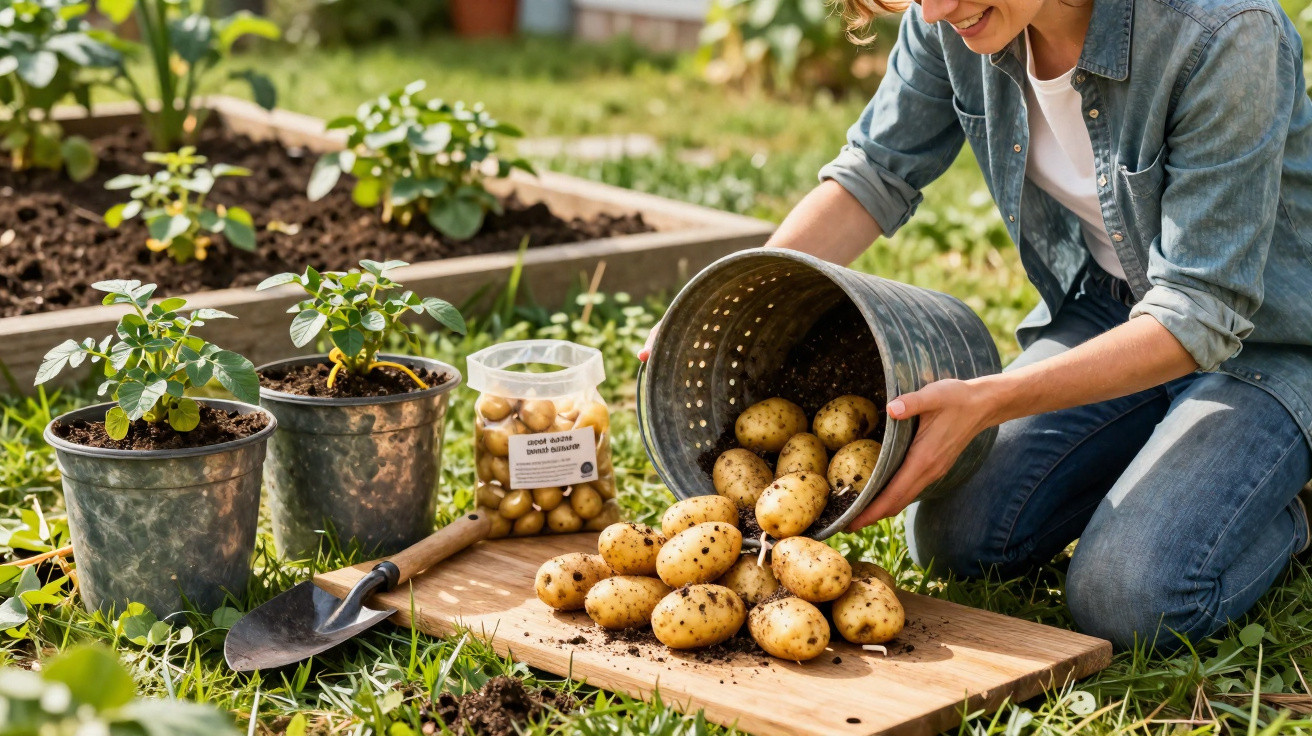
There was nothing about it that suggested a “future feast”. Its label had faded, a crack ran near the handle, and dried paint clung to one side. Yet, weeks later, when the gardener overturned it, a cascade of clean golden potatoes spilled across the paving like coins tumbling from a slot machine.
Neighbours who had passed it throughout the summer, tactfully overlooking the “weird bucket”, suddenly peered over the low wall. One person reached for their phone. Another asked, “You got all that from… that?” Then came a brief, satisfying silence: the sort that carries the scent of soil and possibility.
It had the appearance of a magic trick, but there was no trick involved. It was simply a smart use of limited space and a container most people underestimate.
Why a humble bucket can beat a pristine potato bed
Growing potatoes in a bucket may sound absurd until you compare it directly with a conventional row planted in the ground. In a garden bed, plants compete for room, divide the available nutrients and can be held back by compacted soil. In a bucket, every plant has its own dedicated space. Its roots sit in loose, airy compost, while moisture remains close to where it is required. In effect, you are providing a bespoke flat for a particularly demanding tenant: the potato tuber.
Many people assume potatoes are a crop that “needs lots of space”. That is only partly true. What they actually need is depth, steady moisture and growing medium that does not become waterlogged. Set up properly, a bucket delivers all three. Rather than reducing the crop, it concentrates the ideal conditions.
Buckets also offer an advantage that rows cannot: they can be tucked almost anywhere. Arrange them beside fences, on balconies or along fire escapes. Push them into corners that receive a few hours of sunlight each day. Suddenly, a garden with “no room” can contain ten, twelve or fifteen miniature plots. Each is a separate experiment, able to outperform a patch of open ground that is trampled, dried out, dug over by pets or compacted by children on bikes.
On a compact terraced street in Leeds, one gardener carried out his own comparison. At the back of his home, he planted a conventional 3-metre row of early potatoes in the soil. At the front, he placed eight black builders’ buckets along the path, putting three seed potatoes in each. Every bucket contained a simple blend of compost and garden soil, with no special additions. He used the same seed variety, watered on the same days and relied on the same north-of-England weather.
By harvest time, the in-ground bed looked... fine. The plants were respectable, and each root produced a reasonable handful of potatoes. Once the buckets were tipped out, however, the comparison changed. Each bucket yielded, on average, a generous bowl of mostly medium-sized, clean tubers with almost no slug damage. The combined weight from the eight buckets exceeded that of the long garden row by nearly a third. Laughing with slight disbelief, the gardener said, “I’m moving the lot to buckets next year.”
Similar accounts are now quietly common. Balcony gardeners are lifting more potatoes than their parents once grew in old vegetable plots. Retirees in bungalows line their driveways with tubs and insist they have never eaten so many new potatoes. This is not a miracle method. It is about giving a plant precisely what it requires in a managed setting, instead of expecting it to cope with whatever conditions the ground provides.
Once the romantic appeal of “rows of earth” is set aside, the reasoning is straightforward. Garden soil is unpredictable. It may be overly sandy, too dense and heavy, home to wireworms, scab and deep-rooted weeds, or affected by a history of neglected chemical treatments. Potatoes planted in the ground must contend with all of it. In a bucket, you decide on the mix: typically two-thirds good-quality multipurpose compost and one-third topsoil or well-rotted manure to add substance.
You also decide when and how the roots receive water. Rain is less likely to drown them, while drainage holes in the bucket act as a safety valve. Since the growing medium forms a deep column rather than a broad bed, plants can be “hilled” vertically, which encourages extra tubers to develop along the covered stems. It means less waste and greater output: rather like stacking shelves instead of scattering everything across the floor.
The method: turning an old bucket into a potato machine
The basic equipment could hardly be simpler: any 10–20 litre bucket that holds soil and will not fall apart when lifted. Builders’ buckets, leftover paint tubs and old storage containers can all do the job. Drill plenty of holes through the base, plus a few around the lower sides, to provide drainage and airflow. Think of these as windows that allow the roots to breathe, rather than merely a plughole underneath.
Add around 10–15 cm of damp compost mix to the bucket. Place your seed potatoes inside - generally two or three per bucket, with their sprouts pointing gently upwards - then cover them with a further 10 cm of compost. That is all that is needed on the first day. When the shoots reach 10–15 cm in height, add more compost around them while leaving the tips above the surface. Gradually covering the stems allows them to produce additional tubers along their length. Continue topping up whenever the foliage grows taller, stopping when the compost sits within a few centimetres of the rim.
The usual error is excessive enthusiasm. People cram five or six seed potatoes into one bucket in pursuit of “a bigger crop”. Instead, they create overcrowding, competition and a crop of tiny tubers. It is like a small kitchen: too many cooks do not produce more dinner, only confusion. Two to three seed potatoes per 10-litre bucket is the ideal balance. Watering is another potential problem. Buckets dry more quickly than borders, particularly black plastic containers in full sunshine. During hot weather, the compost can shift from bone-dry to waterlogged if you react with panicked overwatering.
During a busy week, watering once in the evening will usually do. When the foliage is full and the weather is warm, it may be worth checking quickly in the morning by pushing a finger into the compost. If it is dry at knuckle depth, water it. If it remains cool and damp, leave it alone. Let’s be honest: nobody really does that every day, but even a loose routine is more effective than dramatic, infrequent soaking. If slugs are a serious problem where you live, lifting the bucket slightly off the ground on bricks or wood can make a subtle difference.
Eventually, you will feel that familiar urge: “Are they ready yet?”
“The first time I tipped a potato bucket out, I felt like a kid again,” says Anna, a London balcony gardener. “I’d convinced myself it hadn’t worked. Then the soil fell away and there they were, perfectly formed. I actually shouted.”
The sense of reward is genuine. With potatoes grown on this scale, harvesting becomes an occasion. You can decide when to begin: for baby new potatoes, start looking around 10–12 weeks after planting, carefully feeling around the sides with your fingers and taking a few. For full-sized tubers, wait until the foliage turns yellow and falls over, then stop watering for about a week. Choose a dry day, tip the bucket onto a sheet or into a wheelbarrow, and sift through the compost as though panning for gold.
- Choose light, free-draining compost; dense, sticky soil deprives tubers of air.
- Select early or second-early varieties for fast, generous bucket harvests.
- Put buckets in a sunny position, aiming for at least 6 hours of direct light where possible.
- Once the foliage is established, feed sparingly with a balanced or high-potash fertiliser.
- Rotate buckets or replace the compost each year to prevent exhausted, disease-prone growing medium.
More than a hack: what bucket potatoes change in your head
The first time you grow food in such a compact, controlled space, something quietly changes. A bucket of potatoes can initially look strange on a balcony beside laundry airers and recycling bins. By mid-summer, though, the foliage has filled out, flowers have appeared, and you find yourself checking on “them” while putting out the washing. The crop becomes part of everyday life rather than a separate “project” at the allotment.
On a grey Tuesday evening, you return home exhausted, glance at the bucket by the back door and think, “Not yet… maybe next week.” The simple awareness that you control when to dig, and that dinner is slowly swelling beneath the compost, alters your perspective. We have all faced the moment when the fridge is empty and the takeaway app seems appealing. Knowing that a bucket of possible meals is waiting on your doorstep changes the calculation, even if you leave it untouched that evening.
Growing potatoes in a bucket won’t save the world. Nor will it eliminate your food bills. What it reliably does is challenge the idea that proper food growing requires a flawless garden, raised beds, expensive tools or unlimited spare time. One old container, a bag of compost and three knobbly seed potatoes can produce more than an entire strip of neglected lawn. It is a modest rebellion against the belief that you “don’t have space” or that your soil is “no good for anything”. A bucket is unconcerned by either claim. It only needs a corner, some light and occasional attention.
| Key point | Detail | Benefit for the reader |
|---|---|---|
| Choosing the right bucket | 10–20 L, sturdy plastic, with drainage holes in the base and low sides | Prevents suffocated roots and disappointing harvests |
| Limiting the number of plants | 2–3 potato plants per 10 L bucket | Maximises tuber size instead of producing a large number of small potatoes |
| Filling in stages | Cover stems progressively as they grow | Encourages tubers to form higher up, resulting in a more generous harvest |















Comments
No comments yet. Be the first to comment!
Leave a Comment