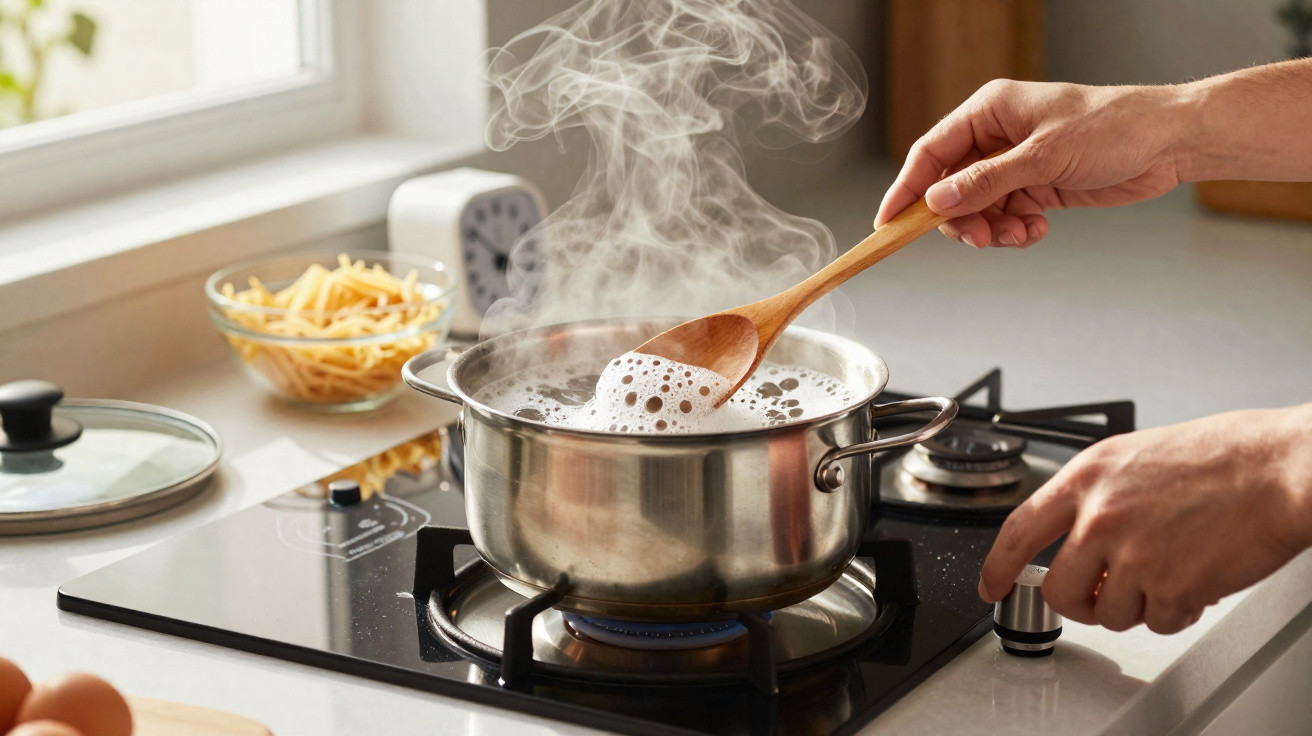
Your spaghetti can be bubbling contentedly in the pan one moment. Then, after you have turned your attention elsewhere, you look back to discover a scorching mess spread across the hob.
Boiling liquid can surge upwards in seconds, often leaving very little time to intervene. So, can you stop a pan from boiling over before it happens? A kitchen tip commonly shared on social media involves laying a wooden spoon across the top of the pan.
But does it actually work? As is often the case with questions about kitchen science, the answer is yes, with plenty of important caveats.
Put simply, it can work - but only temporarily. Here is why.
@spoonfulofsi
Placing a wooden spoon over a pot of boiling water stops it from boiling over🤌 idk who taught me this but tysm!! #kitchenhacks #lifehack #boilingwater
♬ Ultimate life hacks - Kelly | The Life Bath
What makes the bubbles form?
Curiously, a pan of pure water at a vigorous boil will not climb up the sides of the pan.
It is the ingredients added to the water that usually cause overflowing and spills. Pasta, rice, porridge and milk are especially likely to boil over and create a mess. A thick stew is less likely to overflow, unless the pan has been filled too high.
In cooking, the principal food molecules are water, carbohydrates, proteins, lipids - the umbrella term for fats and oils - and, in smaller amounts, vitamins and minerals.
Carbohydrates and proteins are chiefly responsible for fast boiling and overflow. When carbohydrates, proteins, or both, meet heated water molecules, their characteristics alter and their structures reorganise.
At high heat, these changes may occur rapidly. With substantial heat energy, water molecules begin boiling vigorously, producing bubbles in the process.
Why do bubbles climb so fast?
The carbohydrates behind the bubbles that can take over your kitchen are mainly plant starches. Pasta and porridge are made from plant starches including wheat, rice, potato and maize. When you boil something containing milk, a protein called casein can also help create bubbles.
Casein and starches are classed as colloids. "Colloidal dispersion" means that not every particle dissolves in a water solution, as some are too large. Once bubbles develop, the larger starch and/or protein particles begin coating them.
In pasta water and porridge, heat causes the starch solution to begin forming a gel. This gel turns sticky and, depending on the starch type and any other ingredients, can raise the boiling solution's temperature beyond 100°C.
These are therefore more than ordinary bubbles: they are hot and sticky. As the mixture keeps boiling, air-filled bubbles coated in sticky starch gel stack up and move up the pan's sides.
Milk behaves slightly differently. Have you ever seen a layer across the surface of boiled milk? This milk skin develops from heated casein. Once warmed, casein can become relatively tough - rather like plastic - and cover each bubble. Milk bubbles are smaller and form more of a foam, although they can still rise rapidly.
How does a wooden spoon stop bubbles boiling over?
Putting a wooden spoon across a boiling pan disrupts the bubbles: it reduces the surface temperature and offers a porous surface that causes bubbles to burst. This prevents them from travelling over the rim of the pan.
To see why, imagine another porous material: a sponge. Since a sponge contains many holes, you can blow air through it when it is dry. Air cannot move through a wet sponge, however, because water fills those holes.
Wood is porous, and a dry wooden spoon has more pores available than a wet one. When bubbles touch the wood, their air escapes.
However, you cannot leave a wooden spoon across the pan forever and assume it will prevent overflowing. Exposure to heat, moisture, sticky starch and casein bubbles soon brings the spoon to the same temperature as the liquid. It then no longer lowers the surface temperature or remains sufficiently porous to burst the bubbles.
That limited period of effectiveness is why some people say the wooden-spoon trick does not work.
What should I do instead?
Stirring the pan, or using the wooden spoon to fan it, would be just as effective.
Better still, avoid becoming distracted while cooking and choose suitable kitchen equipment: use a larger pan and lower the heat rather than having it at full power.
We prefer to think of time in the kitchen as a form of meditation. Stay present and focused on the moment.
If you are distracted, turn the hob to its lowest setting, switch it off, or take the pan off the heat. The saying "a watched pot never boils" does not apply here. In fact, keeping a watchful eye on the pan is vital.
Jay Deagon, Senior Lecturer of Home Economics, CQUniversity Australia and Gemma Mann, Senior Lecturer in Access and Equity in Education, CQUniversity Australia
This article is republished from The Conversation under a Creative Commons licence. Read the original article.

Comments
No comments yet. Be the first to comment!
Leave a Comment