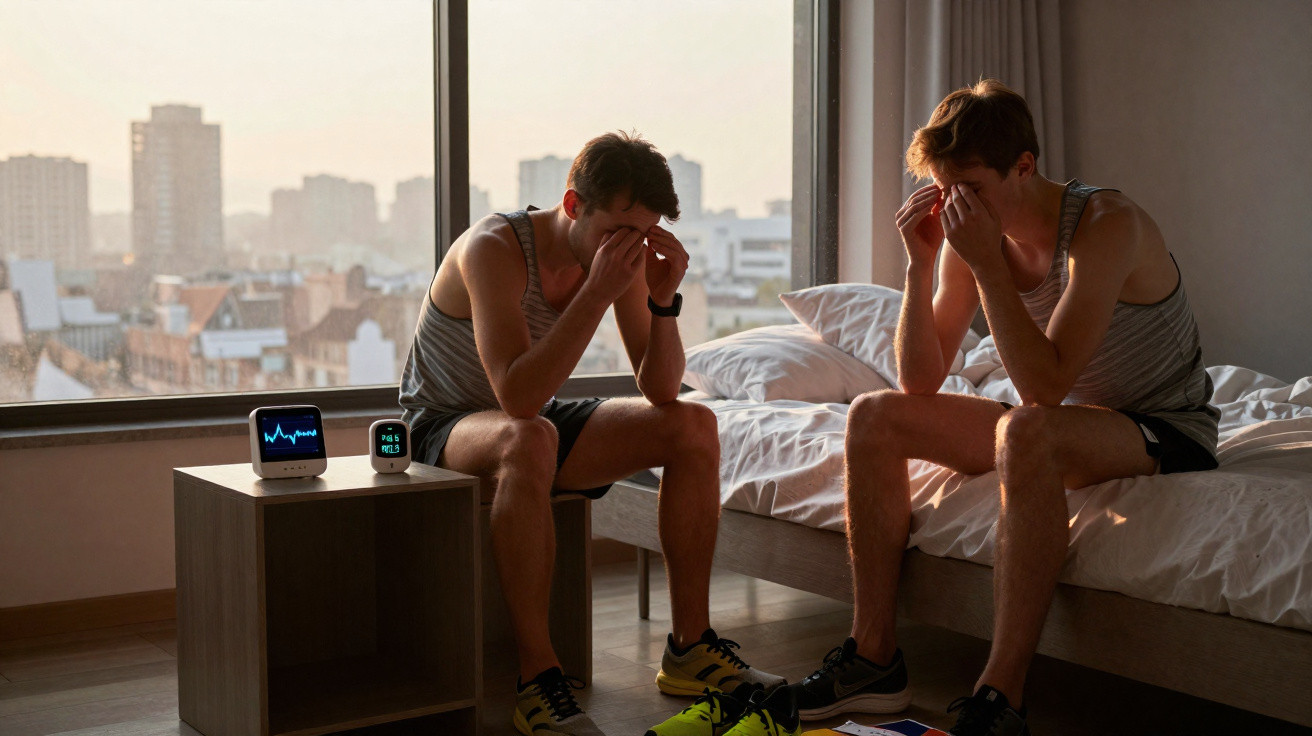
A new study suggests that fine-particle pollution in bedroom air is associated with reduced deep sleep and poorer long-distance running performance the following day among young adults.
The results cast the bedroom in a new light: polluted air may subtly impair sleep and next-morning physical performance.
Air next to the bed
In student dormitories in Shanghai, China, monitors positioned beside beds measured the air nearest to students’ faces over one typical night.
Researchers from Shanghai Jiao Tong University (SJTU) used these beside-bed readings to connect bedroom particle exposure with both less deep sleep and lower morning endurance.
The association appeared in a healthy, young population living in rooms that often seemed comfortable, indicating that air quality may matter even where no problem is immediately apparent.
This raises a more focused question: which elements of bedroom air may interfere with recovery, and why was endurance the most clearly affected outcome?
Pollution and recovery
Fine-particle pollution is a concern because PM2.5 particles, which are no more than 2.5 micrometres wide and can penetrate deep into lung tissue, may irritate the airways.
These particles may trigger inflammation – the body’s protective reaction to injury – and could disrupt overnight recovery during sleep.
In deep sleep, breathing becomes slower, muscles loosen, and the body focuses on restorative processes that help support concentration, mood and movement.
As a result, polluted bedroom air could reduce recovery without causing a person to wake fully or recall any disturbance the next day.
Sleep changed first
Greater particle concentrations in bedrooms were associated with a lower proportion of deep sleep during the monitored night before exercise testing.
The team tracked movement and heart-rate patterns with a wearable sleep tracker – a wrist-worn device used to estimate sleep stages.
Meanwhile, increased carbon dioxide – a gas that builds up in poorly ventilated rooms – was linked with more time spent in light sleep.
Together, these findings suggest a bedroom environment that may keep the body in lighter rest rather than allowing complete overnight recovery.
Pollution reduced endurance
The clearest next-morning effect of dirtier bedroom air appeared in long-distance running results.
Male students completed 0.62 miles (1 kilometre), while female students ran 0.5 miles (800 metres); both distances assessed how long the body could sustain work.
Every increase in particle exposure corresponded with worse results, whereas sprinting, jumping, sit-ups and pull-ups showed no distinct association in this group.
Endurance may have been more responsive because sustained running depends continuously on the lungs and the delivery of oxygen through the blood.
Stale air made effects worse
The analysis found that particle pollution was more harmful when bedrooms also contained very high overnight carbon dioxide levels.
At 3,961 parts per million, carbon dioxide intensified the negative association between particles and long-distance running.
In crowded rooms, poor ventilation can allow exhaled breath, moisture and particles to gather around the bed for many hours of sleep.
This mix may place additional strain on the respiratory system, leaving less capacity for demanding exercise after waking.
Humidity had boundaries
Bedroom moisture showed a different relationship with next-day running performance than particles and carbon dioxide.
Performance appeared strongest at a relative humidity of roughly 62% – the proportion of water vapour in the air – which was close to the average level in the rooms.
Low humidity may dry the surfaces of the airways, whereas high humidity can make it harder for the body to release heat efficiently during sleep.
This apparent optimum does not establish an ideal bedroom condition, but it offers a practical target for future research.
Why running responded
Long-distance running requires the lungs, heart, blood vessels and muscles to work together for much longer than a sprint does.
A broad review of exercise research found that polluted air may influence breathing and performance during physical activity.
Exposure at night may operate differently from exercising in smog, but both routes add stress to the same system responsible for moving oxygen around the body.
Brief strength tests depend more heavily on rapid muscular power, meaning slight changes in breathing may have less influence over only a few seconds.
Reducing indoor pollution
Improving bedroom air may be achievable because the key issues are particles and stale air, rather than unusual hazards or costly medical treatment.
Previous ventilation research increased bedroom airflow using fans and found improved patterns of objective sleep quality over several weeks.
Air filters can reduce fine particles, while fans may dilute carbon dioxide before concentrations rise.
Straightforward measures are most effective when they do not introduce other issues, including noise, cold air, outdoor smoke or unsafe open windows.
What remains uncertain
Several significant limitations mean these findings cannot yet become fixed bedroom guidance for every sleeper or climate.
The SJTU study involved healthy undergraduates aged 18 to 22 who lived in similar university dormitories and followed restrictions on the test night.
Participants were monitored for only one night, and the study did not establish the sources of particles, such as cooking, dust or traffic.
As an observational study, it identifies associations rather than proving cause and effect.
Improving sleep spaces
Cleaner bedrooms, more consistent airflow and moderate humidity may help protect sleep quality and morning endurance in everyday rooms.
Future trials need to examine filters and altered airflow over longer periods before these useful indications can be developed into health guidance.











Comments
No comments yet. Be the first to comment!
Leave a Comment