A phone vanishing from your hand into the yawning white bowl of a toilet can be a distressing sight, but the situation has a precedent stretching back many centuries.
Unlike a handset, however, a small personal notebook believed to have been owned by a medieval German merchant ended up in precisely the conditions needed to remain superbly preserved for centuries.
An early assessment dates the miniature ledger to roughly 700 or 800 years ago. Its state of preservation is so extraordinary that researchers expect to be able to read the inscriptions on its wax-covered pages.
Why medieval latrines preserve archaeological finds
"It sounds strange, but for us archaeologists, latrines are almost always a treasure trove," says archaeologist Barbara Rüschoff-Parzinger, cultural affairs officer of LWL in Germany.
"Comparable medieval artifacts are also known from Lübeck and Lüneburg, where a similarly damp soil environment preserved the finds. However, in no other case has the entire book been preserved as an archaeological find, as was the case here."
Materials of organic origin, including wood and leather, rarely withstand the passage of time.
Contact with oxygen, together with bacteria that consume biological matter, normally causes such materials to deteriorate before conditions suitable for preservation can develop.
Yet waterlogged waste deposits, including cesspits, middens and latrines, can prove a notable exception. Oxygen levels in these places may be sufficiently low to suppress the decay processes that take place in more oxygen-rich surroundings.
Excavating a medieval bog may not seem especially glamorous, but this is why old toilets can become archaeological goldmines.
Medieval wax tablet book found in Paderborn
The particular latrine in question was uncovered during archaeological excavations in Paderborn, Germany, and has been dated to approximately the 13th or 14th century.
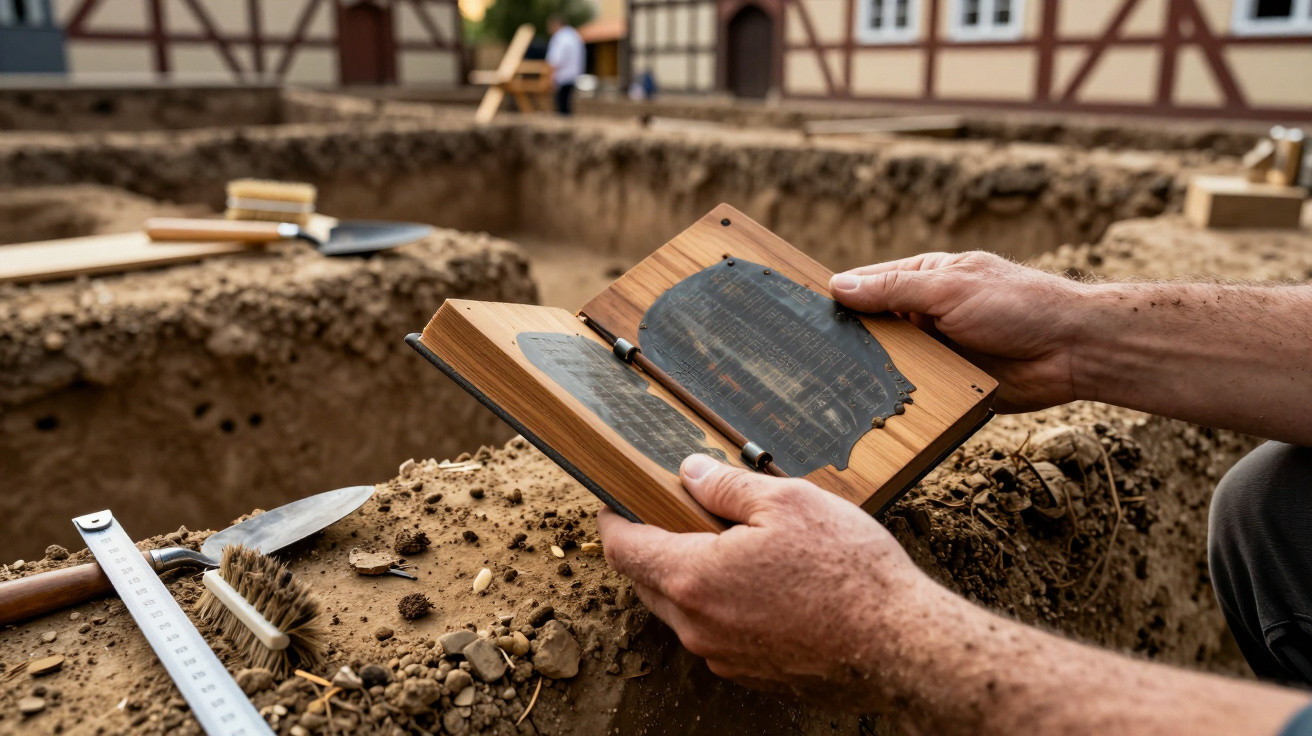
Among the still rather pungent, digested remains from numerous medieval stomachs, excavators found a small oblong item measuring 10 by 7.5 centimetres, or roughly 4 by 3 inches.
Further examination showed that it had an attractively embossed leather cover surrounding several wooden leaves coated in wax. This is a wax tablet book, a medieval device used for making notes.
Writing was made in the soft wax with the pointed end of a stylus. Its opposite end was blunt and shaped like a spatula, allowing the user to scrape off the wax and create a fresh surface for new notes.
"Who wrote the book and what purpose did it serve? Initial assumptions suggest that a Paderborn merchant may have been the author, jotting down business transactions and recording his thoughts in note form," says archaeologist Sveva Gai of LWL.
"Merchants were educated people: Unlike most people, they could both read and write."
The writing and owner of the Paderborn ledger
Once it had been carefully cleaned, the full extent of the discovery became clear. The book has 10 pages: eight are written on both sides, while the two outer pages have only one side each.
The tightly packed writing of its original owner can still be seen across many of those pages.
"I only had to clean the outside of the book, as the inner pages were so tightly bound that there was no dirt on them," says conservator Susanne Bretzel of LWL.
"The wood also hadn't warped, so the wax is still intact and the writing itself is easily legible."
The team believes the text was written by one individual. That person also appears not to have erased especially thoroughly, as parts of the later writing sit over faint traces of an earlier text.
Its beautifully embossed leather cover, decorated with a fleur-de-lis motif, and the script's language, Latin, point to an owner from a comparatively prosperous social class.
The researchers now face considerable work. By establishing the book's age and identifying the materials from which it was made, they hope to discover more about its owner.
Even though the pages are exceptionally well preserved and largely legible, determining their contents will require painstaking effort.
"The text is not easy to decipher, even for experts in the field," Rüschoff-Parzinger explains.
"Individual words are recognizable, but the transcription will take some time, as some words may have been corrupted by incorrect spellings."
Excavation work at the location continues, although other discoveries indicate that this may have been an upmarket toilet. It contained fragments of silk which the researchers think were used as toilet paper by the upper classes.
Modern commoners, meanwhile, are left with wet-wipe fatbergs.















Comments
No comments yet. Be the first to comment!
Leave a Comment