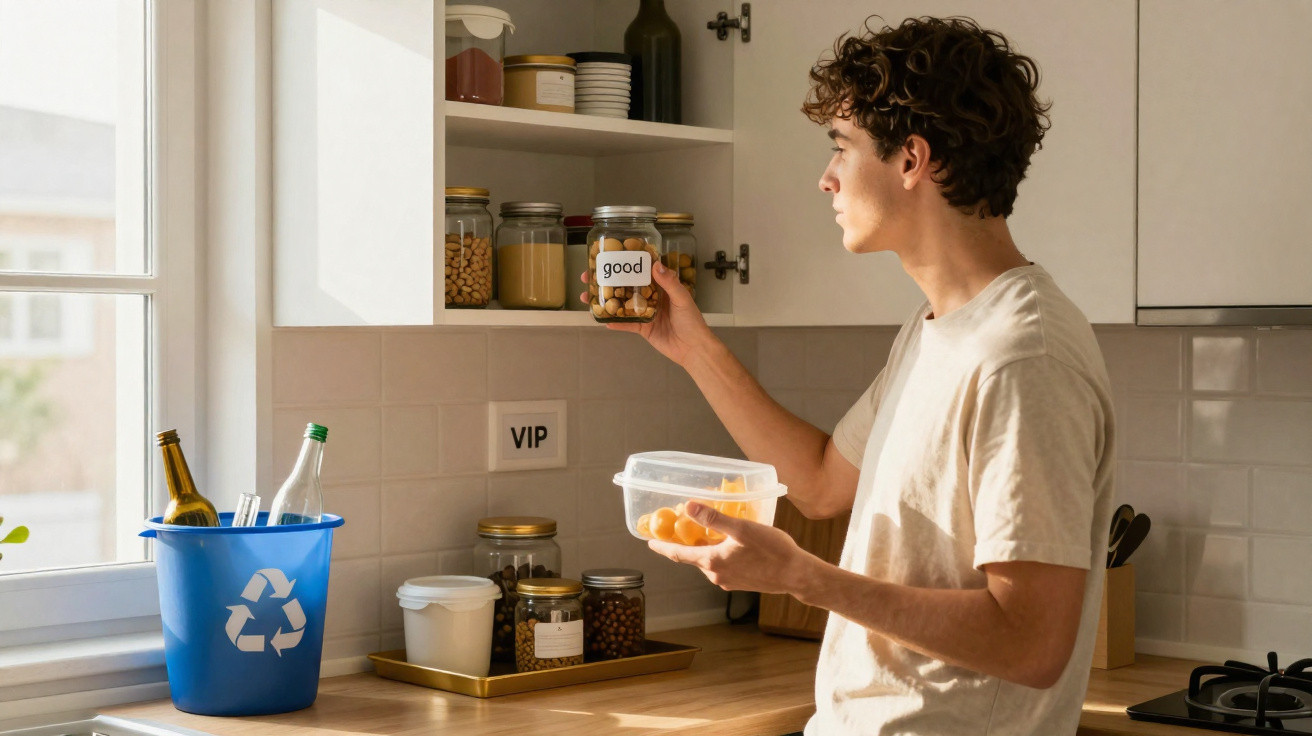
You stand over the recycling bin with a yoghurt pot in your hand. The plastic is spotless and solid, and its little lid clicks back into place with pleasing precision. Throwing it away feels… somehow wrong. Your hand hovers above the bin as your mind says, “But this could be useful.” It might hold leftovers, store screws, or become a future planter for balcony herbs you have not grown yet.
So you wash it and add it to the pile. The cupboard becomes crowded. The drawer will not shut properly. You tell yourself you will deal with it “this weekend”, then reach for your phone and carry on scrolling.
The guilt, low-level anxiety and peculiar physical unease linger.
Where does that reaction actually come from?
When throwing something away feels strangely painful
For certain people, getting rid of a perfectly usable container can feel almost like breaking a small promise. Physical sensations often arrive first: a stomach knot, tense shoulders or a strange feeling of loss over a plastic tub that came free with a takeaway.
This goes beyond being “eco-friendly” or “thrifty.” The response is more instinctive. You notice the feel of a glass jar, the heft of a tin or the snap of a lid, and your brain labels it as “potential.” Releasing that potential may feel like failing an exam you never chose to sit.
The jar therefore remains, while identical ones accumulate behind it.
Consider Léa, 34, who lives in a compact city flat. When she opens a kitchen cupboard, a cascade of cleaned jam jars, ice-cream tubs and takeaway containers threatens to spill out. With friends, she jokes that it is her “future zero-waste empire.”
When she is by herself, though, it creates a pull of stress. The clutter troubles her, but throwing out those containers makes her throat feel tight. Her grandmother reused everything “out of respect,” she explains: soap remnants, string and yoghurt pots for seedlings. In that old farmhouse, wasting anything was almost sinful.
Léa is not struggling financially, she is not a hoarder, and she shops online like everyone else. Yet her body holds on to something more ancient. Discarding an item feels like turning against that memory.
Psychologists refer to “loss aversion” and “endowment effect”: as soon as an item enters your home, your brain begins to see it as valuable, even when it cost nothing. Add environmental guilt-the mental picture of plastic-filled oceans and overflowing landfill sites-and an insignificant container can acquire moral importance.
A question of control may also sit beneath the surface. Reusing items can create the impression that you can repair a broken system alone, one jar at a time. Throwing away something “reusable” conflicts with that idea, prompting physical discomfort. You’re not just throwing away plastic; you’re throwing away the fantasy that you’re a good, careful person who wastes nothing.
How to reuse containers without drowning in them
Giving your reusable items a fixed limit is one straightforward way to reduce this bodily discomfort. Work out how many containers you genuinely use in a week-perhaps 10-and set yourself a firm “jar budget.” Keep ten containers on the shelf and no more.
As soon as an eleventh appears, choose one existing item to leave the house. There is no need for drama or prolonged deliberation. Treat it as a modest ritual: one comes in, one goes out. This gentle but firm boundary reassures your nervous system: “We’re not wasting everything. We’re managing.”
Your hands can still hold on to useful things, while your brain has a rule to rely on whenever guilt arises.
A common pattern is keeping containers “just in case”, although that occasion never arrives. Quietly, shame starts to grow. You may feel untidy, lacking in self-discipline or even childish because you are attached to a pile of old takeaway tubs.
The useful change is to alter the story you tell yourself. Feeling uneasy about discarding objects does not make you a failure. It means your values-care, caution and respect-are clashing with a world that produces far too much packaging. Honestly, no one manages this perfectly every single day.
Rather than criticising yourself, adapt the system around you. Put one short “container check” in your diary each month and set a timer for 10 minutes. Nothing more. Just 10.
Sometimes the deepest relief comes not from saving one more object, but from finally accepting, “I can’t carry the whole planet in my kitchen cupboard.”
- Set your maximum number
Choose a precise limit for jars, tubs and tins. Make it clear, visible and non-negotiable. - Create a “VIP shelf”
Reserve this space for the most useful, best-sealing containers that you genuinely use. - Give everything else a second life elsewhere
Offer unwanted containers through local groups, to schools, neighbours or community gardens. - Follow a “one in, one out” rule
Each new takeaway container means one older item leaves your home. - Pay attention to your body’s signal
If you tense up over the bin, stop and breathe, then ask: “Is this guilt useful right now?”
The quiet stories hiding in our cupboards
Every reused ice-cream tub and coffee jar may hold a story that is rarely voiced. Perhaps it reflects a childhood in which nothing went to waste, a country where you could not rely on finding the same product again, or a financially difficult period when a stack of clean containers offered unexpected comfort-like a backup plan made of plastic.
These responses do not vanish simply because we now have recycling bins and same-day delivery. They remain in the body: in the tension that comes when you hold a jar over the bin, and in the small sense of relief when you place it neatly on a shelf that is already full.
Once you notice this pattern, the question can change from “Why am I like this?” to “What is this part of me trying to protect?”
| Key point | Detail | Value for the reader |
|---|---|---|
| Emotional roots | Unease commonly stems from past experiences, family routines and beliefs about waste | Helps you feel less “weird” and more understood |
| Simple limits | Applying a clear cap on containers and a “one in, one out” rule | Lessens guilt while preserving a feeling of control |
| Reframing guilt | Treating guilt as a signal rather than a judgement of your character | Reduces the emotional burden and makes choices simpler |













Comments
No comments yet. Be the first to comment!
Leave a Comment