The bag of lettuce had looked perfectly fine the previous day.
It was vivid green, crisp and almost glowing beneath the fridge light. Yet, 24 hours later, you open the drawer to find a miserable, slimy lump that you try to ignore. You shut the door rather too quickly, hoping it might somehow disappear by itself. Throwing it away feels absurd, particularly as food prices continue to rise and you are attempting to eat “more greens” than you genuinely fancy.
One evening in a small London kitchen, I saw a friend take out a container of lettuce that had been stored for two weeks. It looked as though it had only just been bought from the market. There was no costly storage gadget or fancy container involved: just one straightforward, almost unremarkable step that made a quiet but enormous difference.
That is where this story properly begins.
Why lettuce goes off so quickly in the fridge
With lettuce, the first surprise is how rapidly it changes from upright and fresh to floppy and translucent. There is no gentle decline; it falls off a cliff. One day, you are putting together a crunchy salad; the next, you are tipping soggy leaves into the bin and telling yourself that you will “buy less next time”.
At that point, the fridge can seem like it has let you down. It should preserve food, not make it spoil faster. But your lettuce is not merely ageing: it is drowning, struggling for air and sweating inside a miniature plastic sauna you accidentally created.
Behind that is a deeply familiar annoyance: you wanted to be someone with fresh salad ready to eat. Your fridge had different ideas.
UK food-waste charities estimate that households discard tonnes of edible food every year, with salad leaves quietly featuring high on the list. A 2020 WRAP report noted that fresh vegetables and salads account for a quarter of avoidable food waste in the home. Lettuce is the classic purchase made with the thought, “I’ll definitely eat healthily this week”, only for real life to get in the way.
Picture a standard Sunday food shop. You pick up a large bag of mixed leaves because it seems like a virtuous choice. On Monday, everything is going well. On Tuesday, you work late and put a pizza in the oven. By Thursday, the lettuce has retreated to the back of the drawer and slipped from your mind. When Saturday arrives and you finally find it again, it is mostly sludge accompanied by guilt.
That bag holds a small, recognisable tale of good intentions meeting everyday life. It is hardly dramatic, but it is familiar.
Lettuce spoils fast in the fridge because it is kept in the wrong microclimate. Plastic bags hold in humidity, while lettuce gives off moisture like an anxious public speaker. The condensation on the inside of the bag is not a sign of “freshness”; it marks the beginning of decay. Add a blast of cold whenever the fridge door opens, along with badly positioned air vents, and the leaves become wet and unevenly chilled.
When their surface remains damp for too long, bacteria and mould are effectively invited in. The leaves start breaking down at the edges and become bruised beneath their own weight. Before long, the issue is not how many days they have spent in the fridge, but how many hours they have endured in the wrong conditions. The enemy isn’t time as much as it is trapped moisture.
The real question, then, is not “How long can lettuce last?” but “How can we manage the tiny environment where it is stored?”
How to keep lettuce fresh: treat it like a delicate sponge
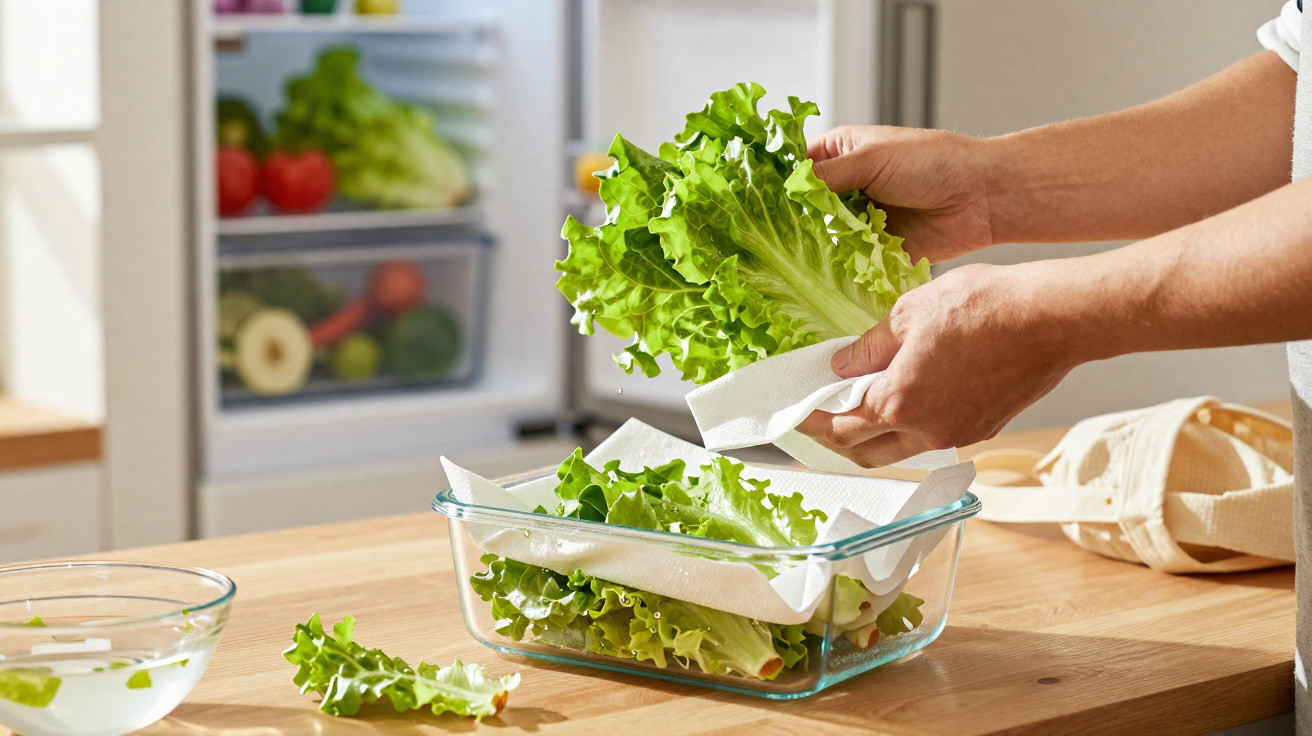
The method for keeping lettuce fresh for weeks is almost frustratingly simple: remove it from the bag, dry it carefully and store it in an airtight box with dry kitchen paper. In effect, you treat it as a delicate sponge that cannot stand sitting in its own bathwater.
As soon as you arrive home, take the lettuce out of its packaging. If the leaves are gritty, give them a quick rinse, then spin or pat them dry as thoroughly as is practical. Leave them spread over a clean tea towel for ten minutes to remove the final light layer of surface moisture. Next, line a container with a sheet of kitchen paper, place the leaves inside loosely, cover them with another sheet and close the lid.
It hardly appears revolutionary. Still, this brief step after food shopping can transform the result.
The mistake most people make is treating the supermarket bag as storage. It is not storage; it is packaging for transport. That plastic is intended for shop shelves and delivery lorries, rather than the unpredictable conditions of your fridge at home. If you tear it open, leave it half-closed and push it back into the drawer, you create the worst possible combination: partly sealed and completely soggy.
Lettuce also dislikes being compressed. Neatly packed, overfilled containers whose lids only just fit may look good in photographs, but they are terrible for airflow. The leaves get bruised, release extra moisture and then rot where the pressure is greatest. Let’s be honest: hardly anyone follows the perfect wash-dry-fold routine every day. That is why this approach needs to be easy enough for real life, rather than TikTok life.
When time is short, do not aim for perfection. Simply opening the bag, putting a folded sheet of kitchen paper inside and sealing it with a clip can extend the life of your lettuce far beyond what you might expect.
A home economist I spoke to put it in a way that stayed with me:
“Lettuce doesn’t die of old age in the fridge. It dies of bad weather.”
Your role, therefore, is to create better weather. That comes down to three things: low surface moisture, gentle airflow and consistently cold conditions. Avoid keeping lettuce at the back of the fridge, where it can become too cold and freeze in places. Do not stack hot leftovers on top of it. Also, keep it away from fruit that releases plenty of ethylene gas, such as apples and pears, as this can speed up wilting.
Here is a simple cheat sheet to make the habit feel automatic:
- Give lettuce a container of its own; never store it with raw meat or strongly scented foods.
- Replace damp kitchen paper with a fresh sheet every few days when it feels wet.
- Keep the box in the vegetable drawer rather than on the fridge door, where temperatures change dramatically.
Lettuce that lasts changes more than your salads
Once you have watched lettuce remain crisp for two or even three weeks, your behaviour in the kitchen begins to shift. You buy the larger head because you know it will not turn into compost by Tuesday. You are more inclined to add a handful to a sandwich, serve it over a hot meal or put it beside a slice of leftover quiche, simply because it is available and ready to use.
The mental burden eases as well. The persistent thought of “You’re wasting money” whenever you open the vegetable drawer becomes quieter. Rather than a graveyard of soft cucumbers and fading herbs, you have a handful of reliable essentials that genuinely last. It is a subtle change, but it makes deciding what to eat less tiring after a long day at work.
On a cold Wednesday evening, being able to take out crisp lettuce without any effort may be the difference between ordering a takeaway and putting together something reasonably decent.
There is also something unexpectedly calming about the small act of rescuing lettuce from its doomed plastic bag. It is a quiet gesture of care that takes three minutes but pays off for weeks. There is one less item for the bin, and one more thing in the fridge that feels managed rather than close to collapse.
Then, two weeks later, you open the container, lift the lid and hear the slight squeak of crisp leaves brushing together. It has an effect on your mind. On a very ordinary level, it feels as though you are succeeding at a part of adulthood that nobody really taught you.
The technique is not glamorous, and it is unlikely to go viral because of its appearance. Yet it changes the everyday story of your kitchen in a small, stubbornly positive way.
| Key point | Detail | Benefit for the reader |
|---|---|---|
| Control moisture | Take the lettuce out of the bag, dry it and place it between sheets of kitchen paper in a sealed container | Keep leaves crisp for 1 to 3 weeks rather than only a few days |
| Reduce damaging conditions | Avoid crushing, temperature fluctuations and contact with fruit that produces ethylene | Cut food waste and avoid unpleasant surprises at the bottom of the vegetable drawer |
| Keep the ritual simple | Make one quick change when you return from the shops rather than attempting an unrealistic “perfect routine” | Make eating fresher, healthier food easier, without adding mental load |












Comments
No comments yet. Be the first to comment!
Leave a Comment